Area of Composite Shapes is a Grade 6 mathematics worksheet that develops students’ ability to analyze compound figures by finding perimeter and area. Across 19 items, students solve 17 multiple-choice questions and complete 2 drawing tasks. They calculate the total perimeter, determine missing side lengths from the dimensions shown, divide composite shapes into two rectangles, find the area of each rectangle, and combine those areas to find the total.
This free printable worksheet supports practice, independent work, homework, or an in-class check of understanding. The drawing prompts require students to show a possible decomposition, while the multiple-choice items check whether they can apply perimeter and rectangle-area calculations accurately. An answer key is included so teachers can review work efficiently and identify whether an error came from finding a missing length, calculating a rectangle’s area, or combining measurements.
Worksheet settings
Font size
S
M
L
XL
Worksheets
Area of Composite Shapes
Total questions: 19
Name
Class
Date
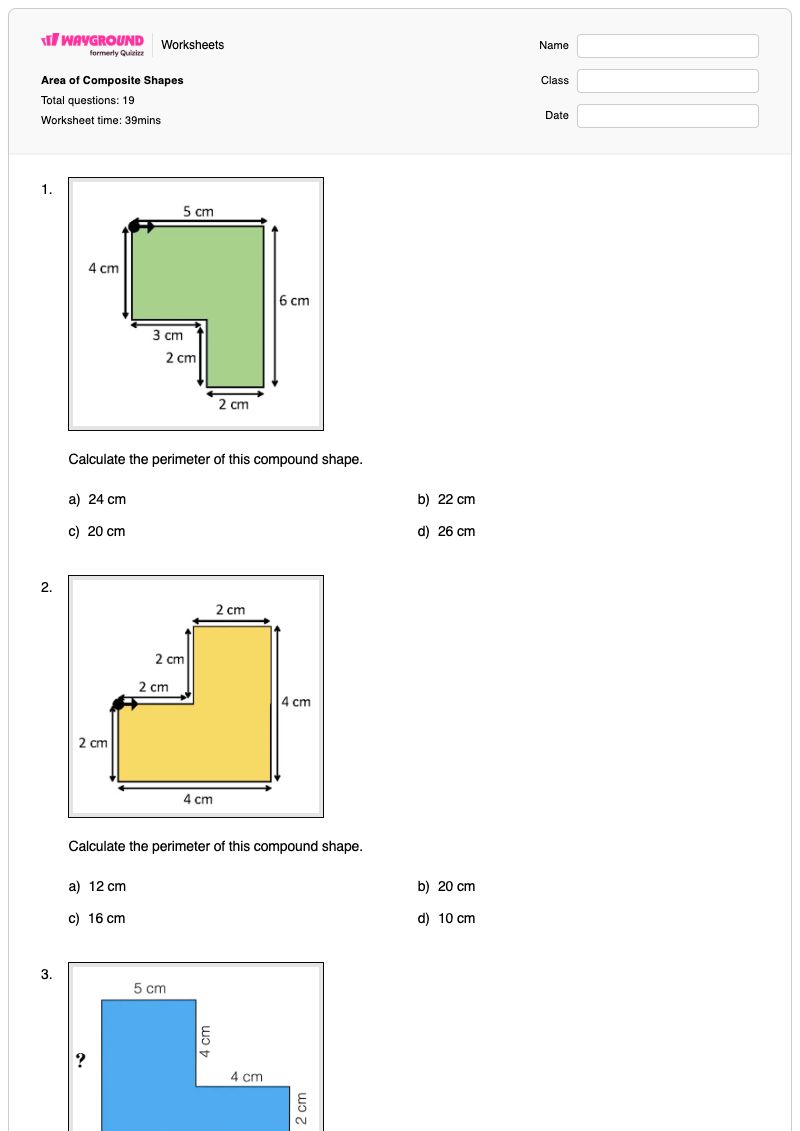
1.
Calculate the perimeter of this compound shape.
a)
24 cm
b)
22 cm
c)
20 cm
d)
26 cm
2.
Calculate the perimeter of this compound shape.
a)
12 cm
b)
20 cm
c)
16 cm
d)
10 cm
3.
To find the perimeter of this shape, first you need to find the length of the side labeled with the question mark. What is the length of that side?
a)
6 cm
b)
4 cm
c)
7 cm
d)
8 cm
4.
What is the perimeter of this shape?
a)
36 cm
b)
24 cm
c)
38 cm
d)
30 cm
5.
What is the length of the side labeled with the thick red line?
a)
5 cm
b)
4 cm
c)
3 cm
d)
9 cm
6.
What is the length of the side labeled with the thick purple line?
a)
4 cm
b)
5 cm
c)
6 cm
d)
7 cm
7.
What is the perimeter of this shape?
a)
44 cm
b)
34 cm
c)
38 cm
d)
87 cm
8.
Show how you could cut this shape into 2 rectangles that you could use to find the area of this shape.
9.
For the purpose of this question, we are going to cut the shape as shown. What is the area of rectangle A?
a)
11 m²
b)
30 m²
c)
22 m²
d)
300 m²
10.
For the purpose of this question, we are going to cut the shape as shown. What is the area of rectangle B?
a)
144 m²
b)
17 m²
c)
36 m²
d)
16 m²
11.
What is the total area of this compound shape?
a)
200 m²
b)
50 m²
c)
66 m²
d)
90 m²
12.
Show how you could cut this shape into 2 rectangles that you could use to find the area of this shape.
13.
What is the area of rectangle A?
a)
20 m²
b)
50 m²
c)
28 m²
d)
18 m²
14.
What is the area of rectangle B?
a)
40 m²
b)
50 m²
c)
25 m²
d)
30 m²
15.
What is the total area of this shape?
a)
140 m²
b)
1,120 m²
c)
78 m²
d)
68 m²
16.
What is the perimeter of this shape?
a)
36 m
b)
65 m
c)
80 m
d)
50 m
17.
What is the area of this shape?
a)
36 m²
b)
65 m²
c)
80 m²
d)
50 m²
18.
What is the perimeter of this shape?
a)
39 m
b)
47 m
c)
44 m
d)
52 m
19.
What is the area of this shape?
a)
165 m²
b)
117 m²
c)
105 m²
d)
66 m²
Answer Key
Area of Composite Shapes
Total questions: 19
1.
b)
22 cm
2.
c)
16 cm
3.
a)
6 cm
4.
d)
30 cm
5.
b)
4 cm
6.
c)
6 cm
7.
a)
44 cm
8.
n/a
9.
b)
30 m²
10.
c)
36 m²
11.
c)
66 m²
12.
n/a
13.
c)
28 m²
14.
a)
40 m²
15.
d)
68 m²
16.
a)
36 m
17.
b)
65 m²
18.
d)
52 m
19.
b)
117 m²
140 %
Browse by subjects
Browse by grades
Browse by format
FAQs
What does the Area of Composite Shapes worksheet cover?
This Grade 6 worksheet combines perimeter and area problems for compound shapes. Students calculate perimeters, determine missing side lengths from the labeled dimensions, draw ways to split shapes into two rectangles, calculate the areas of rectangles A and B, and add them to find each composite shape’s total area.
How can I use this worksheet to teach students to find the area and perimeter of composite shapes?
Begin by modeling how to use aligned side lengths to determine an unlabeled side, then trace and add only the outside edges to find perimeter. For the area tasks, have students draw a line dividing each compound shape into two rectangles, calculate each rectangle’s length × width, and combine the two areas. Use the worksheet’s drawing prompts before the multiple-choice area questions so students explain their decomposition before calculating.
What mistakes should I watch for on this composite-shapes worksheet?
Students may add interior dividing lines when finding perimeter, overlook a missing outer side, or use a side length that does not match the corresponding horizontal or vertical segment. In the area section, watch for students who calculate only rectangle A or B, multiply the wrong dimensions, or choose a total based on subtracting when the shown decomposition requires adding the two rectangle areas.
How do I assign and grade this Area of Composite Shapes worksheet?
On Wayground, assign it as a printable PDF or as a digital quiz. The worksheet includes a complete answer key for the 17 multiple-choice items and the two drawing tasks, and printable submissions can be graded by scanning student work with the Wayground for Teachers app. The printable format can also support classes or schools that want to reduce screen time.
How can I differentiate this composite-shapes worksheet for my students?
Use the worksheet’s Advanced Settings to adjust font spacing or increase the font size so the perimeter diagrams, area labels, and two drawing prompts are easier to read. You can also enable a dyslexia-friendly font or translate the worksheet into another language, depending on students’ reading needs.
Where can I find more worksheets like this on Wayground?
Wayground offers a comprehensive collection of free printable worksheets and practice problems across subjects, with downloadable PDFs and answer keys to help students master essential skills and concepts. Browse more resources at https://wayground.com/en-us/worksheets.

 Worksheets


