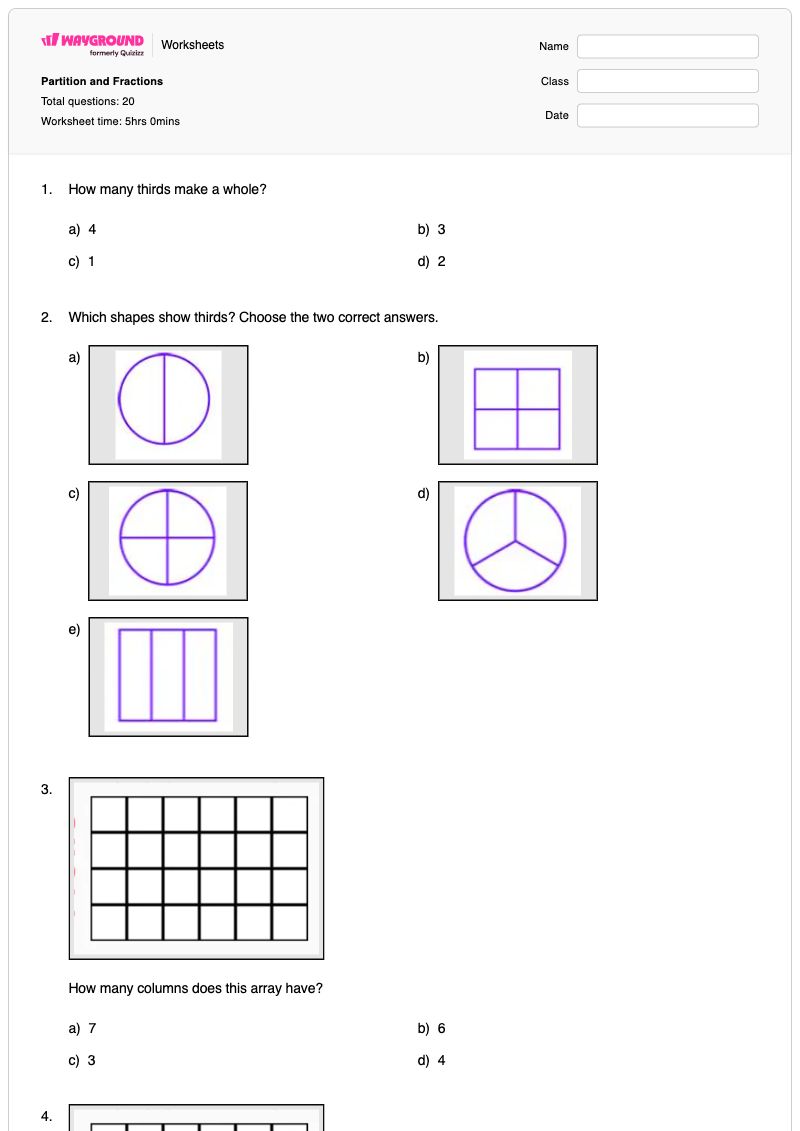
Partition and Fractions is a Grade 2 mathematics worksheet that helps students connect equal parts, visual fractions, and rectangular arrays. Across 20 items—15 multiple-choice questions, 3 multiple-select questions, and 2 fill-in-the-blank questions—students identify thirds, halves, fourths, and other fractional parts; determine shaded and unshaded fractions; recognize whole shapes; and count rows and columns in arrays and rectangles. Several items also ask students to match arrays with repeated-addition number models and identify pictures showing four fourths.
This free printable worksheet is useful for introducing or reviewing how shapes and objects are partitioned into equal shares. It gives teachers a focused way to check whether students can interpret fractions from visual models, distinguish rows from columns, and connect an array’s structure to an addition equation. The worksheet includes a complete answer key for efficient review, independent practice, or formative assessment.
Worksheet settings
Font size
S
M
L
XL
Worksheets
Partition and Fractions
Total questions: 20
Name
Class
Date
1.
How many thirds make a whole?
a)
4
b)
3
c)
1
d)
2
2.
Which shapes show thirds? Choose the two correct answers.
a)
b)
c)
d)
e)
3.
How many columns does this array have?
a)
7
b)
6
c)
3
d)
4
4.
How many rows does this array have?
a)
7
b)
6
c)
3
d)
4
5.
Look at this rectangle. How many rows are there?
(a)
6.
Look at this rectangle. How many columns are there?
(a)
7.
What is the fraction of the shaded shape provided?
a)
1/2
b)
1/3
c)
3/4
d)
2/3
8.
Annabelle, Lynley, Ruby, and Scarlett want to have equal shares of the pizza. How did the partition the pizza?
a)
thirds
b)
fourths
c)
eights
9.
Select the correct number model with the rectangular array:
a)
2+2+2+2=8
b)
3+3+3+3+3=15
c)
5+5+5+5+5=25
d)
4+4+4+4+4=20
10.
If you partition a shape into halves, how many parts are there?
a)
3
b)
4
c)
2
d)
1
11.
What does this picture show?
a)
one whole
b)
three fourths
c)
one half
12.
What fraction of the rectangle is NOT colored in (aka white)
a)
1/4
b)
1/3
c)
2/4
d)
3/4
13.
Check which rows and columns match the array.
a)
Rows: 5
b)
Columns: 5
c)
Rows: 3
d)
Columns: 3
14.
What fraction of the circle is shaded?
a)
one fourths
b)
three thirds
c)
two thirds
d)
three fourths
15.
Click on all the pictures that show four fourths.
a)
b)
c)
d)
16.
How much of the pizza has been eaten?
a)
one-fourth
b)
one-third
c)
three-fourths
d)
three-thirds
17.
What fraction is green?
a)
1/4
b)
2/4
c)
2/3
d)
2/3
18.
Jack has 12 tiles that are all the same size. He wants to use them all to make a rectangle. Which rectangle can he NOT make?
a)
A rectangle with 6 columns and 2 rows
b)
A rectangle with 3 columns and 4 rows
c)
A rectangle with 2 columns and 6 rows
d)
A rectangle with 4 columns and 4 rows
19.
How much more do I need to shade in to get one whole?
a)
one-fourth
b)
one-half
c)
two-fourths
d)
three-fourths
20.
To represent a fraction the pieces must be _________.
a)
different sizes
b)
equal
c)
it doesn't matter
d)
shaped like food
Answer Key
Partition and Fractions
Total questions: 20
1.
b)
3
2.
d) , e)
3.
b)
6
4.
d)
4
5.
5
6.
3
7.
a)
1/2
8.
b)
fourths
9.
c) 5+5+5+5+5=25
10.
c)
2
11.
c) one half
12.
d) 3/4
13.
d)
Columns: 3
, a)
Rows: 5
14.
d)
three fourths
15.
a) , c) , b)
16.
a) one-fourth
17.
b) 2/4
18.
d)
A rectangle with 4 columns and 4 rows
19.
a)
one-fourth
20.
b)
equal
140 %
Browse by subjects
Browse by grades
Browse by format
FAQs
What does the Partition and Fractions worksheet cover?
This Grade 2 worksheet focuses on identifying equal fractional parts such as halves, thirds, and fourths in shaded shapes, circles, rectangles, and sharing situations. Its 20 items also ask students to count rows and columns in arrays, match arrays to repeated-addition models, and select images that represent a given fraction. The multiple-choice, multiple-select, and fill-in-the-blank formats require students to interpret both visual and numerical representations.
How can I use this worksheet to teach partitioning shapes and reading fractions?
Begin by modeling how a whole is divided into equal parts, then use the worksheet’s thirds, halves, and fourths questions to have students explain how the number of parts relates to the fraction. Next, connect the rectangle and array items by asking students to identify rows and columns before matching an array to its repeated-addition equation. Use the pizza-sharing and shaded-shape questions for brief partner discussions about why equal shares must contain the same-sized parts.
What mistakes should I watch for when students complete this worksheet?
Students may confuse the number of equal parts with the number of shaded parts, such as choosing the denominator when identifying a shaded fraction or counting the unshaded portion instead. In the array items, watch for reversing rows and columns, especially when selecting the matching pair or number model. Students may also select only one correct image on the multiple-select fraction questions or treat an unequally partitioned shape as a valid representation.
How do I assign and grade this worksheet?
You can assign Partition and Fractions as a printable PDF or as a digital quiz on Wayground. The worksheet includes a complete answer key, and printable submissions can be graded by scanning student work with the Wayground for Teachers app. The printable format also gives schools an option for practice with less screen use.
How can I differentiate this fractions and arrays worksheet for my students?
Use the worksheet’s Advanced Settings to adjust font spacing and font size so the fraction diagrams, array labels, and answer choices are easier to read. You can also enable a dyslexia-friendly font or translate the worksheet into another language. These options apply to the worksheet file while preserving its visual fraction, row-and-column, and multiple-select tasks.
Where can I find more worksheets like this on Wayground?
Wayground offers a broad collection of free printable worksheets and practice problems across subjects, with downloadable PDFs and answer keys to support essential skills and concepts. Browse more resources at https://wayground.com/en-us/worksheets.


 Worksheets


