

Wayground
Unit 1 vocabulary, timeline and sources quiz (EL) - Printable Social studies Worksheets grade 10 - Wayground

Unit 1 vocabulary, timeline and sources quiz (EL)

Jeffrey Stokes

Created by Jeffrey Stokes

11 questions

10th Grade

Social studies

Updated Aug 2026

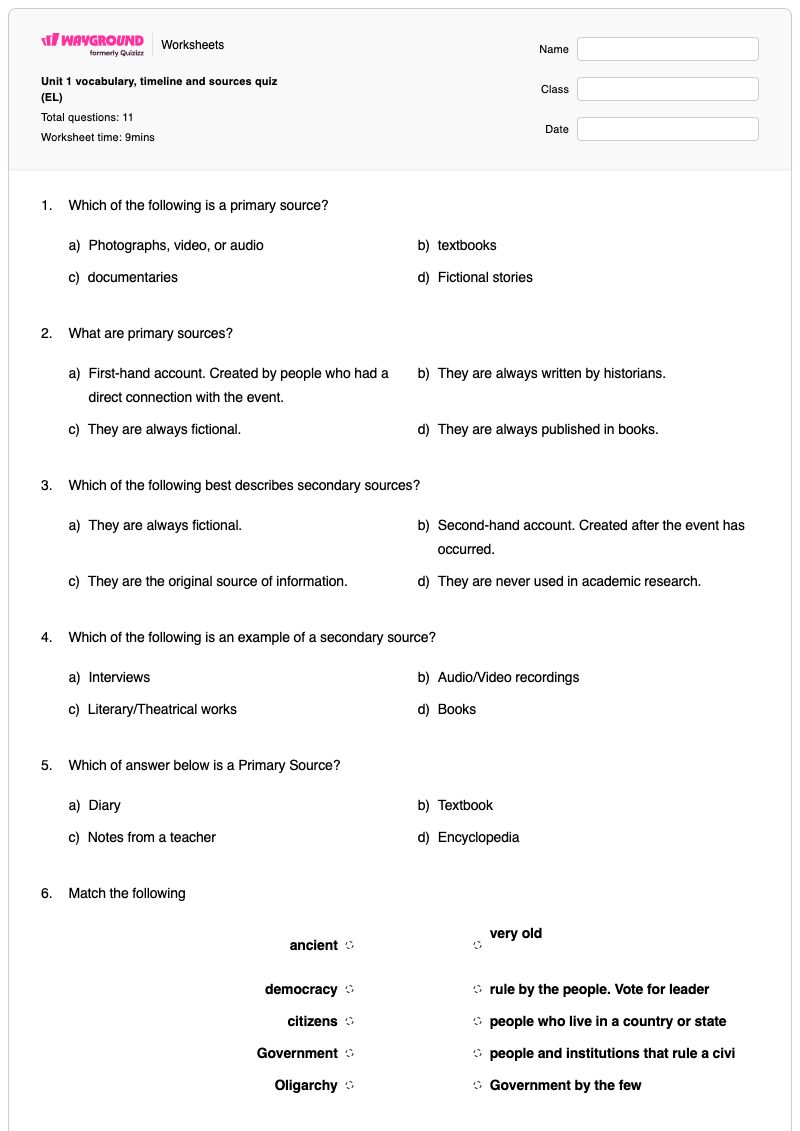
Unit 1 Vocabulary, Timeline and Sources Quiz is a Grade 10 Social Studies worksheet designed to strengthen students’ ability to distinguish primary sources from secondary sources. Across eight multiple-choice questions, students identify first-hand and second-hand accounts and classify examples such as photographs, recordings, books, textbooks, and diaries. The worksheet also reviews key civics and history vocabulary through matching, drag-and-drop, and dropdown items. Students connect a republic with elected representatives, identify monarchy as rule by one person, recognize Athens as an early democracy, and review the significance of the Magna Carta and the Enlightenment. This free printable worksheet includes a complete answer key and can support independent practice, review, or a unit check.

Worksheet settings

Font size

S
M
L
XL
WaygroundWorksheets

Unit 1 vocabulary, timeline and sources quiz (EL)

Total questions: 11

Name
Class
Date
1.

Which of the following is a primary source?

a)

Photographs, video, or audio

b)

textbooks

c)

documentaries

d)

Fictional stories

2.

What are primary sources?

a)

First-hand account. Created by people who had a direct connection with the event.

b)

They are always written by historians.

c)

They are always fictional.

d)

They are always published in books.

3.

Which of the following best describes secondary sources?

a)

They are always fictional.

b)

Second-hand account. Created after the event has occurred.

c)

They are the original source of information.

d)

They are never used in academic research.

4.

Which of the following is an example of a secondary source?

a)

Interviews

b)

Audio/Video recordings

c)

Literary/Theatrical works

d)

Books

5.
Which of answer below is a Primary Source?
a)
Diary
b)
Textbook 
c)
Notes from a teacher
d)
Encyclopedia 
6.

Match the following

ancient

very old


democracy

rule by the people. Vote for leader

citizens

people who live in a country or state

Government

people and institutions that rule a civi

Oligarchy

Government by the few

7.

In a republic people elect​ (a)   who​ (b)   on laws on behalf of the people.

Choose from the below words
representatives
vote
8.

A ​ (a)   is a form of government in which the ruling power is in the hands of one person (king, queen, or emperor)

Choose from the below words
Monarchy
Democracy
Oligarchy
Anarchy
9.

Where was the first known democracy in the world?

a)

Rome

b)

Athens

c)

Sparta

d)

Egypt

10.
What did the Magna Carta do?
a)
Gave more power to the King
b)
Limited the power of the King
c)
Got rid of the Feudal System in England
d)
Gave more power to the Common People
11.
The Enlightenment is
a)

a time of strong religious change

b)

A period of time in history when people began to question traditional ideas and beliefs.

c)

a time when technology ruled

WaygroundAnswer Key

Unit 1 vocabulary, timeline and sources quiz (EL)

Total questions: 11

1.
a)

Photographs, video, or audio

2.
a)

First-hand account. Created by people who had a direct connection with the event.

3.
b)

Second-hand account. Created after the event has occurred.

4.
d)

Books

5.
a) Diary
6.

ancient

 - 

very old


, 

democracy

 - 

rule by the people. Vote for leader

, 

citizens

 - 

people who live in a country or state

, 

Government

 - 

people and institutions that rule a civi

, 

Oligarchy

 - 

Government by the few

7.
representatives, vote
8.
Monarchy
9.
b)

Athens

10.
b) Limited the power of the King
11.
b)

A period of time in history when people began to question traditional ideas and beliefs.

FAQs

What does this Unit 1 worksheet cover, and how does it help students learn?

This Grade 10 Social Studies worksheet combines source analysis with historical and government vocabulary practice. Students answer eight multiple-choice questions about primary and secondary sources, complete a vocabulary matching item, and use drag-and-drop and dropdown questions to identify representatives, monarchy, Athens, the Magna Carta, and the Enlightenment. The varied formats require students to recognize definitions, classify examples, and apply key terms.

How can I use this worksheet to teach primary and secondary sources and government vocabulary?

Begin by modeling the difference between a first-hand account and a source created after an event, using the worksheet’s examples such as a diary, photographs, recordings, books, and textbooks. Then have students complete the source-identification multiple-choice items before reviewing the matching vocabulary and government questions. Use the Athens, Magna Carta, and Enlightenment items as discussion prompts about how forms of government and historical ideas developed.

What mistakes should I watch for when students complete this sources and government vocabulary quiz?

Students may incorrectly treat textbooks, documentaries, or encyclopedias as primary sources instead of recognizing them as accounts created or interpreted after an event; they may also overlook that a diary is a first-hand source. In the government items, watch for students choosing vote instead of representatives in the republic question or confusing monarchy with democracy, oligarchy, or anarchy. Students may also reverse the Magna Carta’s effect by selecting that it increased rather than limited the king’s power.

How do I assign and grade this Unit 1 worksheet?

You can assign it on Wayground as a printable PDF or as a digital quiz, and it includes a complete answer key for checking all 11 items. For printable submissions, scan student work with the Wayground for Teachers app to help grade responses. The printable format also gives schools an option for reducing screen time during source and vocabulary review.

How can I differentiate this worksheet for my students?

Use the worksheet’s Advanced Settings to adjust font spacing or choose a larger font size so the multiple-choice options, matching terms, and dropdown prompts are easier to read. You can also select a dyslexia-friendly font or translate the worksheet into another language when appropriate for your learners. These changes apply to the worksheet file while preserving its source-analysis and government-vocabulary questions.

Where can I find more worksheets like this on Wayground?

Wayground offers a broad collection of free printable worksheets and practice problems across subjects, with downloadable PDFs and answer keys to support essential skills and concepts. Browse more resources at https://wayground.com/en-us/worksheets.