

Wayground
author's purpose - Printable ELA Worksheets grade 10 - Wayground

author's purpose

Jana Lee

Created by Jana Lee

18 questions

10th Grade

ELA

Updated Oct 2026

This Grade 10 English worksheet develops students’ ability to identify an author’s purpose: to inform, persuade, or entertain. It includes 18 multiple-choice questions that ask students to classify short passages such as a historical explanation, an advertisement, and a personal account, then apply the skill to instructional texts about soccer dribbling and making hard-boiled eggs. Additional items reinforce related terms and purposes, including author’s reason, compare, contrast, and humor. Students also select evidence that supports a purpose, such as recognizing when a passage provides sequential steps to teach a process rather than simply making a claim. The repeated multiple-choice format gives learners focused practice distinguishing a text’s intended effect from its topic or content. This free printable worksheet with an answer key is suitable for Grade 10 English instruction, independent practice, review, or a formative check of reading comprehension and author’s purpose.

Worksheet settings

Font size

S
M
L
XL
WaygroundWorksheets

author's purpose

Total questions: 18

Name
Class
Date
1.
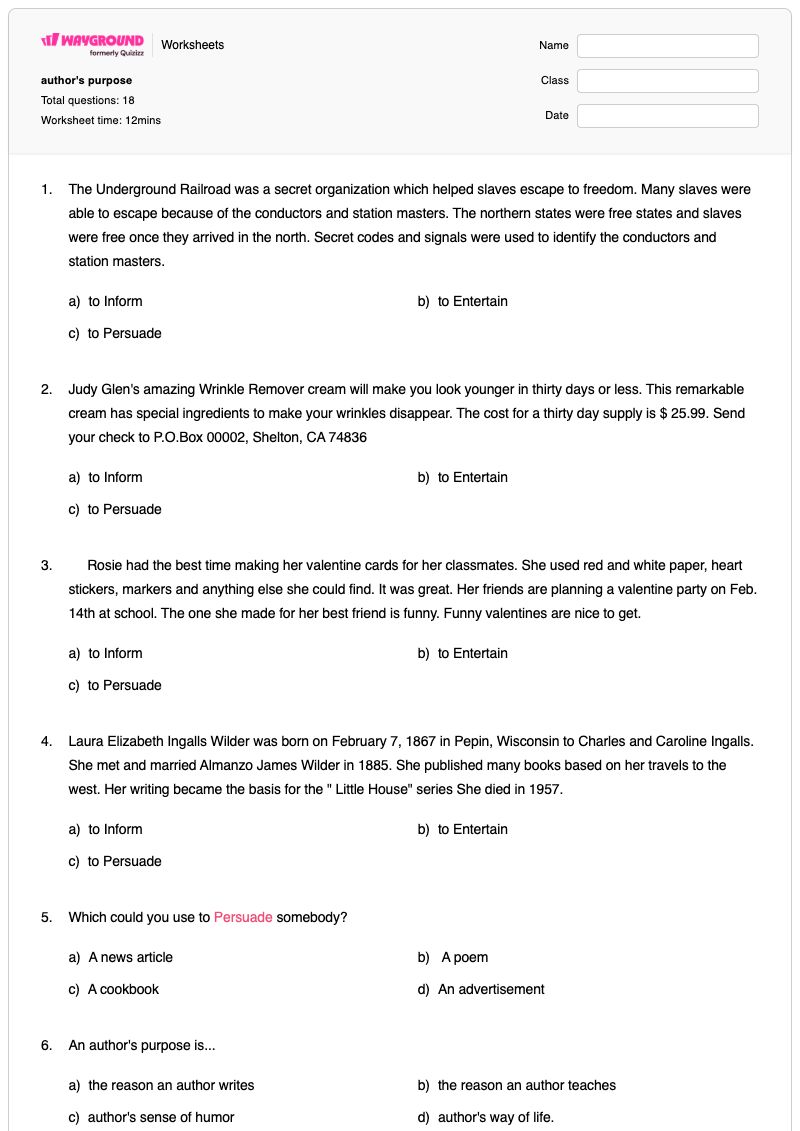
The Underground Railroad was a secret organization which helped slaves escape to freedom. Many slaves were able to escape because of the conductors and station masters. The northern states were free states and slaves were free once they arrived in the north. Secret codes and signals were used to identify the conductors and station masters. 
a)
to Inform
b)
to Entertain
c)
to Persuade
2.
Judy Glen's amazing Wrinkle Remover cream will make you look younger in thirty days or less. This remarkable cream has special ingredients to make your wrinkles disappear. The cost for a thirty day supply is $ 25.99. Send your check to P.O.Box 00002, Shelton, CA 74836 
a)
to Inform
b)
to Entertain
c)
to Persuade
3.
     Rosie had the best time making her valentine cards for her classmates. She used red and white paper, heart stickers, markers and anything else she could find. It was great. Her friends are planning a valentine party on Feb. 14th at school. The one she made for her best friend is funny. Funny valentines are nice to get. 
a)
to Inform
b)
to Entertain
c)
to Persuade
4.
Laura Elizabeth Ingalls Wilder was born on February 7, 1867 in Pepin, Wisconsin to Charles and Caroline Ingalls. She met and married Almanzo James Wilder in 1885. She published many books based on her travels to the west. Her writing became the basis for the " Little House" series She died in 1957.
a)
to Inform
b)
to Entertain
c)
to Persuade
5.
Which could you use to Persuade somebody?
a)
A news article
b)
 A poem
c)
A cookbook
d)
An advertisement
6.
An author's purpose is...
a)
the reason an author writes
b)
the reason an author teaches
c)
author's sense of humor
d)
author's way of life. 
7.
The author is the ____________ of a story. 
a)
writer
b)
artist
c)
reader
d)
setting
8.

Dribbling is a fundamental soccer skill. You can master it by first learning how to make gentle contact, or "touch," with the ball. When players use gentle touches, they contact the ball more often, which leads to greater control. Another key to controlling the ball is keeping it close to your feet, or "shielding." This makes it harder for other players to intercept the ball.


Now you're ready to dribble. Begin by gently passing the ball back and forth using the insides of your feet. Remember to keep your head up while dribbling so you know where you are on the field. With time and practice, you'll gain speed and control.


Which author's purpose is suggested by the text?

a)

to convince readers that dribbling takes practice

b)

to teach readers how to dribble a soccer ball

9.

Review the text.


Dribbling is a fundamental soccer skill. You can master it by first learning how to make gentle contact, or "touch," with the ball. When players use gentle touches, they contact the ball more often, which leads to greater control. Another key to controlling the ball is keeping it close to your feet, or "shielding." This makes it harder for other players to intercept the ball.


Now you're ready to dribble. Begin by gently passing the ball back and forth using the insides of your feet. Remember to keep your head up while dribbling so you know where you are on the field. With time and practice, you'll gain speed and control.


Which best shows that the author's purpose is to teach readers how to dribble a soccer ball?

a)

The author lists specific steps that the readers should take turns to learn how to dribble a soccer ball.

b)

The author argues that dribbling is a fundamental soccer skill.

10.

Read the text.


Place four eggs in a large saucepan. Add enough cold water to cover the eggs by one inch. Slowly bring the water to a boil over medium heat. As soon as the water begins to boil, remove the pan from the burner. Cover it and let the eggs sit for about ten minutes. Then drain the water from the pan. You will notice, though, that a hot hard-boiled egg is not easy to peel. To cool the eggs, rinse them with cold water. Then, when you're ready to peel an egg, gently tap it on the counter until the shell cracks.


Which author's purpose is suggested by the text?

a)

to convince readers that making hard-boiled eggs is easy or to persuade

b)

to teach readers how to make hard-boiled eggs or to inform

11.

Another word for Author's Purpose is _____________

a)

Author's Craft

b)

Author's Reason

c)

Author's Topic

d)

Author's Choice

12.

The author's purpose is?

a)

the feeling associated with a word

b)

the reason the author wrote the text

c)

to make money off his/her writing

d)

the mood the author is in when he/she writes

13.

When the author writes to show similarities between things or ideas, his/her purpose is to?

a)

compare

b)

persuade

c)

contrast

d)

describe

14.

When the author writes to show the differences in things and ideas, his/her purpose is to?

a)

research

b)

entertain

c)

compare

d)

contrast

15.

When the author is trying to make the audience laugh, his/her secondary purpose is to?

a)

unify

b)

humor

c)

intensify

d)

teach a moral lesson

16.
People should not be allowed to have children until they take a parenting class. 
a)
Inform
b)
Instruct
c)
Entertain
d)
Persuade
17.
How to Make an Apple Mummy—Put an apple slice in a plastic cup. Mix 1⁄2 cup of baking soda and 1⁄2 cup of salt. Pour the mixture over the apple until the apple slice is completely covered. Store the apple slice away from light and moisture for one week. 
a)
Inform
b)
Persuade
c)
Instruct
d)
Entertain
18.
1I visited my grandmother in a nursing home yesterday. 2Ninety-two years old and partially paralyzed by a stroke, she now struggles to feed herself and is irreversibly bound to her bed or wheelchair. 3Once vital and fiercely independent, she is now frail and incapable of even using the bathroom unassisted. 4Mortified by her dependence on others, her moods range from quiet acceptance to whining complaint. 5I do not see evidence of a divine plan in this situation. 6Maybe there is no divine plan, or perhaps I am just not wise enough to see it. 
a)
Ironic
b)
Distressed
c)
Annoyed
d)
Forgiving
WaygroundAnswer Key

author's purpose

Total questions: 18

1.
a) to Inform
2.
c) to Persuade
3.
b) to Entertain
4.
a) to Inform
5.
d) An advertisement
6.
a) the reason an author writes
7.
a) writer
8.
b)

to teach readers how to dribble a soccer ball

9.
a)

The author lists specific steps that the readers should take turns to learn how to dribble a soccer ball.

10.
b)

to teach readers how to make hard-boiled eggs or to inform

11.
b)

Author's Reason

12.
b)

the reason the author wrote the text

13.
a)

compare

14.
d)

contrast

15.
b)

humor

16.
d) Persuade
17.
c) Instruct
18.
b) Distressed

FAQs

What does this author’s purpose worksheet cover?

This Grade 10 worksheet uses 18 multiple-choice questions to help students identify whether short texts are written to inform, persuade, or entertain. Students classify examples such as a historical passage, an advertisement, and a personal account, then use details—such as sequential directions in the soccer and hard-boiled egg passages—to determine an instructional purpose. It also reinforces related purposes and terms, including compare, contrast, humor, and author’s reason.

How can I use this worksheet to teach author’s purpose?

Introduce the three main purposes by having students ask what the writer wants the reader to know, believe, or feel. Model the process with one of the worksheet’s clear examples, such as identifying the advertisement as persuasive, and underline the language that supports the choice. Then have students explain why the step-by-step soccer and egg passages are instructional before completing the remaining multiple-choice items independently or in pairs.

What mistakes should I watch for when students complete this author’s purpose worksheet?

Students may choose an answer based on the topic rather than the writer’s goal—for example, labeling a soccer passage persuasive simply because it says dribbling is important. They may also confuse directions that teach a process with an attempt to persuade, or select a purpose without using the passage’s specific evidence. Review the distinction between compare and contrast, and remind students that an entertaining or humorous text is identified by its intended effect, not merely by the presence of a funny detail.

How do I assign and grade this author’s purpose worksheet?

You can assign this worksheet as a printable PDF or use it as a digital quiz on Wayground. It includes a complete answer key for the 18 multiple-choice questions, and printable student work can be graded by scanning it with the Wayground for Teachers app. The printable format also provides an option for schools that are reducing screen time.

How can I differentiate this author’s purpose worksheet for my students?

Use the worksheet’s Advanced Settings to adjust font spacing or increase the font size so the short passages and multiple-choice options are easier to scan. You can also apply a dyslexia-friendly font or translate the worksheet into another language. These adjustments can support access to the historical, advertisement, narrative, and instructional passages without changing the author’s purpose skill being assessed.

Where can I find more worksheets like this on Wayground?

Wayground offers a comprehensive collection of free printable worksheets and practice problems across all subjects, with downloadable PDFs and answer keys to help students master essential skills and concepts. Browse more resources at https://wayground.com/en-us/worksheets.