

Wayground
Economics Stock exchange - Printable Social Studies Worksheets grade 12 - Wayground

Economics Stock exchange

15 questions

12th - 12th Grade

Social Studies

Economics Stock Exchange is a Grade 12 Social Studies worksheet that builds foundational knowledge of stock markets and investing. Students complete two matching activities and 13 multiple-choice questions covering bull and bear markets, shares, common and preferred stock, stock exchanges, dividends, capital gains and losses, stock symbols, stockbrokers, and ways investors may profit from stocks. The worksheet also checks students’ understanding of the Dow Jones Industrial Average and the 1929 stock market crash. This free printable worksheet helps students distinguish related financial terms, connect stock ownership with voting rights and dividends, and recognize how investors and financial markets operate. Use it for direct instruction review, independent practice, or a formative assessment after introducing stock-market vocabulary and basic investing concepts. An answer key is included so teachers can quickly check student understanding and address misconceptions about stock types, market trends, and investment returns.

Worksheet settings

Font size

S
M
L
XL
Worksheets

Economics Stock exchange

Total questions: 15

Name
Class
Date
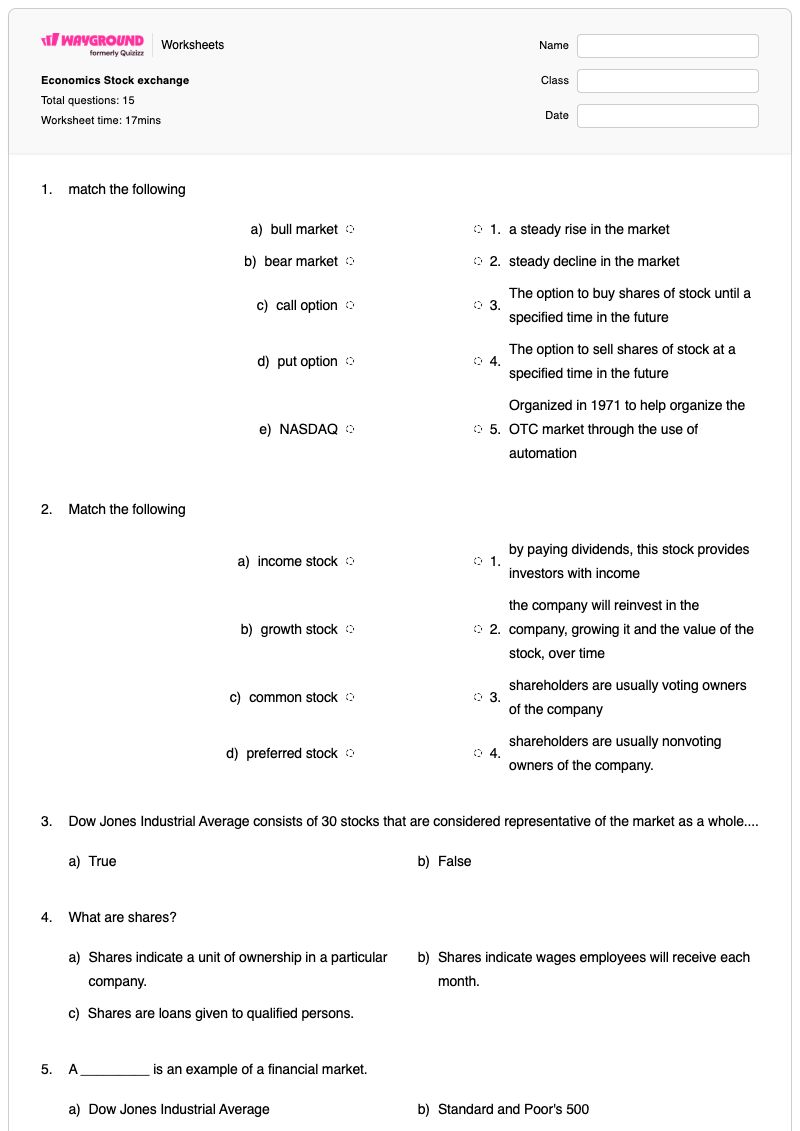
1.

match the following

bull market

a steady rise in the market

bear market

steady decline in the market

call option

The option to buy shares of stock until a specified time in the future

put option

The option to sell shares of stock at a specified time in the future

NASDAQ

Organized in 1971 to help organize the OTC market through the use of automation

2.

Match the following

income stock

by paying dividends, this stock provides investors with income

growth stock

the company will reinvest in the company, growing it and the value of the stock, over time

common stock

shareholders are usually voting owners of the company

preferred stock

shareholders are usually nonvoting owners of the company.

3.

Dow Jones Industrial Average consists of 30 stocks that are considered representative of the market as a whole....

a)

True

b)

False

4.

What are shares?

a)

Shares indicate a unit of ownership in a particular company.

b)

Shares indicate wages employees will receive each month.

c)

Shares are loans given to qualified persons.

5.
A _________ is an example of a financial market.
a)
Dow Jones Industrial Average
b)
Standard and Poor's 500
c)
New York Stock Exchange
d)
Goldman Sachs
6.
A ______ market is one that sees sustained increase in stock prices over time.
a)
Bear
b)
Bull
c)
Volatile
7.
A ______ market is one that sees sustained decrease in stock prices over time.
a)
Bear
b)
Bull
c)
Volatile
d)
Goat
8.

What type of stock would have voting rights?

a)

preferred stock

b)

common stock

c)

chicken stock

d)

stock stock

9.

What is it called when you loss money on stocks you have purchased.

a)

capital gain

b)

capital loss

c)

capital of NY

d)

corporate loss

10.

A portion of a company’s earnings that is paid to shareholders, or people that own that company’s stock, on a quarterly or annual basis

a)

Dividend

b)

Interest

c)

Compound Interest

d)

Capital gain

11.
You decide that you want to invest a little bit of money in Apple stock.  But in order to do that you need to figure out their stock symbol.  What is the symbol that Apple uses on the stock market?  Use the image to help you figure it out.
a)
AAPL
b)
APPLE
c)
IPHONE
d)
STEVEJOBS
12.

Which statement is true about common stock:

a)

 Most companies issue common stock not preferred stock.

b)

Common stock gives you the right to vote at shareholders’ meetings.

c)

You have the right to receive  dividends.

d)

All of the above

13.

A stockbroker...

a)

owns the company

b)

may provide clients advice on stocks and help them make trades

c)

is not allowed to buy and sell stocks

d)

all of the above

14.

Stock investors can profit from stocks from

a)

bankruptcy

b)

dividends

c)

growth

d)

dividends and growth

15.
The first major stock market crash happened in
a)
1875
b)
1929
c)
1955
d)
1987
Answer Key

Economics Stock exchange

Total questions: 15

1.

bull market

 - 

a steady rise in the market

, 

bear market

 - 

steady decline in the market

, 

call option

 - 

The option to buy shares of stock until a specified time in the future

, 

put option

 - 

The option to sell shares of stock at a specified time in the future

, 

NASDAQ

 - 

Organized in 1971 to help organize the OTC market through the use of automation

2.

income stock

 - 

by paying dividends, this stock provides investors with income

, 

growth stock

 - 

the company will reinvest in the company, growing it and the value of the stock, over time

, 

common stock

 - 

shareholders are usually voting owners of the company

, 

preferred stock

 - 

shareholders are usually nonvoting owners of the company.

3.
a)

True

4.
a)

Shares indicate a unit of ownership in a particular company.

5.
c) New York Stock Exchange
6.
b) Bull
7.
a) Bear
8.
b)

common stock

9.
b)

capital loss

10.
a)

Dividend

11.
a) AAPL
12.
d)

All of the above

13.
b)

may provide clients advice on stocks and help them make trades

14.
d)

dividends and growth

15.
b) 1929

FAQs

What does the Economics Stock Exchange worksheet cover?

This Grade 12 worksheet uses two matching activities and 13 multiple-choice questions to assess stock-market vocabulary and concepts. Students identify bull and bear markets, distinguish common from preferred stock, explain shares, dividends, capital losses, and stockbroker roles, recognize the New York Stock Exchange and Apple’s AAPL symbol, and connect stock investing with the 1929 market crash.

How can I use this worksheet to teach stock-market basics?

Introduce the worksheet by grouping its terms into categories: market conditions, stock types, ownership and returns, and financial institutions. Have students complete the two matching sections after discussing the vocabulary, then use the multiple-choice items to apply those ideas to examples such as voting rights, dividends, stock symbols, and investor profits. Review the choices students selected and ask them to explain why a term such as bull market differs from bear market.

What mistakes should I watch for on this stock exchange worksheet?

Students may confuse a bull market with a bear market, or mistake a market index such as the Dow Jones Industrial Average for a financial market such as the New York Stock Exchange. They may also overlook that common stock is associated with voting rights, dividends, and the worksheet’s “all of the above” response, or confuse a capital loss with a capital gain. Check that students distinguish dividends from interest and identify AAPL as Apple’s stock symbol.

How do I assign and grade the Economics Stock Exchange worksheet?

The worksheet is available as a printable PDF and as a digital quiz on Wayground, with a complete answer key for all 15 matching and multiple-choice items. You can print it for paper-based practice or assign the digital version for online completion. Printable submissions can be graded by scanning student work with the Wayground for Teachers app.

How can I differentiate this stock exchange worksheet for my students?

Use the worksheet’s Advanced Settings to adjust font spacing and font size so the matching terms and multiple-choice options are easier to track. You can also apply a dyslexia-friendly font to the stock-market vocabulary and translate the worksheet into another language when language support is needed. These options change the worksheet file while preserving its questions about stock types, market trends, and investing.

Where can I find more worksheets like this on Wayground?

Wayground offers a broad collection of free printable worksheets and practice problems across subjects, with downloadable PDFs and answer keys to support essential skills and concepts. Browse more resources at https://wayground.com/en-us/worksheets.