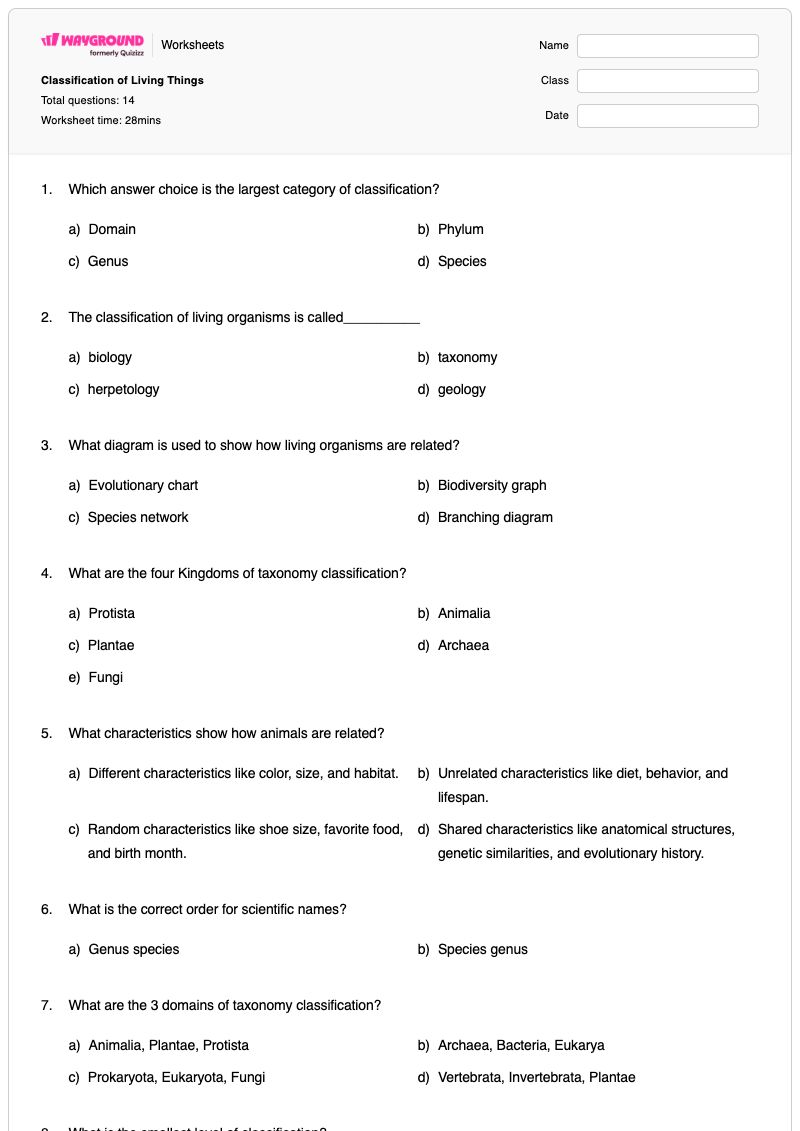
Classification of Living Things is a Grade 6 science worksheet that builds foundational taxonomy knowledge through 14 questions: 13 multiple-choice items and one multiple-select item. Students identify the largest and smallest classification levels, name taxonomy’s three domains and four kingdoms, arrange scientific names in genus-species order, recognize the role of branching diagrams and dichotomous keys, and identify characteristics used to compare related organisms. True-or-false questions also check understanding that skeletal structures support classification, branching diagrams are not used to identify unknown organisms, and classification systems change over time.
This worksheet helps students connect taxonomy vocabulary with the structure and purpose of biological classification. It also introduces the contribution of Carolus Linnaeus and reinforces how scientists use shared characteristics, including anatomical structures, genetic similarities, evolutionary history, and physical and chemical characteristics, when classifying organisms. The free printable worksheet includes a complete answer key for efficient review, independent practice, or classroom assessment.
Worksheet settings
Font size
S
M
L
XL
Worksheets
Classification of Living Things
Total questions: 14
Name
Class
Date
1.
Which answer choice is the largest category of classification?
a)
Domain
b)
Phylum
c)
Genus
d)
Species
2.
The classification of living organisms is called__________
a)
biology
b)
taxonomy
c)
herpetology
d)
geology
3.
What diagram is used to show how living organisms are related?
a)
Evolutionary chart
b)
Biodiversity graph
c)
Species network
d)
Branching diagram
4.
What are the four Kingdoms of taxonomy classification?
a)
Protista
b)
Animalia
c)
Plantae
d)
Archaea
e)
Fungi
5.
What characteristics show how animals are related?
a)
Different characteristics like color, size, and habitat.
b)
Unrelated characteristics like diet, behavior, and lifespan.
c)
Random characteristics like shoe size, favorite food, and birth month.
d)
Shared characteristics like anatomical structures, genetic similarities, and evolutionary history.
6.
What is the correct order for scientific names?
a)
Genus species
b)
Species genus
7.
What are the 3 domains of taxonomy classification?
a)
Animalia, Plantae, Protista
b)
Archaea, Bacteria, Eukarya
c)
Prokaryota, Eukaryota, Fungi
d)
Vertebrata, Invertebrata, Plantae
8.
What is the smallest level of classification?
a)
Family
b)
Order
c)
Species
d)
Kingdom
9.
A __________ uses a series of paired statements to identify organisms.
a)
dichotomous key
b)
progressive key
c)
binary key
d)
sequential key
10.
What 2 characteristics do we use to tell if organisms are related?
a)
Physical size and color
b)
Habitat and diet
c)
Behavior and lifespan
d)
Physical and chemical
11.
True or False: Scientists compare skeletal structures to classify organisms.
a)
True
b)
False
12.
True or False: Branching diagrams are used to identify unknown organisms.
a)
True
b)
False
13.
True or False: Classification systems change over time.
a)
True
b)
False
14.
Who is thought to be the "father of taxonomy"?
a)
Galileo Galilei
b)
Carolus Linnaeus
c)
Albert Einstein
d)
Isaac Newton
Answer Key
Classification of Living Things
Total questions: 14
1.
a)
Domain
2.
b) taxonomy
3.
d)
Branching diagram
4.
a)
Protista
, b)
Animalia
, c)
Plantae
, e)
Fungi
5.
d) Shared characteristics like anatomical structures, genetic similarities, and evolutionary history.
6.
a) Genus species
7.
b) Archaea, Bacteria, Eukarya
8.
c)
Species
9.
a) dichotomous key
10.
d)
Physical and chemical
11.
a)
True
12.
b)
False
13.
a)
True
14.
b)
Carolus Linnaeus
140 %
Browse by subjects
Browse by grades
Browse by format
FAQs
What does the Classification of Living Things worksheet cover?
This Grade 6 science worksheet uses 13 multiple-choice questions and one multiple-select question to assess taxonomy concepts, including classification levels, the three domains, the four kingdoms, genus-species naming, and the roles of branching diagrams and dichotomous keys. Students also evaluate how shared characteristics and skeletal structures help classify related organisms and identify Carolus Linnaeus’s contribution to taxonomy.
How can I use this worksheet to teach taxonomy and classification?
Introduce the classification hierarchy and vocabulary first, then have students complete the questions in sections: levels and domains, kingdoms and scientific naming, and tools for identifying or showing relationships among organisms. Use the branching-diagram and dichotomous-key items to prompt a comparison of their purposes, and discuss why classification systems can change as scientists gather new evidence.
What mistakes should I watch for when students complete this taxonomy worksheet?
Students may confuse Domain with Species, reverse the genus-species order, or select Archaea as one of the four kingdoms instead of recognizing it as one of the three domains. Watch for confusion between branching diagrams, which the worksheet connects with organism relationships, and dichotomous keys, which use paired statements to identify organisms; students may also overlook that the kingdoms question requires multiple selections.
How do I assign and grade this Classification of Living Things worksheet?
You can assign it as a printable PDF or use it as a digital quiz on Wayground. The worksheet includes a complete answer key, and printable submissions can be graded by scanning student work with the Wayground for Teachers app. The printable format also gives schools an option for reducing screen time while students practise taxonomy.
How can I differentiate this taxonomy worksheet for my students?
Use the worksheet’s Advanced Settings to adjust font spacing or increase the font size so the classification terms, answer choices, and true-or-false items are easier to read. You can also apply a dyslexia-friendly font or translate the worksheet into another language, depending on your students’ needs.
Where can I find more worksheets like this on Wayground?
Wayground offers a broad collection of free printable worksheets and practice problems across subjects, with downloadable PDFs and answer keys to support mastery of essential skills and concepts. Browse more resources at https://wayground.com/en-us/worksheets.


 Worksheets