Biotic and Abiotic Factors: Science Literacy Article
Created by Mary Cobia
10 questions
6th Grade
Science
Updated Sep 2026
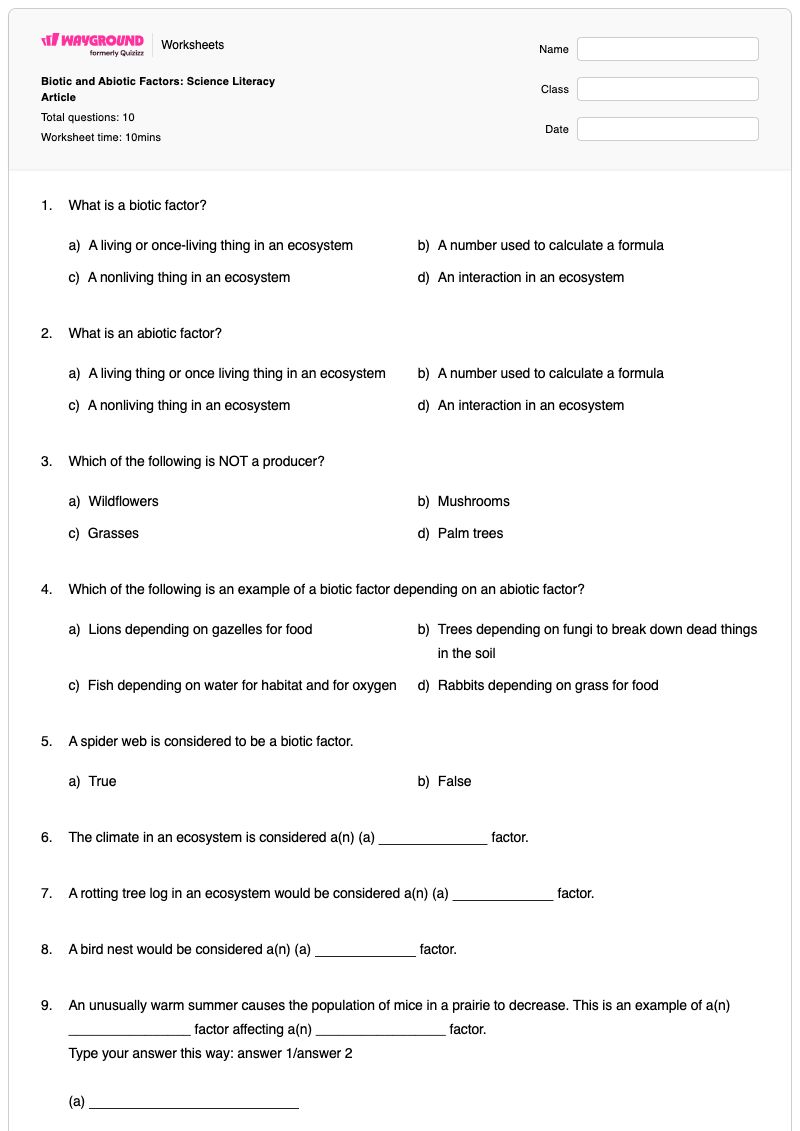
Biotic and Abiotic Factors: Science Literacy Article is a Grade 6 science worksheet that builds students’ ability to classify ecosystem components as biotic or abiotic. Across five multiple-choice questions, four fill-in-the-blank items, and one open-ended sorting task, students define both factor types, identify producers, classify examples such as climate, rotting logs, bird nests, and spider webs, and recognize how abiotic conditions can affect living populations.
The worksheet also asks students to interpret relationships such as fish depending on water for habitat and oxygen and unusually warm weather affecting mice. It is useful for introducing ecosystem vocabulary, checking understanding after instruction, or providing focused practice with classification and cause-and-effect relationships. This free printable worksheet includes a complete answer key for efficient review and assessment.
Worksheet settings
Font size
S
M
L
XL
Worksheets
Biotic and Abiotic Factors: Science Literacy Article
Total questions: 10
Name
Class
Date
1.
What is a biotic factor?
a)
A living or once-living thing in an ecosystem
b)
A number used to calculate a formula
c)
A nonliving thing in an ecosystem
d)
An interaction in an ecosystem
2.
What is an abiotic factor?
a)
A living thing or once living thing in an ecosystem
b)
A number used to calculate a formula
c)
A nonliving thing in an ecosystem
d)
An interaction in an ecosystem
3.
Which of the following is NOT a producer?
a)
Wildflowers
b)
Mushrooms
c)
Grasses
d)
Palm trees
4.
Which of the following is an example of a biotic factor depending on an abiotic factor?
a)
Lions depending on gazelles for food
b)
Trees depending on fungi to break down dead things in the soil
c)
Fish depending on water for habitat and for oxygen
d)
Rabbits depending on grass for food
5.
A spider web is considered to be a biotic factor.
a)
True
b)
False
6.
The climate in an ecosystem is considered a(n) (a) factor.
7.
A rotting tree log in an ecosystem would be considered a(n) (a) factor.
8.
A bird nest would be considered a(n) (a) factor.
9.
An unusually warm summer causes the population of mice in a prairie to decrease. This is an example of a(n) ________________ factor affecting a(n) _________________ factor.
Type your answer this way: answer 1/answer 2
(a)
10.
Sort the following terms into the correct location in your answer below. Do it the following way:
Biotic Factors: (list your answers)
Abiotic Factors: (list your answers)
4 lines
Answer Key
Biotic and Abiotic Factors: Science Literacy Article
Total questions: 10
1.
a)
A living or once-living thing in an ecosystem
2.
c)
A nonliving thing in an ecosystem
3.
b)
Mushrooms
4.
c)
Fish depending on water for habitat and for oxygen
5.
a)
True
6.
abiotic, Abiotic
7.
biotic, Biotic
8.
biotic
9.
abiotic/biotic, abiotic / biotic
10.
n/a
140 %
Browse by subjects
Browse by grades
Browse by format
FAQs
What does this biotic and abiotic factors worksheet cover?
This Grade 6 worksheet uses five multiple-choice questions, four fill-in-the-blank items, and an open-ended sorting task to practice classifying ecosystem factors as biotic or abiotic. Students also distinguish producers from nonproducers and identify relationships in which abiotic conditions, such as water or unusually warm weather, affect living organisms.
How can I use this worksheet to teach biotic and abiotic factors?
Introduce the distinction by having students explain whether each example is living, once living, or nonliving, then use the worksheet’s climate, rotting log, bird nest, and spider web items for guided classification. After reviewing the multiple-choice and fill-in-the-blank questions, discuss the fish-and-water and warm-summer-and-mice examples to connect classification with ecosystem cause and effect before students complete the final sorting task independently.
What mistakes should I watch for when students complete this worksheet?
Students may confuse abiotic factors with organisms, especially when identifying climate or water, or overlook that the worksheet treats once-living materials such as a rotting log as biotic. Watch for confusion between producers and other organisms, reversal of the abiotic/biotic order in the warm-summer-and-mice response, and misclassification of the spider web or bird nest items.
How do I assign and grade this biotic and abiotic factors worksheet?
Wayground provides this worksheet as a printable PDF and as a digital quiz, and it includes a complete answer key for the multiple-choice, fill-in-the-blank, and sorting responses. For printable submissions, scan student work with the Wayground for Teachers app to support grading and review.
How can I differentiate this worksheet for my students?
Under the worksheet’s Advanced Settings, adjust font spacing or choose a larger font size so the classification labels, fill-in-the-blank prompts, and final sorting directions have more visual space. You can also apply a dyslexia-friendly font or translate the worksheet into another language while preserving its biotic-and-abiotic practice format.
Where can I find more worksheets like this on Wayground?
Wayground offers a broad collection of free printable worksheets and practice problems across subjects, with downloadable PDFs and answer keys to help students master essential skills and concepts. Browse more resources at https://wayground.com/en-us/worksheets.


 Worksheets
