

This Grade 8 science worksheet helps students distinguish biotic factors, which are living components of an ecosystem, from abiotic factors, which are nonliving components. Across 18 questions—15 multiple choice and 3 multiple select—students classify examples such as water, sunlight, food, predators, disease, space, and temperature, then identify how these factors limit population size.
Students also apply ecosystem vocabulary and relationships by identifying populations, limiting factors, and carrying capacity; recognizing competition between organisms for resources; tracing which organisms rely on grains; and interpreting a population change in grasshoppers. The varied question formats require students to select one answer or identify every correct option, supporting both vocabulary recall and application to simple food-resource scenarios. This free printable worksheet includes a complete answer key and is designed for Grade 8 science review, independent practice, or formative assessment.
Worksheet settings
Font size
S
M
L
XL
Worksheets
Biotic and Abiotic
Total questions: 18
Name
Class
Date
1.
Biotic factors are
a)
Living
b)
nonliving
2.
Abiotic factors
a)
living
b)
nonliving
3.
Water would be an example of:
a)
Biotic
b)
abiotic
4.
A biotic factor that limits the size of a population would be:
a)
food
b)
space
c)
water
5.
An abiotic factor that limits a population size would be?
a)
Food
b)
predators
c)
space
d)
disease
6.
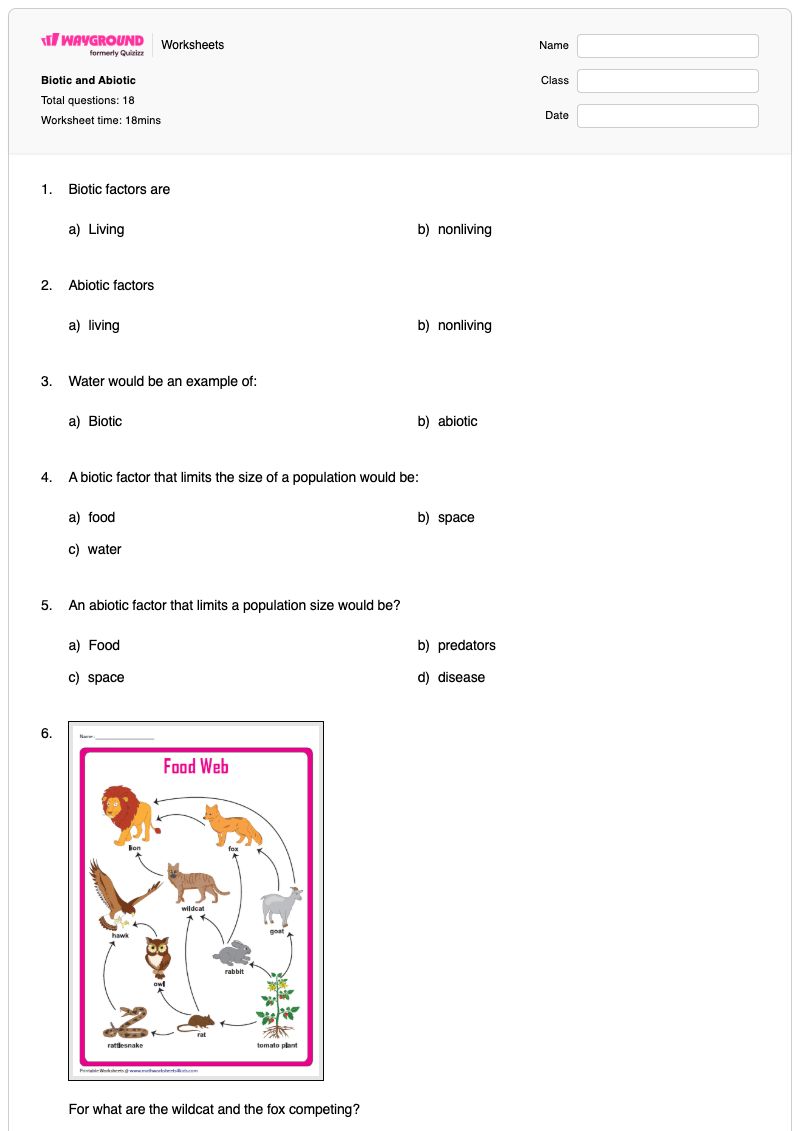
For what are the wildcat and the fox competing?
a)
Goat
b)
rabbit
c)
owl
d)
hawk
7.
All of the organisms of the same species in an area is defined as:
a)
Community
b)
population
c)
limiting factor
d)
carrying capacity
8.
The factors that limit the size of a population are:
a)
Ecos factor
b)
carrying capacity
c)
limiting factor
d)
abiotic number
9.
The amount of sunlight available for plants would be a:
a)
Limiting factor
b)
abiotic number
c)
carrying capacity
d)
population
10.
Choose all the organisms that rely on grains as a food source.
a)
Rabbits
b)
Mice
c)
grasshopper
d)
birds
e)
owls
11.
Choose all the abiotic factors listed
a)
water
b)
mates
c)
space
d)
temperature
e)
predators
12.
Do the owl and the bird compete for resources?
a)
Yes, for the grasshopper
b)
Yes for the mice
c)
No they do not compete
13.
Choose all the biotic factors listed
a)
sunlight
b)
food
c)
predators
d)
disease
e)
water
14.
Which color of grasshopper has a population that is decreasing?
a)
Green
b)
Brown
15.
The carrying capacity is defined as:
a)
The factors that limit the size of a population
b)
The total number of organisms that an area can support
c)
All of the same species living in one area
16.
A dead squirrel is an abiotic factor because it is not living anymore.
a)
True
b)
False
17.
What abiotic factor would plants compete for?
a)
Food
b)
Sunlight
c)
Parasites
d)
predators
18.
What does the Bacteria use as a food source?
a)
small mammals
b)
grasses, brush, cacti
c)
Dead plants, dead animals
d)
small frogs, worms, insects
Answer Key
Biotic and Abiotic
Total questions: 18
1.
a)
Living
2.
b)
nonliving
3.
b)
abiotic
4.
a)
food
5.
c)
space
6.
b)
rabbit
7.
b)
population
8.
c)
limiting factor
9.
a)
Limiting factor
10.
b)
Mice
, c)
grasshopper
, d)
birds
11.
d)
temperature
, c)
space
, a)
water
12.
a)
Yes, for the grasshopper
13.
d)
disease
, c)
predators
, b)
food
14.
a)
Green
15.
b)
The total number of organisms that an area can support
16.
b)
False
17.
b)
Sunlight
18.
c)
Dead plants, dead animals
140 %
Browse by subjects
Browse by grades
Browse by format
FAQs
What does the Biotic and Abiotic worksheet cover?
This Grade 8 science worksheet uses 15 multiple-choice and 3 multiple-select questions to assess biotic and abiotic factors, limiting factors, populations, competition, and carrying capacity. Students classify examples such as water, sunlight, food, predators, disease, space, and temperature, then apply those classifications to resource-use and population scenarios.
How can I use this worksheet to teach biotic and abiotic factors?
Introduce the distinction by having students sort the worksheet’s examples into living and nonliving categories before they begin the questions. As students work, ask them to explain why food, predators, and disease are biotic factors, while water, space, and temperature are abiotic factors, then connect those examples to competition and carrying capacity.
What mistakes should I watch for when students complete this worksheet?
Students may confuse a resource’s source with its category—for example, classifying water or sunlight as biotic because organisms need them. Watch also for students selecting only one option on the multiple-select items, confusing a population with a community, or treating every factor that affects population size as carrying capacity rather than a limiting factor.
How do I assign and grade the Biotic and Abiotic worksheet?
The worksheet is available as a printable PDF and as a digital quiz on Wayground, and it includes a complete answer key for all 18 questions. You can grade printable submissions by scanning student work with the Wayground for Teachers app, while the digital quiz can be assigned through the platform for online completion.
How can I differentiate this worksheet for my students?
In the worksheet’s Advanced Settings, adjust font spacing and font size to make the biotic-versus-abiotic classifications and multiple-select choices easier to read. You can also enable a dyslexia-friendly font or translate the worksheet into another language while keeping its ecosystem vocabulary and question format.
Where can I find more worksheets like this on Wayground?
Wayground offers a comprehensive collection of free printable worksheets and practice problems across all subjects, with downloadable PDFs and answer keys to support essential skills and concepts. Browse more resources at https://wayground.com/en-us/worksheets.