

Wayground
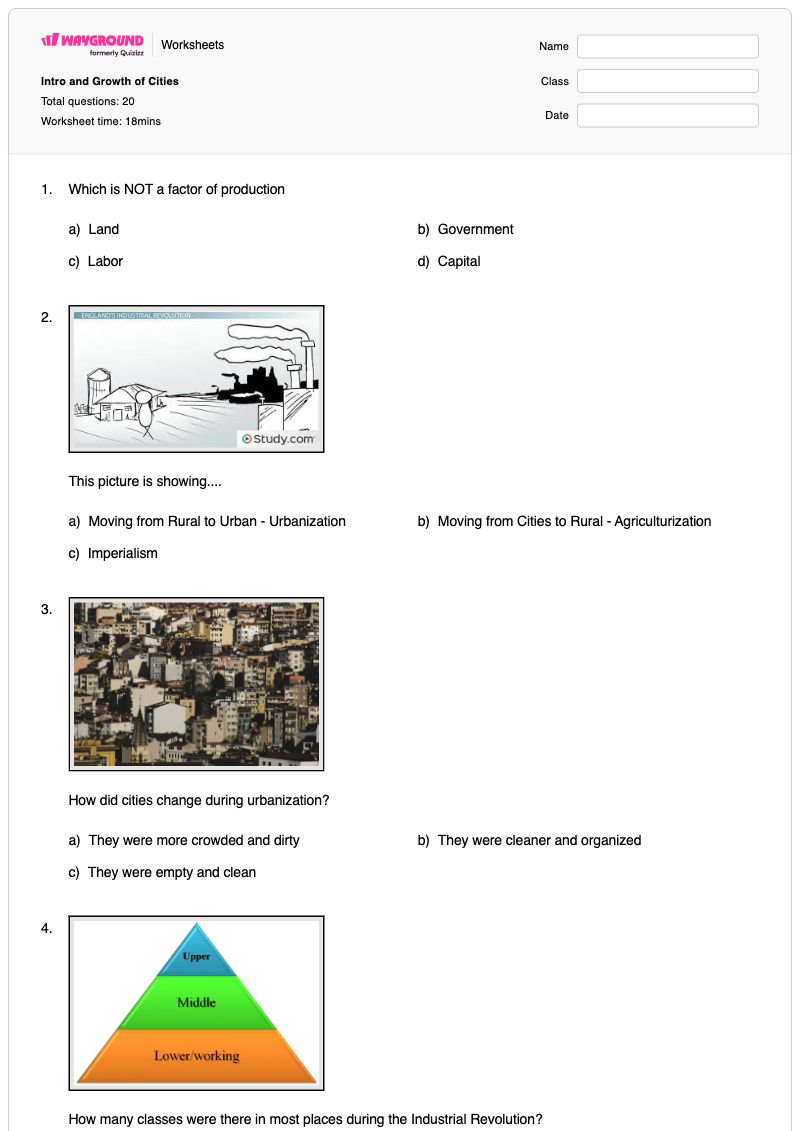
Intro and Growth of Cities - Printable Social studies Worksheets grade 10 - Wayground

Intro and Growth of Cities

James Millholland

Created by James Millholland

20 questions

10th Grade

Social studies

Updated Oct 2026

This Grade 10 Social Studies worksheet examines the introduction and growth of cities during the Industrial Revolution. Students identify urbanization, explain why people moved from rural areas to cities for factory work, recognize how cities became more crowded and unsanitary, and connect industrialization with changes in production, working conditions, social classes, and life expectancy. It also introduces related terms such as rural, enclosure, and the factors of production: land, labor, capital, and entrepreneurship. The 20-question set uses varied formats, including multiple choice, matching, open-ended response, drag-and-drop, fill-in-the-blank, and multiple select. Students define vocabulary, interpret a historical description of Manchester, sequence the shift from hand production to machine production, match production factors, and describe Industrial Revolution working conditions. This free printable worksheet includes a complete answer key and supports Grade 10 review, independent practice, or a social studies assessment.

Worksheet settings

Font size

S
M
L
XL
WaygroundWorksheets

Intro and Growth of Cities

Total questions: 20

Name
Class
Date
1.

Which is NOT a factor of production

a)

Land

b)

Government

c)

Labor

d)

Capital

2.
This picture is showing....

This picture is showing....

a)

Moving from Rural to Urban - Urbanization

b)

Moving from Cities to Rural - Agriculturization

c)

Imperialism

3.
How did cities change during urbanization?

How did cities change during urbanization?

a)

They were more crowded and dirty

b)

They were cleaner and organized

c)

They were empty and clean

4.
How many classes were there in most places during the Industrial Revolution?

How many classes were there in most places during the Industrial Revolution?

a)

2

b)

3

c)

4

d)

5

e)

6

5.

Match the following

Land

Oil, trees, wool

Labor

Random workers

Capital

Money, skilled labor, factories

Entrepreneur

The person that puts the factors together

6.

Describe working conditions during the Industrial Revolution.

4 lines
7.

What is being described: The streets are usually unpaved, full of holes, filthy and strewn with refuse.  Since they have neither gutters nor drains, the refuse accumulates in stagnant, stinking puddles.  The view of Manchester is quite typical.  The main river is narrow, coal-black and full of stinking filth and rubbish which it deposits on its bank ….

a)

A super clean place

b)

A nasty dirty place

c)

A fun place to visit

d)

Disneyland

8.

During the Industrial Revolution products went from being made by ​ (a)   to being made by ​ (b)   .

Choose from the below words
hand
machine
Rivers
Robots
9.

Where were people moving during the industrial revolution?

a)

farms

b)

cities

c)

suburbs

d)

the moon

10.

During the industrial revolution why did life expectancy rise?

a)

more food and better nutrition

b)

crowded working areas

c)

factory life was nice

11.

Which of the following is a common effect of urbanization?

a)

Decreased population density

b)

Increased agricultural production

c)

Growth of cities

d)

Reduction in pollution

12.

Enclosure

a)

fencing-in by landowners of formerly common lands

b)

an industrial system of manufacturing in which workers, raw materials, and machinery are gathered under the same roof

c)

farming

d)

the growth of cities

13.

What caused the growth of cities during the Industrial Revolution?

a)

Growing demand for farmers

b)

Unsanitary conditions

c)

Creation of a new middle class

d)

Need for factory workers

14.

When Europeans starting moving into the cities because of the available work in factories, this period was called (a)  

15.

RURAL means

a)

City

b)

Farmland

c)

Suburb

d)

Beach

16.

Which of the following was a common labor condition during the early Industrial Revolution?

a)

Short working hours

b)

High wages

c)

Safe working environments

d)

Long working hours and unsafe conditions

17.

Child labor, low wages and long work hours, unsafe working conditions, are all...

a)

reasons why people moved to the cities

b)

negative outcomes of the industrial revolution

c)

against the law during the Industrial Revolution

d)

bad conditions that only took place in the meat packing industry

18.
Which of the following is not a factor of production? 
a)
Import 
b)
Land 
c)
Labor 
d)
Capital 
19.

What are the factors of production?

a)

Capital

b)

Entrepreneur

c)

Land

d)

Labor

20.

Land, capital, and labor are all examples of:

a)

Factors of production

b)

Factors of manufacturing

c)

Means of production

d)

Means of manufacturing

WaygroundAnswer Key

Intro and Growth of Cities

Total questions: 20

1.
b)

Government

2.
a)

Moving from Rural to Urban - Urbanization

3.
a)

They were more crowded and dirty

4.
b)

3

5.

Land

 - 

Oil, trees, wool

, 

Labor

 - 

Random workers

, 

Capital

 - 

Money, skilled labor, factories

, 

Entrepreneur

 - 

The person that puts the factors together

6.
n/a
7.
b)

A nasty dirty place

8.
hand, machine
9.
b)

cities

10.
a)

more food and better nutrition

11.
c)

Growth of cities

12.
a)

fencing-in by landowners of formerly common lands

13.
d)

Need for factory workers

14.
urbanization
15.
b)

Farmland

16.
d)

Long working hours and unsafe conditions

17.
b)

negative outcomes of the industrial revolution

18.
a) Import 
19.
d)

Labor

, c)

Land

, b)

Entrepreneur

, a)

Capital

20.
a)

Factors of production

FAQs

What does the “Intro and Growth of Cities” worksheet cover?

This 20-question Grade 10 Social Studies worksheet asks students to explain urbanization and the growth of cities during the Industrial Revolution. Its mixed-format items have students identify rural-to-urban migration, connect factory work to city growth, interpret evidence about Manchester’s unsanitary conditions, describe working conditions, and distinguish land, labor, capital, and entrepreneurship.

How can I use this worksheet to teach urbanization during the Industrial Revolution?

Introduce the lesson by reviewing rural, urbanization, enclosure, and the four factors of production, then have students complete the matching and vocabulary items before the cause-and-effect questions. Use the Manchester excerpt and the open-ended working-conditions prompt to discuss how factory employment drew people to cities while rapid growth created crowding and poor sanitation. Finish by asking students to explain the shift from hand production to machine production using the drag-and-drop item as a check for understanding.

What mistakes should I watch for when students complete this cities and Industrial Revolution worksheet?

Watch for students selecting government as a factor of production instead of recognizing land, labor, capital, and entrepreneurship, or confusing rural with urban. Students may also reverse the direction of migration, choose unsanitary conditions as a cause of city growth rather than the need for factory workers, or place “hand” and “machine” in the wrong order. In the open-ended response, check that students describe working conditions rather than merely naming factories or cities.

How do I assign and grade this Industrial Revolution worksheet?

You can assign “Intro and Growth of Cities” as a printable PDF or as a digital quiz on Wayground. It includes a complete answer key for the multiple-choice, matching, drag-and-drop, fill-in-the-blank, and multiple-select items; review the open-ended response with the same historical criteria used in instruction. For printable submissions, scan student work with the Wayground for Teachers app to streamline grading.

How can I differentiate this urbanization worksheet for my students?

Use the worksheet’s Advanced Settings to adjust font spacing or font size so the 20 mixed-format items are easier to navigate. You can also enable a dyslexia-friendly font for students working through the vocabulary, Manchester source description, and open-ended working-conditions prompt, or translate the worksheet into another language to support comprehension of terms such as urbanization, enclosure, and capital.

Where can I find more worksheets like this on Wayground?

Wayground offers a comprehensive collection of free printable worksheets and practice problems across subjects, with downloadable PDFs and answer keys to support essential skills and concepts. Browse more resources at https://wayground.com/en-us/worksheets.