

Wayground
Boyle's Law and Charles' Law - Printable Science Worksheets 7th - 8th Grade - Wayground

Boyle's Law and Charles' Law

Cassandra Lockward

By Cassandra Lockward

25 questions

7th - 8th Grade

Science

57 plays

Updated Jan 2026

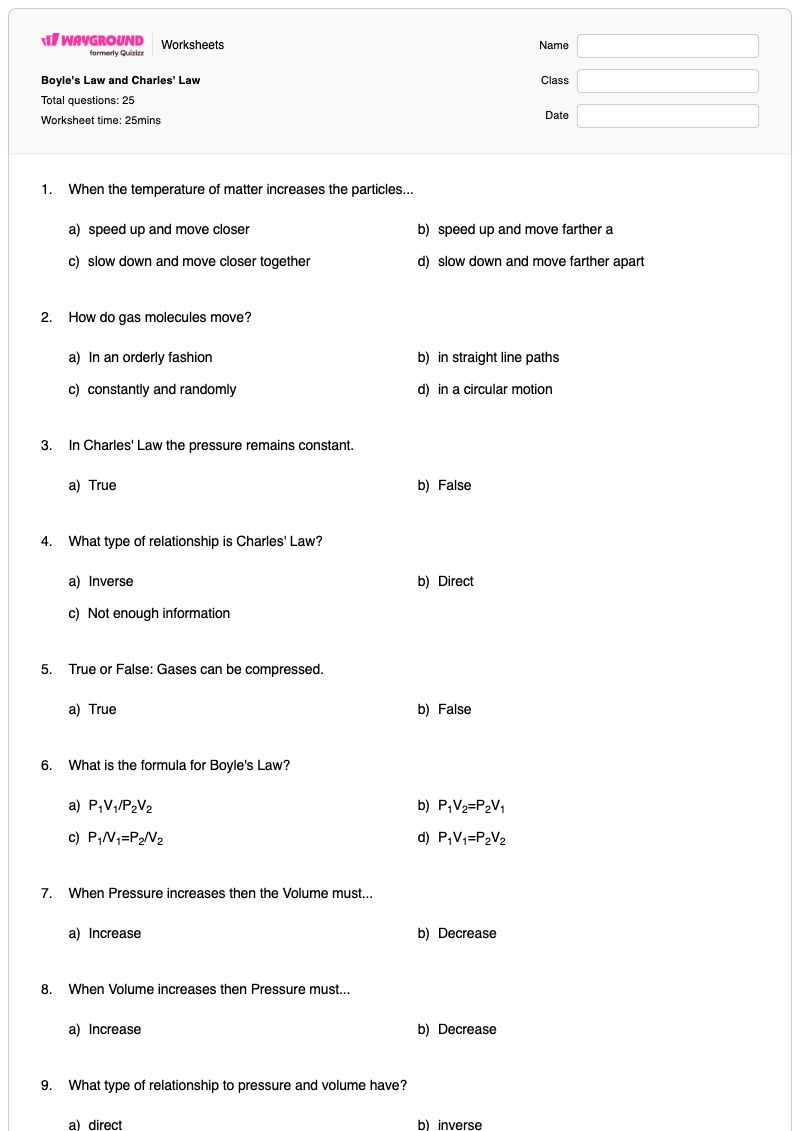
This Grade 7–8 science worksheet uses 25 multiple-choice questions to build understanding of Boyle’s Law and Charles’ Law. Students identify how gas particles move, explain that particle collisions cause pressure, recognize that gases can be compressed, and distinguish the inverse pressure–volume relationship in Boyle’s Law from the direct volume–temperature relationship in Charles’ Law. They also select the correct formulas for both gas laws and identify the variables involved. The worksheet includes questions about constant pressure in Charles’ Law, changing pressure and volume, and identifying an independent variable in an experiment. It gives students repeated practice interpreting relationships, connecting formulas to gas behavior, and applying key vocabulary through selected-response items. This free printable worksheet is designed for Grade 7 and Grade 8 science instruction, review, or assessment and includes a complete answer key.

Worksheet settings

Font size

S
M
L
XL
WaygroundWorksheets

Boyle's Law and Charles' Law

Total questions: 25

Name
Class
Date
1.

When the temperature of matter increases the particles...

a)

speed up and move closer

b)

speed up and move farther a

c)

slow down and move closer together

d)

slow down and move farther apart

2.

How do gas molecules move? 

a)

In an orderly fashion

b)

in straight line paths

c)

constantly and randomly

d)

in a circular motion

3.

In Charles' Law the pressure remains constant.

a)

True

b)

False

4.

What type of relationship is Charles' Law?

a)

Inverse

b)

Direct

c)

Not enough information

5.

True or False: Gases can be compressed. 

a)

True

b)

False

6.

What is the formula for Boyle's Law?

a)

P1V1/P2V2

b)

P1V2=P2V1

c)

P1/V1=P2/V2

d)

P1V1=P2V2

7.

When Pressure increases then the Volume must...

a)

Increase

b)

Decrease

8.

When Volume increases then Pressure must...

a)

Increase

b)

Decrease

9.

What type of relationship to pressure and volume have?

a)

direct

b)

inverse

c)

no relationship

10.

What does Boyle's law relate to?

a)

Temperature and

b)

Volume and Pressure

c)

Temperature and Pressure

d)

Amount and Volume

11.

What causes pressure?

a)

The walls of the container

b)

The vacuum in the container

c)

The collisions of the particles

d)

Atmospheric pressure acting on the outside walls

12.

 The relationship of which two variables are compared in Boyle's Law?

a)

pressure and volume

b)

volume and temperature

c)

temperature and pressure

d)

amount and volume

13.

What is the formula Charles' Law?

a)

V=T

b)

VT=VT

c)

T1 / V1 = T2 / V2

d)

V1 / T1 = V2 / T2

14.

This variable in an experiment is the one being deliberately changed by the scientist. 

a)

dependent variable

b)

independent variable

c)

data

d)

control group

15.

TRUE/ FALSE: Science is a continually ongoing process.

a)

True

b)

False

16.

Gas Laws involve what three factors?

a)

solid, liquid, gas

b)

speed, velocity, acceleration

c)

elements, compunds, mixtures

d)

pressure, temperature, volume

17.

Directly proportional means that as one value increases ...

a)

the other stays the same

b)

the other increases as well

c)

the other decreases

d)

the other goes to zero

18.

Inversely proportional means as one value increases the other...

a)

increases

b)

decreases

c)

stays the same

d)

does to zero

19.

The word inverse means.......

a)

the same

b)

opposite

20.

Temperature describes  the ______________ of particles.

a)

volume

b)

mass

c)

motion

d)

conductivity

21.

If the temperature of a gas increase, the pressure... (volume is constant)

a)

decreases

b)

increases

c)

does not change

22.

If a balloon is cooled what will happen to the volume?

a)

Volume will increase

b)

Volume will decrease

c)

Volume will not change

23.

A student inflates a balloon with helium then places it in the freezer. The student should expect

a)

The balloon's volume to increase

b)

The balloons volume to decrease

24.

If a hairspray can is heated, what can be expected of the pressure of the gas inside the can?

a)

The pressure will increase

b)

The pressure will decrease

c)

The pressure will remain constant

d)

The pressure will equalize

25.
Which container will have lower pressure?
a)
left
b)
right
c)
they both have the same pressure
WaygroundAnswer Key

Boyle's Law and Charles' Law

Total questions: 25

1.
b)

speed up and move farther a

2.
c)

constantly and randomly

3.
a)

True

4.
b)

Direct

5.
a)

True

6.
d)

P1V1=P2V2

7.
b)

Decrease

8.
b)

Decrease

9.
b)

inverse

10.
b)

Volume and Pressure

11.
c)

The collisions of the particles

12.
a)

pressure and volume

13.
d)

V1 / T1 = V2 / T2

14.
b)

independent variable

15.
a)

True

16.
d)

pressure, temperature, volume

17.
b)

the other increases as well

18.
b)

decreases

19.
b)

opposite

20.
c)

motion

21.
b)

increases

22.
b)

Volume will decrease

23.
b)

The balloons volume to decrease

24.
a)

The pressure will increase

25.
a) left

FAQs

What does the Boyle’s Law and Charles’ Law worksheet cover?

This Grade 7–8 science worksheet contains 25 multiple-choice questions about gas behavior and the relationships among pressure, volume, and temperature. Students practice identifying Boyle’s Law as an inverse pressure–volume relationship, Charles’ Law as a direct volume–temperature relationship, and selecting the correct formula for each law.

How can I use this worksheet to teach Boyle’s Law and Charles’ Law?

Introduce gas particles, compression, and particle collisions before assigning the multiple-choice questions. Have students explain why pressure decreases when volume increases for Boyle’s Law, then compare that inverse relationship with Charles’ Law, where pressure remains constant and volume changes directly with temperature. Use the formula questions as a check that students can connect each equation to the correct variables.

What mistakes should I watch for when students complete this gas laws worksheet?

Students may confuse Boyle’s inverse pressure–volume relationship with Charles’ direct volume–temperature relationship, or match a law with the wrong pair of variables. Watch for errors in selecting P₁V₁ = P₂V₂ and V₁/T₁ = V₂/T₂, as well as the misconception that increasing pressure increases volume. Students may also overlook that pressure remains constant in Charles’ Law or attribute pressure to something other than particle collisions.

How do I assign and grade this Boyle’s Law and Charles’ Law worksheet?

Wayground provides this 25-question worksheet as a printable PDF and as a digital quiz, and it includes a complete answer key for grading the multiple-choice responses. For printable submissions, scan student work with the Wayground for Teachers app to streamline grading. The PDF option also supports classrooms that want to reduce screen time.

How can I differentiate this multiple-choice gas laws worksheet for my students?

Use the worksheet’s Advanced Settings to adjust font spacing and font size so the 25 multiple-choice questions are easier to read. You can also enable a dyslexia-friendly font or translate the worksheet into another language while students work with the gas-law vocabulary, relationships, and formulas.

Where can I find more worksheets like this on Wayground?

Wayground offers a comprehensive collection of free printable worksheets and practice problems across subjects, with downloadable PDFs and answer keys to support mastery of essential skills and concepts. Browse more resources at https://wayground.com/en-us/worksheets.