

Wayground
Balancing Chemical Equations - Printable Science Worksheets 7th - 7th Grade - Wayground

Balancing Chemical Equations

Janelle Dominick

By Janelle Dominick

20 questions

7th - 7th Grade

Science

81 plays

Updated Sep 2026

Balancing Chemical Equations is a free printable Grade 7 science worksheet that builds the foundational skills students need to interpret and evaluate chemical equations. Across 20 items—one dropdown, 15 multiple-choice questions, and four drag-and-drop tasks—students apply the Law of Conservation of Mass, identify reactants and products, distinguish coefficients from subscripts, and count atoms in chemical formulas, including formulas with parentheses. Students then use those skills to determine whether chemical equations are balanced and identify which elements are unbalanced. The worksheet supports vocabulary development, accurate atom counting, and evidence-based checking of equations rather than asking students to memorize isolated terms. It is suitable for classroom practice, independent review, or a quick formative assessment, and includes a complete answer key for efficient checking.

Worksheet settings

Font size

S
M
L
XL
WaygroundWorksheets

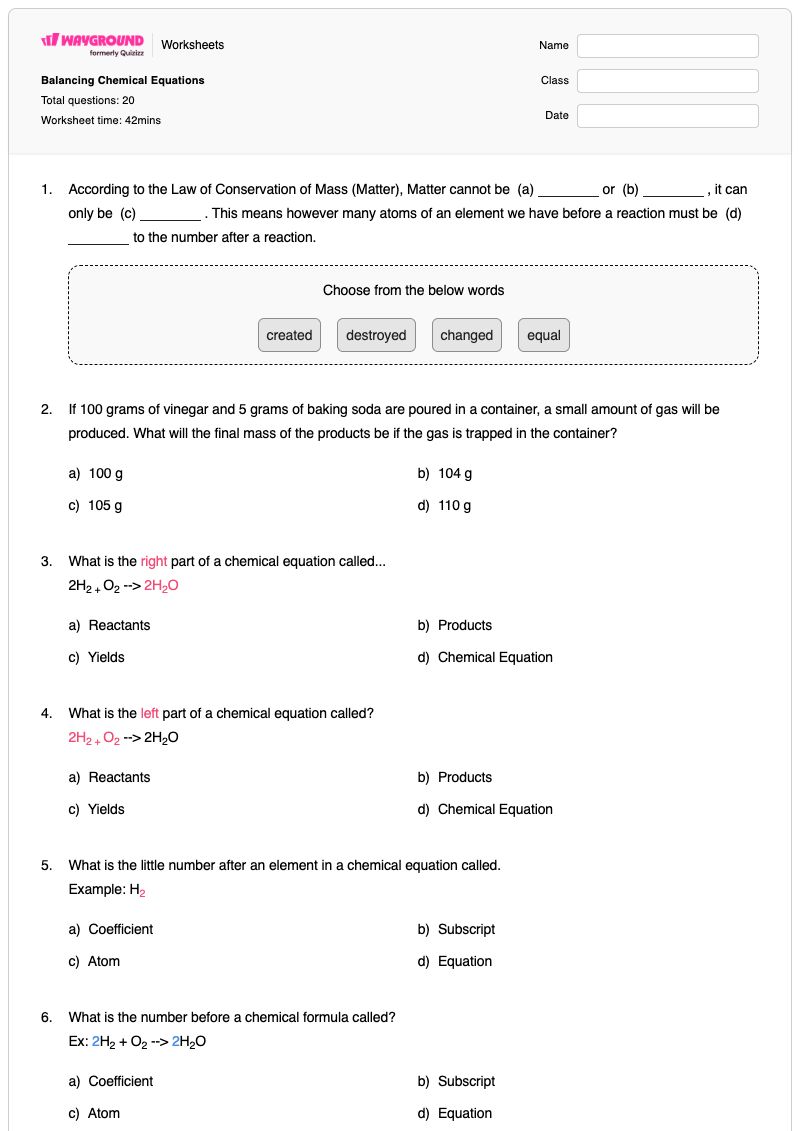
Balancing Chemical Equations

Total questions: 20

Name
Class
Date
1.

According to the Law of Conservation of Mass (Matter), Matter cannot be ​ (a)   or ​ (b)   , it can only be ​ (c)   . This means however many atoms of an element we have before a reaction must be ​ (d)   to the number after a reaction.

Choose from the below words
created
destroyed
changed
equal
2.

If 100 grams of vinegar and 5 grams of baking soda are poured in a container, a small amount of gas will be produced. What will the final mass of the products be if the gas is trapped in the container?

a)

100 g

b)

104 g

c)

105 g

d)

110 g

3.
What is the right part of a chemical equation called...
2H2 + O2 --> 2H2O
a)
Reactants
b)
Products 
c)
Yields 
d)
Chemical Equation 
4.
What is the left part of a chemical equation called?
2H2 + O2 --> 2H2O
a)
Reactants
b)
Products 
c)
Yields 
d)
Chemical Equation 
5.
What is the little number after an element in a chemical equation called.
Example: H2
a)

Coefficient 

b)

Subscript

c)

Atom

d)

Equation

6.
What is the number before a chemical formula called?
Ex: 2H2 + O2 --> 2H2O
a)
Coefficient
b)
Subscript
c)
Atom
d)
Equation
7.

The coefficient in 3H2O is

a)

6

b)

5

c)

2

d)

3

8.

In 3P2O5, there are ​ (a)   phosphorus (P) atoms and ​ (b)   oxygen (O) atoms.

Choose from the below words
6
15
8
3
12
21
9.
How many Oxygens are in this molecule? 
(OH)2
a)
4
b)
1
c)
2
d)
3
10.
How many atoms of carbon (C) are in C6H12O6?
a)
3
b)
6
c)
12
d)
24
11.

What's unbalanced about this equation? 

Al + O2 --> Al2O3

a)

Oxygen (O) only

b)

Aluminum (Al) only

c)

Both oxygen and aluminum

d)

Nothing; it is balanced.

12.

Is the equation balanced?: 2H2O + O2 --> 4MgO + 3Fe

a)

yes

b)

no

13.
Is the following equation balanced?
4Fe + 3O2 --> 2Fe2O3
a)
yes
b)
no
14.
Is this equation balanced?
a)
yes
b)
no
c)
Not enough information
15.
Is the following equation balanced?...
Al + O2 --> 2Al2O3
a)
Yes!
b)
No!
16.
Is the following equation balanced?
2C2H2 + 5O2 --> 4CO2 + 2H2O
a)
yes
b)
no
17.

What coefficient should be used to make the following equation balanced?

N2+O2--> __?__NO

a)

1

b)

2

c)

3

d)

4

18.

How many HCl molecules do you need to balance this equation?

2Mg + ​ (a)   HCl ---> 2MgCl2 + 2H2

Choose from the below words
4
1
2
3
19.

Drag and drop the coefficients that balance this equation 2 FeFe   + ​ (a)   Cl2Cl_2  ---->  ​ (b)     FeCl3FeCl_3  

Choose from the below words
3
2
20.

Balance this equation ​ (a)   N2 + ​ (b)   H2 --> ​ (c)   NH3

Choose from the below words
1
3
2
WaygroundAnswer Key

Balancing Chemical Equations

Total questions: 20

1.
created, destroyed, changed, equal
2.
c)

105 g

3.
b) Products 
4.
a) Reactants
5.
b)

Subscript

6.
a) Coefficient
7.
d)

3

8.
6, 15
9.
c) 2
10.
b) 6
11.
c)

Both oxygen and aluminum

12.
b)

no

13.
a) yes
14.
b) no
15.
b) No!
16.
a) yes
17.
b)

2

18.
4
19.
3, 2
20.
1, 3, 2

FAQs

What does this Balancing Chemical Equations worksheet cover?

This Grade 7 science worksheet develops the foundation for balancing chemical equations through a dropdown, multiple-choice questions, and drag-and-drop atom-counting items. Students apply conservation of mass, identify reactants and products, distinguish coefficients from subscripts, count atoms in formulas such as 3P₂O₅ and C₆H₁₂O₆, and decide whether equations are balanced.

How can I use this worksheet to teach students to balance chemical equations?

Introduce the worksheet by modeling how coefficients and subscripts affect atom counts, then connect those counts to the Law of Conservation of Mass. Have students complete the vocabulary and counting items before evaluating the balanced and unbalanced equations, and ask them to explain which element count does not match on an equation they mark as unbalanced. This sequence helps students check both sides systematically before they begin changing coefficients.

What mistakes should I watch for when students complete this worksheet?

Students may confuse a coefficient with a subscript, count only the visible number rather than multiplying a coefficient across a formula, or overlook the effect of parentheses when counting atoms in (OH)₂. They may also check only one element when deciding whether an equation is balanced, or reverse the meanings of reactants and products based on their positions around the arrow.

How do I assign and grade this Balancing Chemical Equations worksheet?

Wayground provides this worksheet as a printable PDF and as a digital quiz, and it includes a complete answer key for all 20 items. You can grade printable submissions by scanning student work with the Wayground for Teachers app, or review responses through the digital quiz.

How can I differentiate this chemical equations worksheet for my students?

In the worksheet’s Advanced Settings, adjust font spacing and font size to make the chemical formulas, atom-counting prompts, and answer choices easier to read. You can also apply a dyslexia-friendly font or translate the worksheet text into another language while retaining the equation symbols and formulas.

Where can I find more worksheets like this on Wayground?

Wayground offers a comprehensive collection of free printable worksheets and practice problems across all subjects, with downloadable PDFs and answer keys to support mastery of essential skills and concepts. Browse more resources at https://wayground.com/en-us/worksheets.