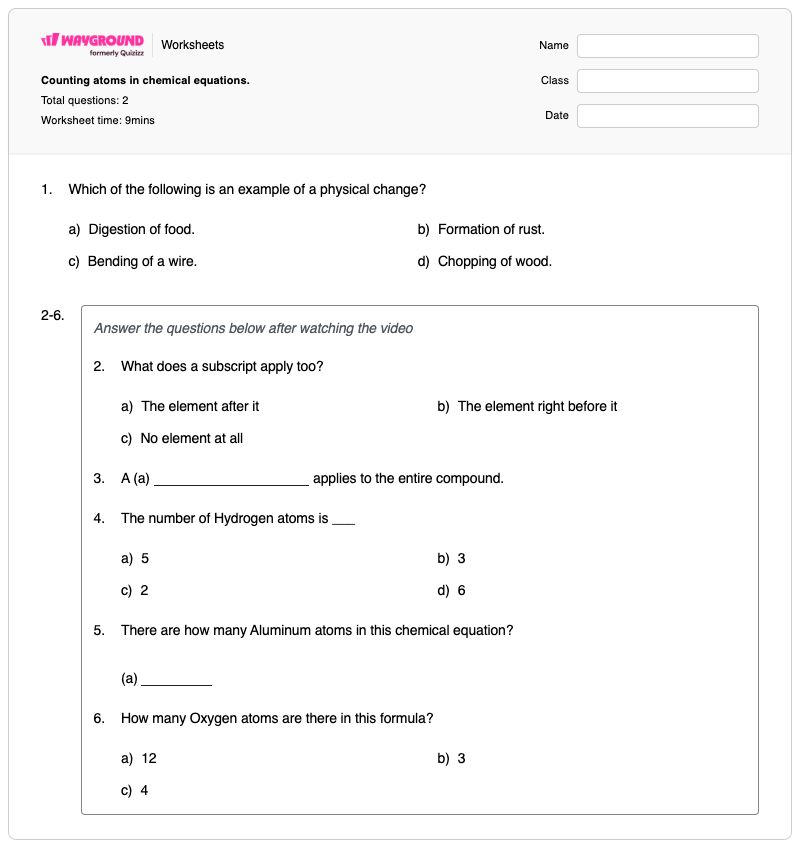
Counting Atoms in Chemical Equations is a Grade 7 science worksheet that builds students’ ability to interpret chemical notation and determine how many atoms appear in a formula or equation. Students identify what a subscript modifies, recognize that a coefficient applies to an entire compound, and calculate the numbers of hydrogen, aluminum, and oxygen atoms shown in the items. The worksheet also includes a multiple-select question about identifying physical changes, giving students a brief opportunity to distinguish physical-change examples from other types of change.
The seven-item set combines multiple-choice, multiple-select, fill-in-the-blank, and comprehension-video questions. It is designed for guided practice, independent review, or a quick check of students’ understanding of subscripts, coefficients, and atom counting. This free printable worksheet includes a complete answer key, making it practical for Grade 7 science instruction and assessment.
Worksheet settings
Font size
S
M
L
XL
Worksheets
Counting atoms in chemical equations.
Total questions: 2
Name
Class
Date
1.
Which of the following is an example of a physical change?
a)
Digestion of food.
b)
Formation of rust.
c)
Bending of a wire.
d)
Chopping of wood.
2-6.
Answer the questions below after watching the video
2.
What does a subscript apply too?
a)
The element after it
b)
The element right before it
c)
No element at all
3.
A (a) applies to the entire compound.
4.
The number of Hydrogen atoms is ___
a)
5
b)
3
c)
2
d)
6
5.
There are how many Aluminum atoms in this chemical equation?
(a)
6.
How many Oxygen atoms are there in this formula?
a)
12
b)
3
c)
4
Answer Key
Counting atoms in chemical equations.
Total questions: 2
1.
c)
Bending of a wire.
, d)
Chopping of wood.
2-6.
2.
b)
The element right before it
3.
Coefficient
4.
d)
6
5.
two
6.
a)
12
140 %
Browse by subjects
Browse by grades
Browse by format
FAQs
What does the Counting Atoms in Chemical Equations worksheet help students practice?
This Grade 7 science worksheet helps students interpret subscripts and coefficients to count atoms in chemical formulas and equations. Its multiple-choice and fill-in-the-blank items ask students to identify what a subscript applies to, recognize that a coefficient applies to the entire compound, and determine the numbers of hydrogen, aluminum, and oxygen atoms.
How can I use this worksheet to teach students to count atoms in chemical equations?
First model how to read the number immediately before a compound and the subscript attached to an element, then work through one atom-counting example aloud. Use the worksheet’s questions about subscripts and coefficients as guided practice before students complete the hydrogen, aluminum, and oxygen counting items independently. Discuss why changing the part of the formula a number applies to changes the final atom count.
What mistakes should I watch for when students complete this atom-counting worksheet?
Students may apply a subscript to the element after it instead of the element immediately before it, or treat a coefficient as applying to only one element rather than the entire compound. They may also skip a subscript when counting hydrogen, aluminum, or oxygen atoms, or select only one example in the multiple-select physical-change question when two choices are required.
How do I assign and grade the Counting Atoms in Chemical Equations worksheet?
You can assign this worksheet as a printable PDF or as a digital quiz on Wayground. It includes a complete answer key for the multiple-select, multiple-choice, fill-in-the-blank, and comprehension-video items, and printable submissions can be graded by scanning student work with the Wayground for Teachers app.
How can I differentiate this worksheet for my students?
In the worksheet’s Advanced Settings, adjust font spacing or font size to make the atom-counting questions and answer choices easier to read. You can also use a dyslexia-friendly font or translate the worksheet into another language when those options better support access to the subscripts, coefficients, and fill-in-the-blank prompts.
Where can I find more free worksheets like this on Wayground?
Wayground offers a broad collection of free printable worksheets and practice problems across subjects, with downloadable PDFs and answer keys to support essential skills and concepts. Browse more resources at https://wayground.com/en-us/worksheets.


 Worksheets