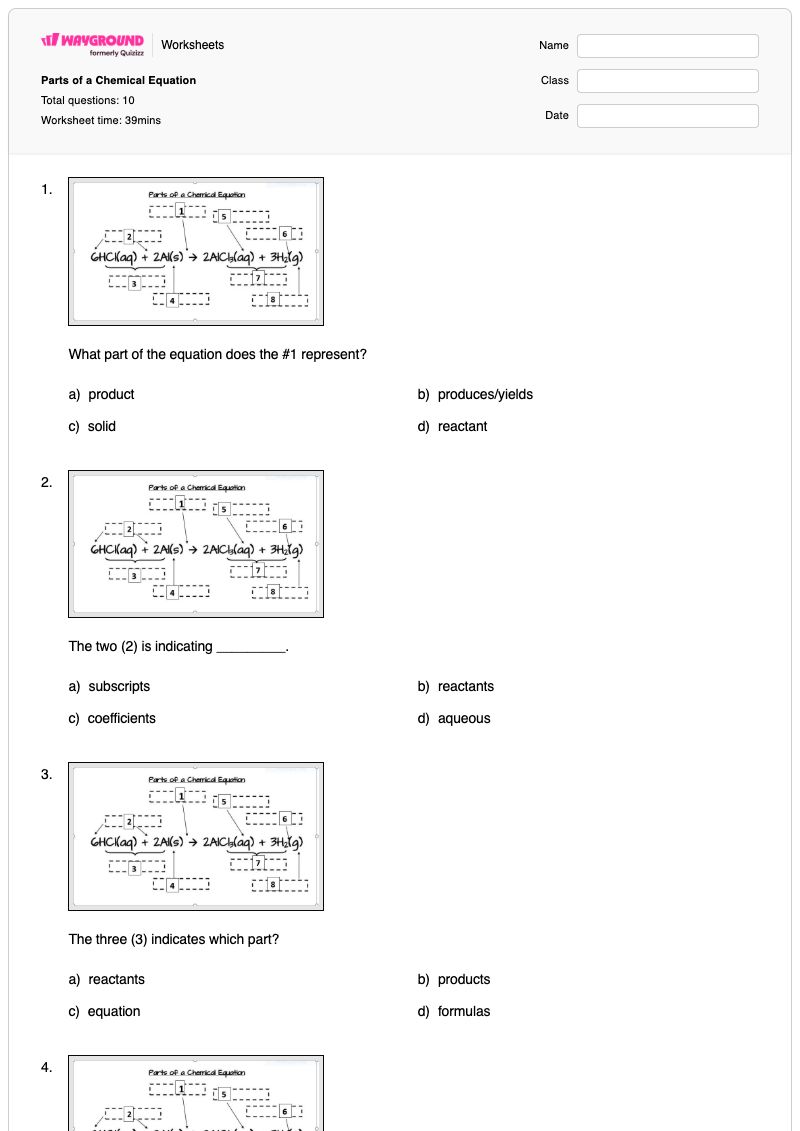
Parts of a Chemical Equation is a free printable Grade 8 science worksheet that helps students identify the roles of labeled elements in chemical equations. Through eight multiple-choice questions, students distinguish the yields symbol, coefficients, reactants, products, and phase labels for solids, aqueous substances, and gases. The numbered equation features make each term’s function explicit and support accurate interpretation of chemical notation.
Two multiple-select questions extend the practice to balancing equations. Students determine whether an equation is balanced and identify a product-side element count, including sodium or oxygen, that supports the unbalanced conclusion. This combination of terminology recognition and evidence-based checking helps teachers assess whether students can read equation structure and compare reactant and product information. The worksheet includes a complete answer key and is available as a free printable resource for Grade 8 science instruction, guided practice, or review.
Worksheet settings
Font size
S
M
L
XL
Worksheets
Parts of a Chemical Equation
Total questions: 10
Name
Class
Date
1.
What part of the equation does the #1 represent?
a)
product
b)
produces/yields
c)
solid
d)
reactant
2.
The two (2) is indicating _________.
a)
subscripts
b)
reactants
c)
coefficients
d)
aqueous
3.
The three (3) indicates which part?
a)
reactants
b)
products
c)
equation
d)
formulas
4.
The number four (4) represents which part of the equation?
a)
aqueous
b)
gas
c)
liquid
d)
solid
5.
Number five (5) is indicating ____ of the equation.
a)
solid
b)
liquid
c)
gas
d)
aqueous
6.
Number six (6) is indicating ____ of the equation.
a)
solid
b)
liquid
c)
gas
d)
aqueous
7.
Number seven (7) is indicating ____ of the equation.
a)
reactants
b)
products
c)
equation
d)
formulas
8.
Number eight (8) is indicating ____ of the equation.
a)
solid
b)
liquid
c)
gas
d)
aqueous
9.
Is the equation balance?
a)
Yes, Balanced
b)
No, Unbalanced
c)
Reactant Na = 2
d)
Product Na = 2
10.
Is this equation balanced?
a)
Yes, balanced.
b)
No, unbalanced
c)
Reactant O = 2
d)
Product O = 2
Answer Key
Parts of a Chemical Equation
Total questions: 10
1.
b)
produces/yields
2.
c)
coefficients
3.
a)
reactants
4.
d)
solid
5.
d)
aqueous
6.
c)
gas
7.
b)
products
8.
c)
gas
9.
b)
No, Unbalanced
, d)
Product Na = 2
10.
b)
No, unbalanced
, d)
Product O = 2
140 %
Browse by subjects
Browse by grades
Browse by format
FAQs
What does the Parts of a Chemical Equation worksheet cover?
This Grade 8 science worksheet uses eight labeled multiple-choice items to assess whether students can identify chemical equation parts, including the yields symbol, coefficients, reactants, products, and phase labels for solid, aqueous, and gas substances. Two multiple-select items then require students to decide whether an equation is balanced and identify a product-side element count that supports the answer.
How can I use this worksheet to teach the parts of a chemical equation?
Introduce a labeled chemical equation before assigning the worksheet, and have students explain what each numbered location represents: the yields symbol, coefficient, reactant, product, or phase label. After reviewing those items, model how to compare an element count on the reactant side with the product side before students complete the two multiple-select balancing questions. Ask students to justify why the selected product count shows that an equation is unbalanced.
What mistakes should I watch for on this chemical equation worksheet?
Students may confuse the yields symbol with a reactant or product, mistake coefficients for another part of the equation, or mix up reactants and products based on their position. They may also confuse the solid, aqueous, and gas labels. In the balancing items, watch for students who select only “unbalanced” without selecting the product-side count that provides the evidence, or who compare only one side of the equation.
How do I assign and grade this chemical equation worksheet?
Wayground provides this worksheet as a printable PDF and as a digital quiz, with a complete answer key for all eight multiple-choice and two multiple-select questions. Printable submissions can be graded by scanning student work with the Wayground for Teachers app, while the digital version can be assigned through Wayground for online completion and grading.
How does this worksheet build students’ ability to evaluate balanced equations?
The final two multiple-select questions move beyond naming equation parts by asking students to determine whether each equation is balanced and select the relevant product-side element count. This format reinforces that students must use count-based evidence, such as the product sodium or oxygen count provided in the choices, rather than rely on a guess about the equation’s status.
Where can I find more free worksheets like this on Wayground?
Wayground offers a broad collection of free printable worksheets and practice problems across subjects, with downloadable PDFs and answer keys to support mastery of essential skills and concepts. Browse more resources at https://wayground.com/en-us/worksheets.


 Worksheets


