Chemistry: Classification of Matter is a Grade 10 worksheet with 20 multiple-choice questions that builds students’ ability to classify matter and identify related chemical concepts. Students distinguish matter from nonmatter, use particle views and chemical formulas to identify elements, compounds, pure substances, and mixtures, and classify mixtures as homogeneous or heterogeneous. The worksheet also asks students to recognize physical properties, chemical changes, and visual representations of samples.
This free printable worksheet gives students focused practice interpreting both symbolic and visual evidence rather than relying only on definitions. Questions involving formulas such as H₂SO₄ and CO₂ with H₂S reinforce the difference between a single compound and a mixture of compounds, while examples such as silver, burning wood, milk, and a Caesar salad connect classification to observable situations. An answer key is included for efficient review, independent practice, or assessment.
Worksheet settings
Font size
S
M
L
XL
Worksheets
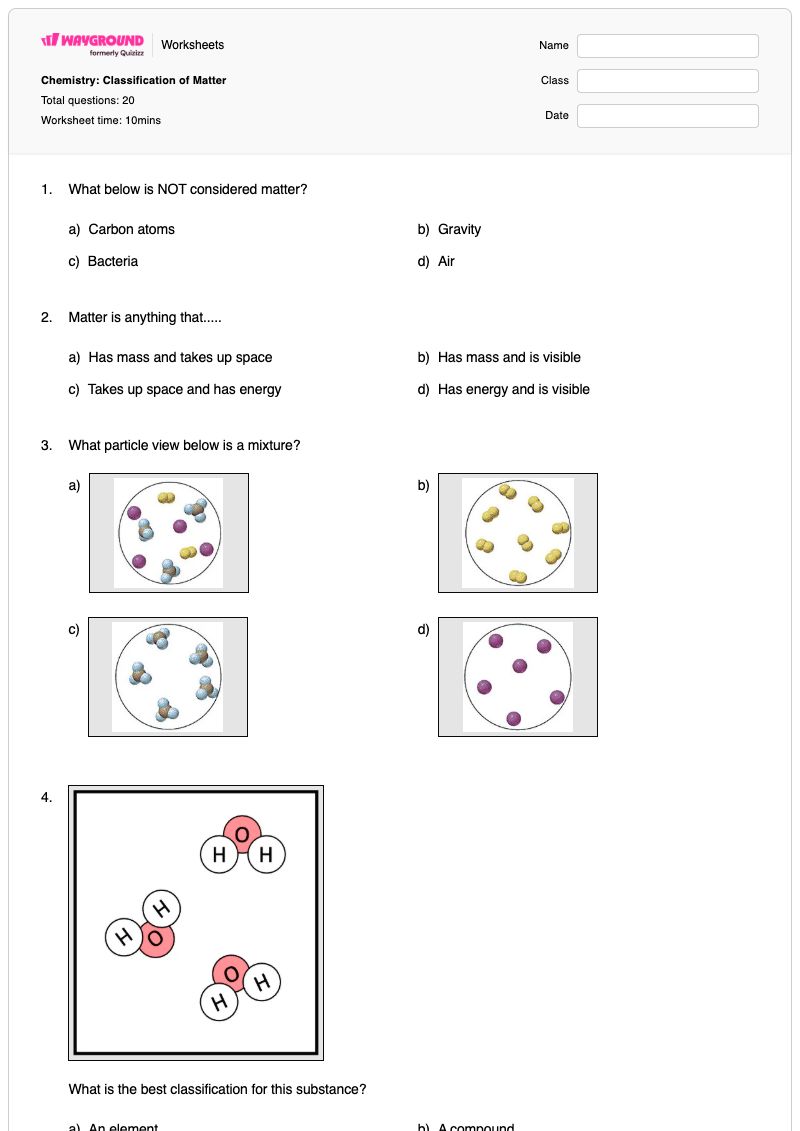
Chemistry: Classification of Matter
Total questions: 20
Name
Class
Date
1.
What below is NOT considered matter?
a)
Carbon atoms
b)
Gravity
c)
Bacteria
d)
Air
2.
Matter is anything that.....
a)
Has mass and takes up space
b)
Has mass and is visible
c)
Takes up space and has energy
d)
Has energy and is visible
3.
What particle view below is a mixture?
a)
b)
c)
d)
4.
What is the best classification for this substance?
a)
An element
b)
A compound
c)
A mixture
5.
Is this a pure substance?
a)
Yes
b)
No
6.
What is the best classification of this substance?
a)
An element
b)
A compound
c)
A mixture of 2 elements
d)
A mixture of 2 compounds
7.
What is the best classification of this substance? H2SO4
a)
An element
b)
A compound
c)
A mixture
8.
What is the best classification of this substance? CO2 & H2S
a)
An element
b)
A compound
c)
A mixture of 2 compounds
d)
A mixture of many elements
9.
How would you name this sample? T = triangle, Sq = square, C = circle.
a)
T + Sq + C
b)
TC + Sq
c)
TC4 + Sq3
d)
TCSq
10.
What is an example of a physical property?
a)
Silver is shiny
b)
Alcohols are flammable
c)
Alkali metals are reactive with water
d)
Acids are sometimes corrosive
11.
What is an example of a chemical change?
a)
Tearing paper
b)
Dissolving salt in water
c)
Melting ice
d)
Burning wood
12.
Does this particle view show an element or a compound?
a)
element
b)
compound
13.
Is this image showing a homogeneous or a heterogeneous mixture? Image: Cesar salad
a)
homogeneous
b)
heterogeneous
14.
Is this image showing a homogeneous or a heterogeneous mixture? Image: Milk
a)
homogeneous
b)
heterogeneous
15.
Does this image represent a chemical or a physical change?
a)
Chemical change
b)
Physical change
16.
Does this image represent a chemical or physical change?
a)
Chemical change
b)
Physical change
17.
Which below shows a CHEMICAL change?
a)
b)
c)
18.
How many different TYPES of ATOMS are in this image?
a)
1
b)
2
c)
3
d)
4
19.
How many TOTAL MOLECULES are in this image?
a)
4
b)
5
c)
15
d)
2
20.
How many different TYPES of MOLECULES are in this image?
a)
1
b)
2
c)
4
d)
5
Answer Key
Chemistry: Classification of Matter
Total questions: 20
1.
b)
Gravity
2.
a)
Has mass and takes up space
3.
a)
4.
b)
A compound
5.
a)
Yes
6.
c)
A mixture of 2 elements
7.
b)
A compound
8.
c)
A mixture of 2 compounds
9.
b)
TC + Sq
10.
a)
Silver is shiny
11.
d)
Burning wood
12.
a)
element
13.
b)
heterogeneous
14.
a)
homogeneous
15.
a)
Chemical change
16.
b)
Physical change
17.
a)
18.
b)
2
19.
b)
5
20.
a)
1
140 %
Browse by subjects
Browse by grades
Browse by format
FAQs
What does the Chemistry: Classification of Matter worksheet cover?
This Grade 10 chemistry worksheet uses 20 multiple-choice questions to practice classifying samples as elements, compounds, pure substances, or mixtures. Students interpret particle views, chemical formulas such as H₂SO₄ and CO₂ with H₂S, and images such as milk and a Caesar salad, then identify physical properties and distinguish physical from chemical changes.
How can I use this worksheet to teach classification of matter?
Introduce the classification hierarchy—matter versus nonmatter, then pure substances versus mixtures—before asking students to justify answers from particle views and formulas. Have students explain why H₂SO₄ represents one compound while CO₂ and H₂S together represent a mixture of two compounds, then use the milk and Caesar salad items to connect homogeneous and heterogeneous mixtures to familiar samples.
What mistakes should I watch for when students complete this worksheet?
Students may treat anything visible or energetic as matter instead of applying the definition that matter has mass and takes up space. Watch for confusion between an element and a compound in particle diagrams, between one compound and a mixture of compounds in formulas, and between a physical change such as melting ice and a chemical change such as burning wood.
How do I assign and grade this Chemistry: Classification of Matter worksheet?
Wayground provides this worksheet as a printable PDF and as a digital quiz, and it includes a complete answer key for all 20 multiple-choice questions. You can grade printed student work by scanning it with the Wayground for Teachers app, or review responses through the digital quiz.
How can I differentiate this classification of matter worksheet for my students?
In the worksheet’s Advanced Settings, adjust font spacing and font size to make the multiple-choice questions, chemical formulas, and particle-view prompts easier to read. You can also apply a dyslexia-friendly font or translate the worksheet into another language while keeping the classification and physical-versus-chemical-change practice intact.
Where can I find more worksheets like this on Wayground?
Wayground offers a broad collection of free printable worksheets and practice problems across subjects, with downloadable PDFs and answer keys to support essential skills and concepts. Browse more resources at https://wayground.com/en-us/worksheets.

 Worksheets


