
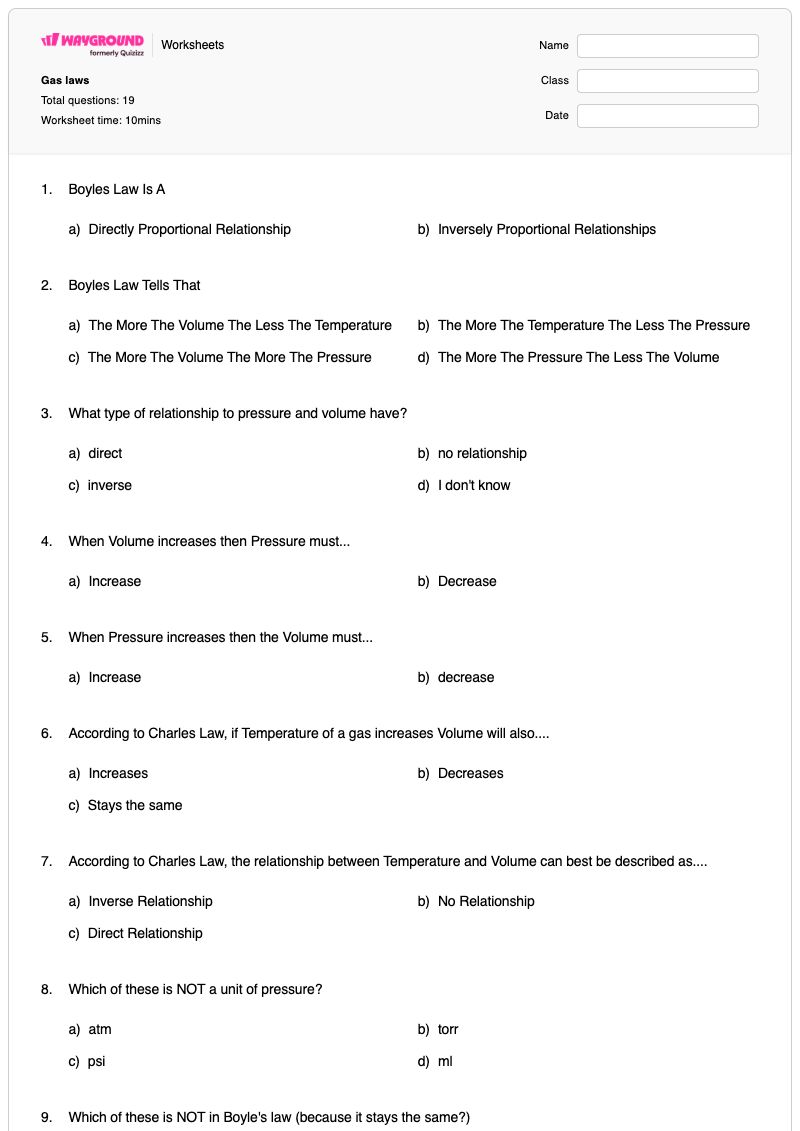

This Grade 8 science worksheet helps students distinguish the relationships described by Boyle’s Law and Charles’ Law. Students identify inverse relationships between pressure and volume, direct relationships between temperature and volume, and the variable that remains constant in each law. They also recognize pressure units, interpret how paired variables change, and select the appropriate gas law for a temperature-and-volume scenario.
The worksheet contains 19 questions: 17 multiple-choice items and 2 multiple-select items. The questions ask students to identify laws, classify direct and inverse proportions, determine how pressure, volume, and temperature change, and choose two correct descriptions of each relationship. This free printable worksheet includes a complete answer key and is designed for Grade 8 science instruction, guided practice, review, or an independent check of students’ understanding of foundational gas-law relationships.
Worksheet settings
Font size
S
M
L
XL
Worksheets
Gas laws
Total questions: 19
Name
Class
Date
1.
Boyles Law Is A
a)
Directly Proportional Relationship
b)
Inversely Proportional Relationships
2.
Boyles Law Tells That
a)
The More The Volume The Less The Temperature
b)
The More The Temperature The Less The Pressure
c)
The More The Volume The More The Pressure
d)
The More The Pressure The Less The Volume
3.
What type of relationship to pressure and volume have?
a)
direct
b)
no relationship
c)
inverse
d)
I don't know
4.
When Volume increases then Pressure must...
a)
Increase
b)
Decrease
5.
When Pressure increases then the Volume must...
a)
Increase
b)
decrease
6.
According to Charles Law, if Temperature of a gas increases Volume will also....
a)
Increases
b)
Decreases
c)
Stays the same
7.
According to Charles Law, the relationship between Temperature and Volume can best be described as....
a)
Inverse Relationship
b)
No Relationship
c)
Direct Relationship
8.
Which of these is NOT a unit of pressure?
a)
atm
b)
torr
c)
psi
d)
ml
9.
Which of these is NOT in Boyle's law (because it stays the same?)
a)
Pressure
b)
Volume
c)
Temp
10.
Which of these is NOT in CHARLES's law (because it stays the same?)
a)
Pressure
b)
Volume
c)
Temp
11.
One goes up, one goes down is which of the following: PICK TWO
a)
Inverse proportion
b)
Charles' Law
c)
Direct Proportion
d)
Boyles' Law
12.
BOTH goes up, BOTH goes down is which of the following: PICK TWO
a)
Inverse proportion
b)
Charles' Law
c)
Direct Proportion
d)
Boyles' Law
13.
Which gas law would you use to solve the following:
At 27.00 °C a gas has a volume of 6.00 L. What will the volume be at 150.0 °C?
a)
Boyles
b)
Charles
c)
Lussacs
d)
Combined
14.
Charles' Law States...
a)
As Pressure goes up volume goes down
b)
As Pressure goes up temperature goes up
c)
As Volume goes up temperature goes up
d)
As Pressure goes down volume goes down
15.
Which law?
a)
Charles
b)
Boyle
c)
Hooke
d)
Peter Pan
16.
Which law?
a)
Charles
b)
Boyle
c)
Diegel
d)
Mitchell
17.
A balloon will pop in the atmosphere because..
a)
Pressure goes down volume goes up
b)
Pressure goes up volume goes down
c)
temperature goes down volume goes up
d)
volume goes down temperature goes down
18.
a)
This is an example of Charles's law
b)
This is an example of Boyle's law
19.
a)
this is a graph representing Boyle's law
b)
this is a graph representing Charles's law
Answer Key
Gas laws
Total questions: 19
1.
b)
Inversely Proportional Relationships
2.
d)
The More The Pressure The Less The Volume
3.
c)
inverse
4.
b)
Decrease
5.
b)
decrease
6.
a)
Increases
7.
c)
Direct Relationship
8.
d)
ml
9.
c)
Temp
10.
a)
Pressure
11.
a)
Inverse proportion
, d)
Boyles' Law
12.
b)
Charles' Law
, c)
Direct Proportion
13.
b)
Charles
14.
c) As Volume goes up temperature goes up
15.
a) Charles
16.
a)
Charles
17.
a) Pressure goes down volume goes up
18.
a) This is an example of Charles's law
19.
a) this is a graph representing Boyle's law
140 %
Browse by subjects
Browse by grades
Browse by format
FAQs
What does this gas laws worksheet cover?
This Grade 8 science worksheet focuses on identifying Boyle’s Law as an inverse pressure–volume relationship and Charles’ Law as a direct temperature–volume relationship. Its 17 multiple-choice and 2 multiple-select questions also ask students to identify constant variables, recognize pressure units, interpret whether paired variables rise or fall together, and select the correct law for a temperature-and-volume situation.
How can I use this worksheet to teach Boyle’s Law and Charles’ Law?
Introduce the worksheet by having students compare the variable pairs: pressure and volume for Boyle’s Law, then temperature and volume for Charles’ Law. As students complete the multiple-choice items, ask them to explain why one relationship is inverse or direct and use the multiple-select questions to reinforce that Boyle’s Law describes one variable rising while the other falls, whereas Charles’ Law describes both changing in the same direction.
What mistakes should I watch for when students complete this gas laws worksheet?
Watch for students reversing Boyle’s Law and Charles’ Law, especially when deciding whether pressure and volume have a direct or inverse relationship. Students may also select the wrong variable as constant, treat milliliters as a pressure unit, choose only one answer on the two multiple-select items, or identify the wrong law for the temperature-and-volume scenario.
How do I assign and grade this gas laws worksheet?
You can assign this gas laws worksheet as a printable PDF or as a digital quiz on Wayground. It includes a complete answer key, and printable submissions can be graded by scanning student work with the Wayground for Teachers app. The printable format can also support instruction in settings that are reducing screen time.
How can I differentiate this gas laws worksheet for my students?
Use the worksheet’s Advanced Settings to adjust font spacing or choose a larger font size so the gas-law statements and answer choices are easier to read. You can also apply a dyslexia-friendly font or translate the worksheet into another language while keeping the Boyle’s Law, Charles’ Law, and direct-versus-inverse relationship questions in the same format.
Where can I find more worksheets like this on Wayground?
Wayground offers a broad collection of free printable worksheets and practice problems across subjects, with downloadable PDFs and answer keys to support mastery of essential skills and concepts. Browse more resources at https://wayground.com/en-us/worksheets.