This Grade 3 mathematics worksheet gives students focused practice with the commutative, associative, and distributive properties of multiplication. Across 12 items—10 multiple-choice questions, one multiple-select question, and one fill-in-the-blank question—students identify properties, rewrite multiplication equations, break apart products using the distributive property, and use arrays to connect visual models with equations. Several items also ask students to complete multiplication and division fact families.
The worksheet helps students explain why factors can be reordered or regrouped, decompose products into easier parts, and connect multiplication facts with related division facts. It is suitable for guided instruction, independent practice, or a quick skills check after introducing multiplication properties. This free printable worksheet includes a complete answer key for efficient review and grading.
Worksheet settings
Font size
S
M
L
XL
Worksheets
Multiplication Properties
Total questions: 12
Name
Class
Date
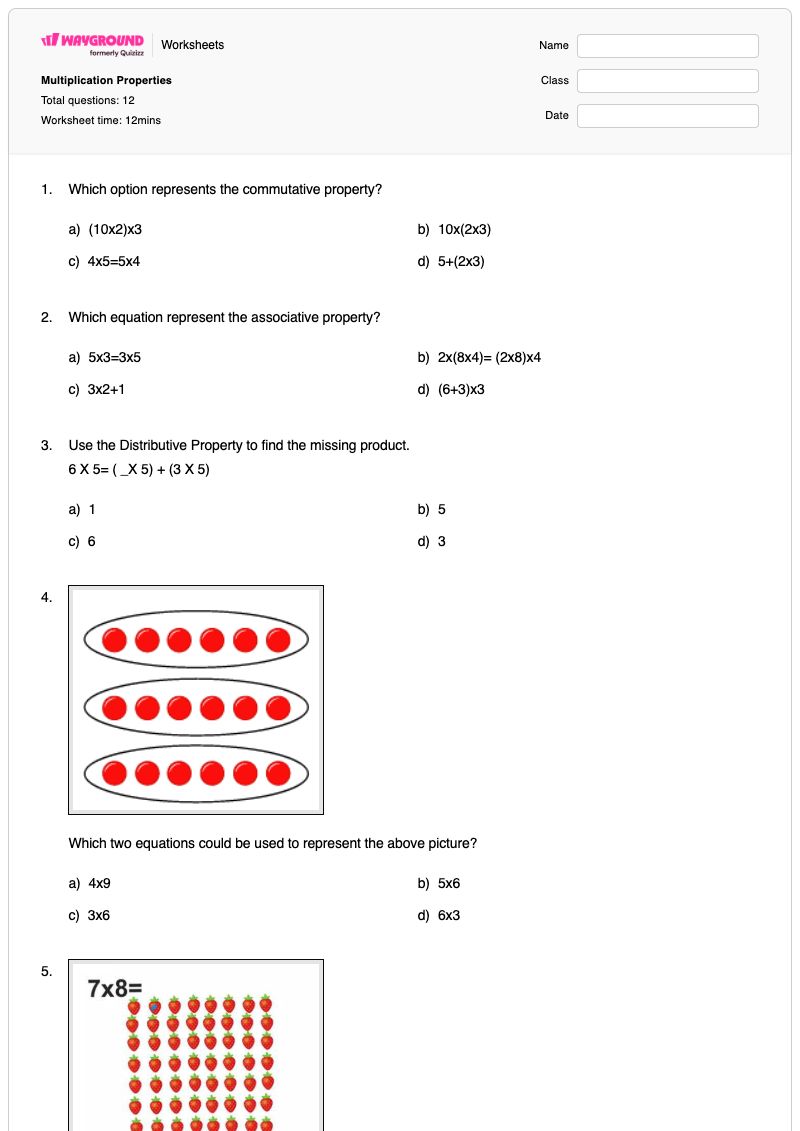
1.
Which option represents the commutative property?
a)
(10x2)x3
b)
10x(2x3)
c)
4x5=5x4
d)
5+(2x3)
2.
Which equation represent the associative property?
a)
5x3=3x5
b)
2x(8x4)= (2x8)x4
c)
3x2+1
d)
(6+3)x3
3.
Use the Distributive Property to find the missing product.
6 X 5= ( _X 5) + (3 X 5)
a)
1
b)
5
c)
6
d)
3
4.
Which two equations could be used to represent the above picture?
a)
4x9
b)
5x6
c)
3x6
d)
6x3
5.
Use the distributive property to break the array apart.
a)
(7x4)+(7x4)
b)
7+4)+(7+4)
c)
(7x4)+(7x3)
6.
Which factor completes the fact family?
2x___=14
__x2=14
14÷2=7
14÷7=2
a)
7
b)
5
c)
3
d)
2
7.
Use the Distributive Property to find the Missing Factor.
8X6= (5X6) + ( _ X 6)
a)
5
b)
3
c)
4
d)
2
8.
Use the associative property to solve. 2x3x5
(a)
9.
Which factor completes the fact family?
7x6=42
6x7=42
42/7=___
42/___=7
a)
7
b)
42
c)
6
d)
8
10.
Which property does this multiplication problem represent? 2x5=10 is the same as 5x2=10
a)
Associative Property
b)
Commutative Property
c)
Distributive Property
d)
Identity Property
11.
Which property does this represent? 3x(9x1)=(3x9)x1
a)
Commutative Property
b)
Identity Property
c)
Associative Property
d)
Distributive Property
12.
Which problem shows the distributive property of 3x18=
a)
(3x10)+(3x8)
b)
(3x10)x(4x8)
c)
(3+10)+(3+8)
Answer Key
Multiplication Properties
Total questions: 12
1.
c)
4x5=5x4
2.
b)
2x(8x4)= (2x8)x4
3.
d)
3
4.
d)
6x3
, c)
3x6
5.
a)
(7x4)+(7x4)
6.
a)
7
7.
b)
3
8.
30
9.
c)
6
10.
b)
Commutative Property
11.
c)
Associative Property
12.
a)
(3x10)+(3x8)
140 %
Browse by subjects
Browse by grades
Browse by format
FAQs
What does the Multiplication Properties worksheet cover?
This Grade 3 worksheet builds fluency with the commutative, associative, and distributive properties of multiplication through 12 mixed-format questions. Students identify properties in equations, complete distributive-property decompositions such as 6 × 5 = (3 × 5) + (3 × 5), interpret an array, solve a regrouped product, and complete related multiplication-division fact families.
How can I use this worksheet to teach multiplication properties?
Introduce one property at a time with an equation or array, then have students explain what changes and what stays equivalent. Use the worksheet’s distributive-property items to model breaking an array or product into parts, and pause at the associative-property question to have students regroup 2 × 3 × 5 before calculating. Finish with the fact-family items so students connect multiplication-property reasoning with inverse division facts.
What mistakes should I watch for on this multiplication properties worksheet?
Students may confuse commutative order changes, such as 4 × 5 and 5 × 4, with associative regrouping, such as 2 × (8 × 4) and (2 × 8) × 4. In the distributive items, check that they split a factor without changing the total product and preserve the other factor, rather than adding factors or multiplying the decomposed parts incorrectly. In the fact-family questions, students may reverse the missing divisor and quotient, so ask them to verify all four related equations.
How do I assign and grade the Multiplication Properties worksheet?
The worksheet is available as a printable PDF and as a digital quiz on Wayground, and it includes a complete answer key. For printable submissions, teachers can scan student work with the Wayground for Teachers app to support faster grading. The printable format can also help schools reduce screen time when appropriate.
How can I differentiate this multiplication properties worksheet for my students?
Use the worksheet’s Advanced Settings to adjust font spacing and font size so the equations, answer choices, and array-based multiple-select item are easier to read. You can also enable a dyslexia-friendly font or translate the worksheet into another language when that better supports access to the multiplication-property directions and fact-family questions.
Where can I find more free worksheets like this on Wayground?
Wayground offers a broad collection of free printable worksheets and practice problems across subjects, with downloadable PDFs and answer keys to help students build essential skills and concepts. Browse more resources at https://wayground.com/en-us/worksheets.


 Worksheets
