

Wayground
crime scene evaluation - Printable Science Worksheets 11th - 12th Grade - Wayground

crime scene evaluation

Thomas Edwards

Created by Thomas Edwards

10 questions

11th - 12th Grade

Science

Updated Oct 2026

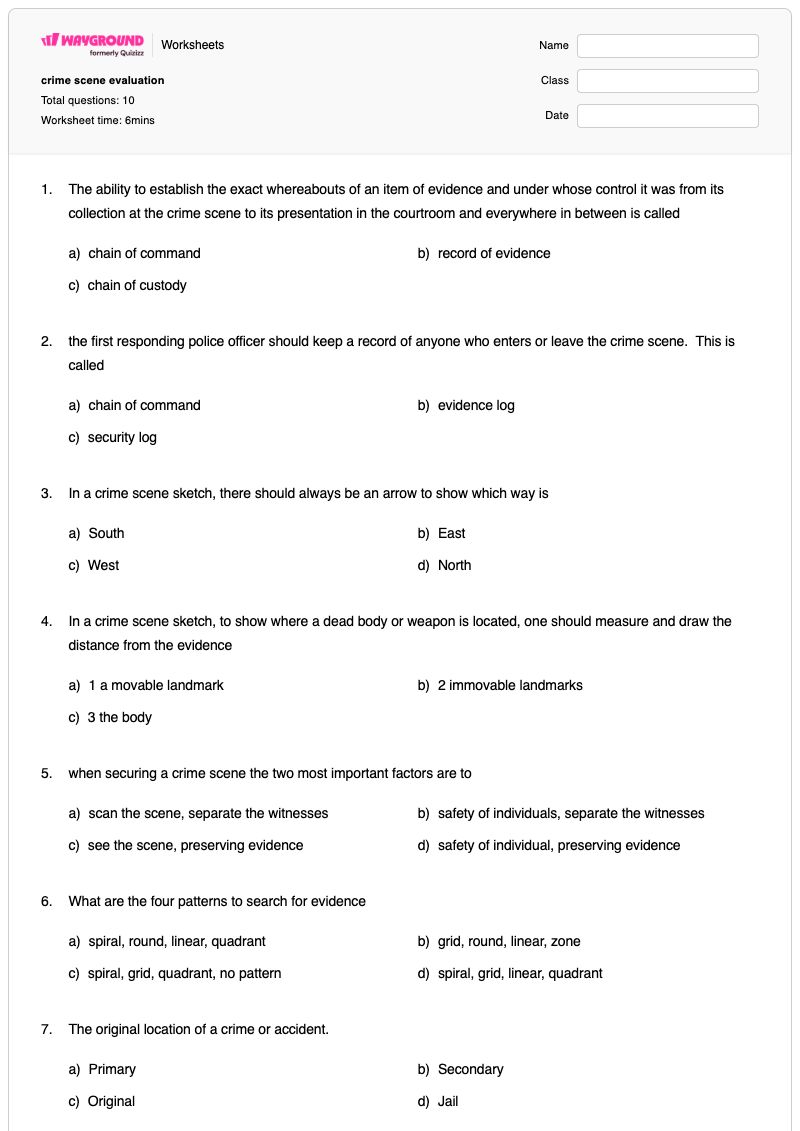
Crime Scene Evaluation is a free printable worksheet for Grades 11–12 in Other Sciences that builds foundational forensic investigation knowledge through 10 multiple-choice questions. Students identify procedures and terminology used to secure and document a scene, including chain of custody, security logs, evidence preservation, crime scene sketches, north indicators, and measurements from immovable landmarks. The worksheet also checks students’ understanding of evidence-search patterns—spiral, grid, linear, and quadrant—and the distinctions among crime scenes, primary crime scenes, and secondary crime scenes. A final item applies Locard’s Principle to the transfer of trace evidence. The worksheet includes a complete answer key, making it useful for review, independent practice, or assessment of crime scene evaluation concepts.

Worksheet settings

Font size

S
M
L
XL
WaygroundWorksheets

crime scene evaluation

Total questions: 10

Name
Class
Date
1.
The ability to establish the exact whereabouts of an item of evidence and under whose control it was from its collection at the crime scene to its presentation in the courtroom and everywhere in between is called
a)
chain of command
b)
record of evidence
c)
chain of custody
2.
the first responding police officer should keep a record of anyone who enters or leave the crime scene.  This is called
a)
chain of command
b)
evidence log
c)
security log
3.
In a crime scene sketch, there should always be an arrow to show which way is
a)
South
b)
East
c)
West
d)
North
4.
In a crime scene sketch, to show where a dead body or weapon is located, one should measure and draw the distance from the evidence
a)
1 a movable landmark
b)
2 immovable landmarks
c)
3 the body
5.
when securing a crime scene the two most important factors are to
a)
scan the scene, separate the witnesses
b)
safety of individuals, separate the witnesses
c)
see the scene, preserving evidence
d)
safety of individual, preserving evidence
6.
What are the four patterns to search for evidence
a)
spiral, round, linear, quadrant
b)
grid, round, linear, zone
c)
spiral, grid, quadrant, no pattern
d)
spiral, grid, linear, quadrant
7.
The original location of a crime or accident. 
a)
Primary
b)
Secondary 
c)
Original 
d)
Jail
8.
An alternate location where additional evidence has been found.
a)
Secondary crime scene
b)
Primary crime scene
c)
Physical location 
d)
Suspected location 
9.
Any physical location in which a crime has occurred or is suspected of having occurred. 
a)
Crime Scene
b)
Primary Location 
c)
Secondary Location 
d)
Alibi 
10.
Define the "Locard's Principle."
a)
the scientific examination of evidence in a criminal investigation
b)
states that criminals always take a trace of something with them or leave a trace of something behind at the scene of the crime
c)
a type of evidence
d)
the person who runs the Locard School
WaygroundAnswer Key

crime scene evaluation

Total questions: 10

1.
c) chain of custody
2.
c) security log
3.
d) North
4.
b) 2 immovable landmarks
5.
d) safety of individual, preserving evidence
6.
d) spiral, grid, linear, quadrant
7.
a) Primary
8.
a) Secondary crime scene
9.
a) Crime Scene
10.
b) states that criminals always take a trace of something with them or leave a trace of something behind at the scene of the crime

FAQs

What does the Crime Scene Evaluation worksheet cover?

This Grade 11–12 worksheet uses 10 multiple-choice questions to assess crime scene evaluation skills and terminology. Students distinguish chain of custody from a security log, identify the safety and evidence-preservation priorities, interpret crime scene sketch conventions, recognize four evidence-search patterns, classify primary and secondary crime scenes, and apply Locard’s Principle.

How can I use this worksheet to teach crime scene evaluation?

Introduce the worksheet after modeling how investigators secure, document, and search a scene. Have students explain why a security log, north arrow, and measurements from two immovable landmarks support reliable documentation, then use the multiple-choice items to discuss why each correct procedure matters for preserving evidence and reconstructing events.

What mistakes should I watch for when students complete this worksheet?

Students may confuse chain of custody, which tracks evidence control from collection through court, with a security log, which records who enters or leaves the scene. Watch also for selecting a movable landmark instead of two immovable landmarks in a sketch, omitting the north direction, mixing up primary and secondary crime scenes, or choosing an incomplete evidence-search pattern.

How do I assign and grade this Crime Scene Evaluation worksheet?

You can assign it as a printable PDF or as a digital quiz on Wayground. The worksheet includes a complete answer key, and printable submissions can be graded by scanning student work with the Wayground for Teachers app. The PDF option can also support classrooms that are reducing screen time.

How can I differentiate this worksheet for my students?

Use the worksheet’s Advanced Settings to adjust font spacing or choose a larger font size so the 10 multiple-choice prompts are easier to read. You can also apply a dyslexia-friendly font or translate the crime scene evaluation worksheet into another language while keeping its question format.

Where can I find more worksheets like this on Wayground?

Wayground offers a broad collection of free printable worksheets and practice problems across all subjects, with downloadable PDFs and answer keys to help students master essential skills and concepts. Browse more resources at https://wayground.com/en-us/worksheets.