Missing Sides area/perimeter is a Grade 4 mathematics worksheet that helps students find an unknown side length when they know a shape’s perimeter or area. The 16 items include 5 fill-in-the-blank problems and 11 multiple-choice questions covering perimeter formulas, area and perimeter word problems, missing dimensions, and appropriate measurement units.
Students practise deciding whether to use addition, multiplication, or division to solve for a missing side. Problems include finding a rectangle’s width from its perimeter, finding length from area and width, calculating fencing needed around a rectangle, and identifying which expression does not represent perimeter. This free printable worksheet includes a complete answer key, making it useful for independent practice, homework, review, or a Grade 4 mathematics assessment.
Worksheet settings
Font size
S
M
L
XL
Worksheets
Missing sides area/perimeter
Total questions: 16
Name
Class
Date
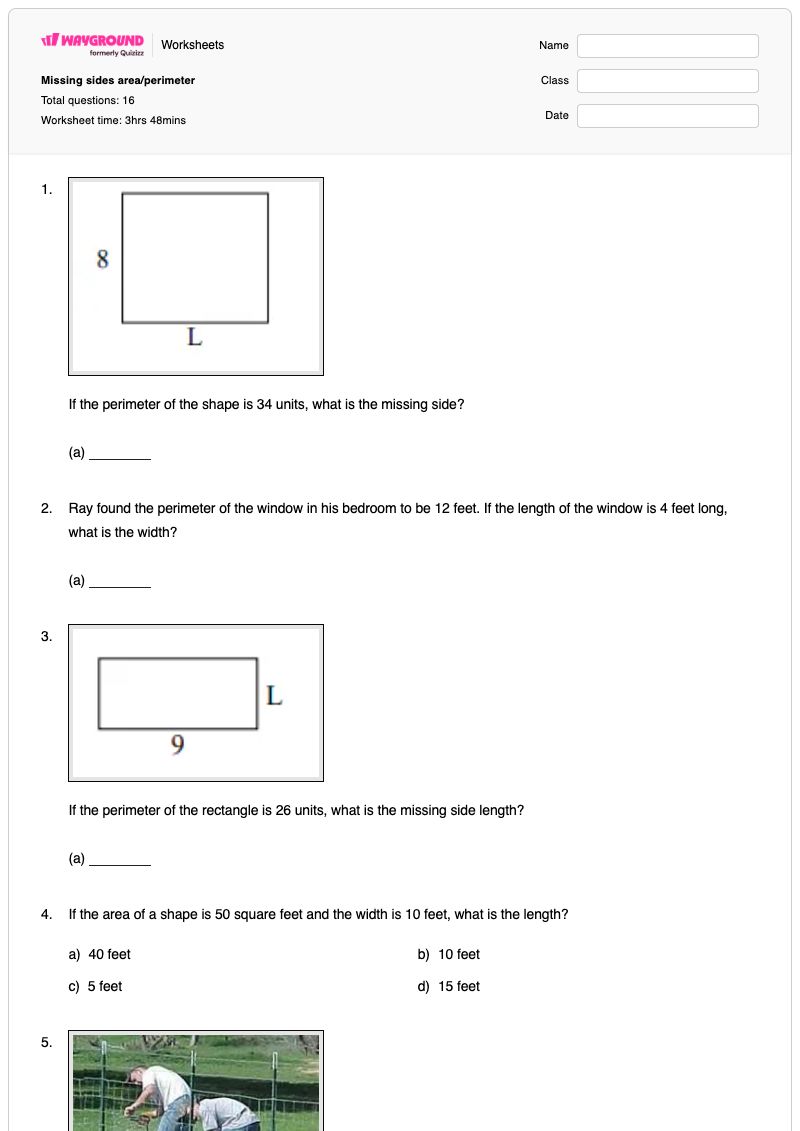
1.
If the perimeter of the shape is 34 units, what is the missing side?
(a)
2.
Ray found the perimeter of the window in his bedroom to be 12 feet. If the length of the window is 4 feet long, what is the width?
(a)
3.
If the perimeter of the rectangle is 26 units, what is the missing side length?
(a)
4.
If the area of a shape is 50 square feet and the width is 10 feet, what is the length?
a)
40 feet
b)
10 feet
c)
5 feet
d)
15 feet
5.
Farmer Bob needs to build a fence for his chickens. The space he wants to build a fence around is 40 feet long and 20 feet wide. How many feet of fence does he need to buy?
a)
800 feet
b)
120 feet
c)
60 feet
d)
80 feet
6.
a)
L= 22
b)
L= 8
c)
L= 7
d)
L = 14
7.
(a)
8.
(a)
9.
Which is NOT a formula to find the Perimeter
a)
P= L + L + W +W
b)
P = L X W
c)
P = 2 x (L+W)
d)
P = (2 x L) + (2 x W)
10.
a)
Area = 16 units
b)
Area = 32 units
c)
Perimeter = 32 Units
d)
Perimeter = 63 units
11.
a)
Area = 13 units
b)
Area = 10 units + 3 Units
c)
Area = 2 x (10 units + 3 units)
d)
Area = 10 units x 3 units
12.
a)
Perimeter = 90 square units
b)
Perimeter = 19 units
c)
Area = 900 square units
d)
Perimeter = 38 units
13.
This is ____
a)
A Giraffe
b)
An Elephant
c)
A Dog
d)
A Ha
14.
A= 36 sq in
P= 26 in
What is one of the sides
a)
12
b)
3
c)
4
d)
8
15.
A= 20 sq ft
P = 18 ft
What is one of the sides?
a)
2 ft
b)
10 ft
c)
4 ft
d)
6
16.
A= 10 sq cm
P = 22 cm
What is one side?
a)
4 cm
b)
5 cm
c)
2 cm
d)
10 cm
Answer Key
Missing sides area/perimeter
Total questions: 16
1.
9
2.
2
3.
4
4.
c)
5 feet
5.
b) 120 feet
6.
c)
L= 7
7.
7
8.
10
9.
b)
P = L X W
10.
c)
Perimeter = 32 Units
11.
d)
Area = 10 units x 3 units
12.
d)
Perimeter = 38 units
13.
a)
A Giraffe
14.
c)
4
15.
c)
4 ft
16.
d)
10 cm
140 %
Browse by subjects
Browse by grades
Browse by format
FAQs
What does the Missing Sides area/perimeter worksheet cover?
This Grade 4 worksheet focuses on finding an unknown side length from a shape’s area or perimeter. Its 16 items combine 5 fill-in-the-blank questions with 11 multiple-choice questions, asking students to apply perimeter formulas, divide area by a known dimension, and solve practical problems such as determining the fencing needed for a rectangular chicken pen.
How can I use this worksheet to teach finding missing sides from area and perimeter?
First review the difference between perimeter as the distance around a shape and area as the space inside it. Model one fill-in-the-blank perimeter problem by subtracting the known side lengths from the total, then model an area problem by dividing the area by the known dimension. Use the multiple-choice formula question and fencing scenario to have students explain why each operation and unit is appropriate.
What mistakes should I watch for when students complete this worksheet?
Students may multiply length and width when a perimeter problem requires addition, or add side lengths when an area problem requires multiplication. They may also forget to subtract all known sides from the perimeter, divide area by the known dimension, or report square units for perimeter and linear units for area. Check their work especially on the fill-in-the-blank problems, where an incorrect operation is less visible than in a multiple-choice item.
How do I assign and grade this area and perimeter worksheet?
On Wayground, this worksheet is available as a printable PDF and as a digital quiz, and it includes a complete answer key for the 5 fill-in-the-blank and 11 multiple-choice items. Printable submissions can be graded by scanning student work with the Wayground for Teachers app. The PDF option can also support schools that are reducing screen time.
How can I differentiate this missing-side worksheet for my students?
Use the worksheet’s Advanced Settings to create an alternate version with more font spacing or a larger font size, which can make the perimeter and area word problems easier to track. You can also enable a dyslexia-friendly font or translate the worksheet into another language when those options support access to the rectangular-area and perimeter questions.
Where can I find more free worksheets like this on Wayground?
Wayground offers a broad collection of free printable worksheets and practice problems across subjects, with downloadable PDFs and answer keys to help students build essential skills and concepts. Browse more resources at https://wayground.com/en-us/worksheets.


 Worksheets


