This free printable Grade 5 mathematics worksheet provides a focused review of the distributive property and related multiplication strategies. Students identify the definition and algebraic forms of the property, distinguish distributive equations from an associative equation, and use distribution to solve 4 × (2 + 3) and 31 × 25 with mental math. The 12-item set includes 9 multiple-choice questions, 2 fill-in-the-blank mnemonic questions, and 1 multiple-select array question.
The worksheet also reinforces PEMDAS, FOIL vocabulary, and recognizing an array for 4 × 3, helping students connect mathematical language, visual representations, and computation. It is designed for Grade 5 instruction, guided practice, review, or a quick formative check after introducing the distributive property. The worksheet is available as a free printable PDF and includes a complete answer key for efficient checking.
Worksheet settings
Font size
S
M
L
XL
Worksheets
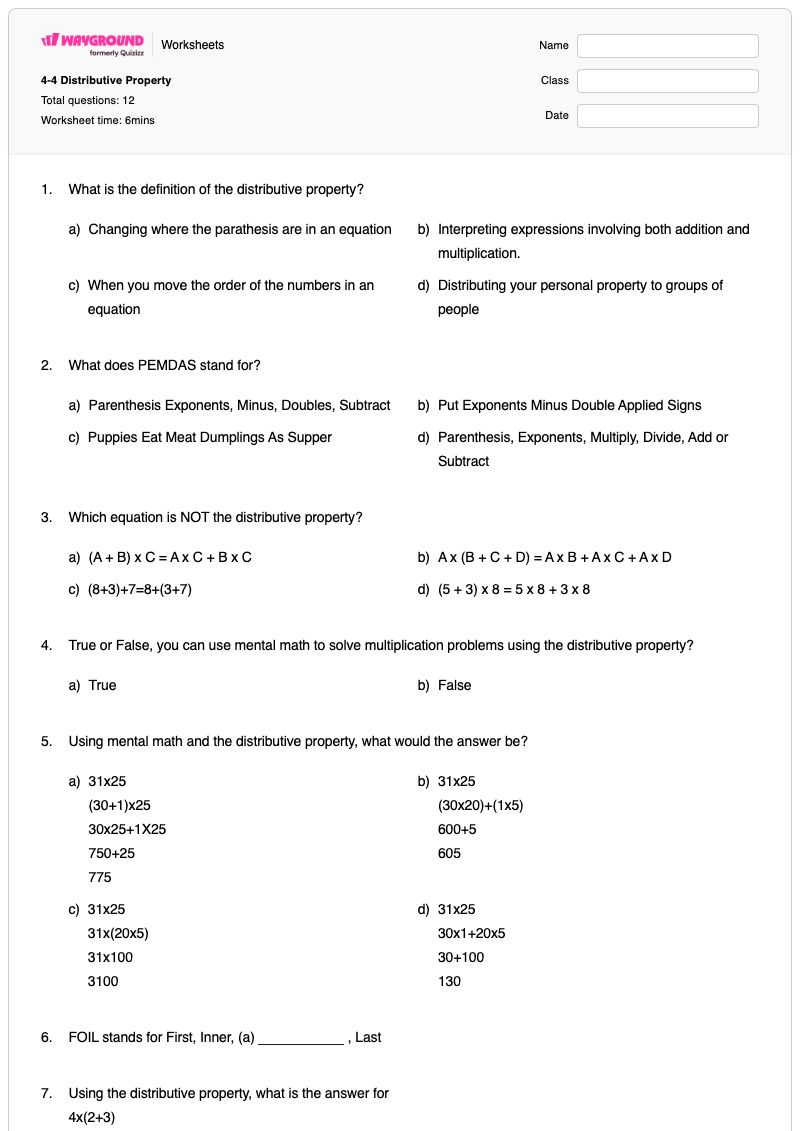
4-4 Distributive Property
Total questions: 12
Name
Class
Date
1.
What is the definition of the distributive property?
a)
Changing where the parathesis are in an equation
b)
Interpreting expressions involving both addition and multiplication.
c)
When you move the order of the numbers in an equation
d)
Distributing your personal property to groups of people
2.
What does PEMDAS stand for?
a)
Parenthesis Exponents, Minus, Doubles, Subtract
b)
Put Exponents Minus Double Applied Signs
c)
Puppies Eat Meat Dumplings As Supper
d)
Parenthesis, Exponents, Multiply, Divide, Add or Subtract
3.
Which equation is NOT the distributive property?
a)
(A + B) x C = A x C + B x C
b)
A x (B + C + D) = A x B + A x C + A x D
c)
(8+3)+7=8+(3+7)
d)
(5 + 3) x 8 = 5 x 8 + 3 x 8
4.
True or False, you can use mental math to solve multiplication problems using the distributive property?
a)
True
b)
False
5.
Using mental math and the distributive property, what would the answer be?
a)
31x25
(30+1)x25
30x25+1X25
750+25
775
b)
31x25
(30x20)+(1x5)
600+5
605
c)
31x25
31x(20x5)
31x100
3100
d)
31x25
30x1+20x5
30+100
130
6.
FOIL stands for First, Inner, (a) , Last
7.
Using the distributive property, what is the answer for
Interpreting expressions involving both addition and multiplication.
2.
d)
Parenthesis, Exponents, Multiply, Divide, Add or Subtract
3.
c)
(8+3)+7=8+(3+7)
4.
a)
True
5.
a)
31x25
(30+1)x25
30x25+1X25
750+25
775
6.
Outer
7.
d)
20
8.
a)
Array
9.
b)
🍪🍪🍪🍪
🍪🍪🍪🍪
🍪🍪🍪🍪
, c)
🍪🍪🍪
🍪🍪🍪
🍪🍪🍪
🍪🍪🍪
10.
Aunt
11.
c)
Abby, Heidi, Brooklyn, Adam, Kaitlyn, Natalie
12.
b)
Christie
140 %
Browse by subjects
Browse by grades
Browse by format
FAQs
What does this worksheet cover, and how does it help students use the distributive property?
This Grade 5 worksheet reviews how the distributive property connects multiplication with addition and asks students to recognize its equation forms, identify a non-example, and apply it to problems such as 4 × (2 + 3) and 31 × 25. Its 9 multiple-choice, 2 fill-in-the-blank, and 1 multiple-select question give students practice moving between definitions, symbolic equations, mental-math steps, mnemonics, and an array representation of 4 × 3.
How can I use this worksheet to teach the distributive property?
Introduce the property with 4 × (2 + 3), showing how the factor is multiplied by both addends before students complete the corresponding worksheet item. Then model the 31 × 25 question by decomposing 31 into 30 + 1 and discussing why both partial products must be added. Use the non-example, PEMDAS, FOIL, and 4 × 3 array questions as short discussion prompts to connect notation, vocabulary, and visual structure.
What mistakes should I watch for when students complete this distributive property worksheet?
Watch for students selecting the associative equation, (8 + 3) + 7 = 8 + (3 + 7), as a distributive example, or distributing a factor to only one addend. In the 31 × 25 item, students may decompose the numbers incorrectly or combine partial products inconsistently; in the multiple-select array item, they may choose a picture that does not show 4 by 3. Students may also confuse the words in the PEMDAS and FOIL mnemonic fill-ins.
How do I assign and grade this worksheet?
You can assign this distributive property worksheet as a printable PDF or as a digital quiz on Wayground, and it includes a complete answer key for the multiple-choice, fill-in-the-blank, and multiple-select items. For printable submissions, scan student work with the Wayground for Teachers app to streamline grading.
How can I differentiate this worksheet for my students?
In the worksheet’s Advanced Settings, adjust font spacing or choose a larger font size to make the distributive-property equations, mnemonic prompts, and array choices easier to read. You can also apply a dyslexia-friendly font or translate the worksheet into another language while keeping its multiple-choice, fill-in-the-blank, and multiple-select format.
Where can I find more worksheets like this on Wayground?
Wayground offers a comprehensive collection of free printable worksheets and practice problems across all subjects, with downloadable PDFs and answer keys to support essential skills and concepts. Browse more resources at https://wayground.com/en-us/worksheets.


 Worksheets