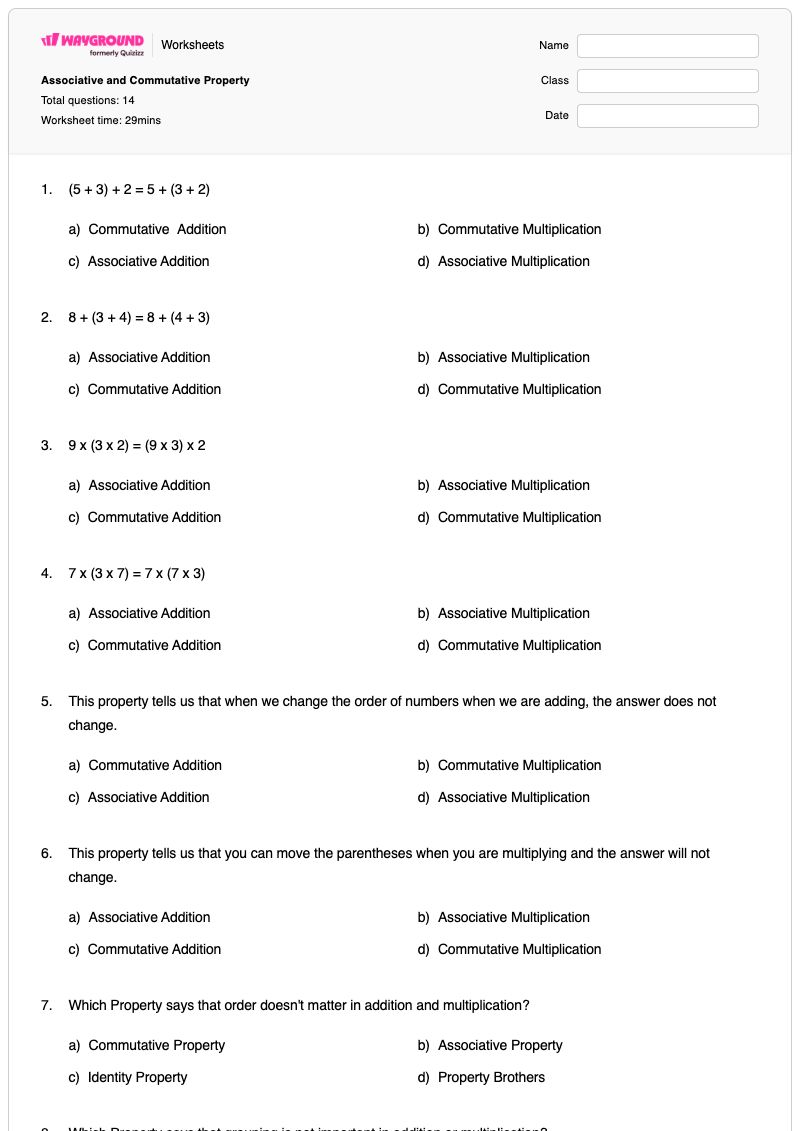
This free printable Grade 8 mathematics worksheet gives students focused practice identifying the associative and commutative properties of addition and multiplication. Across 14 multiple-choice questions, students analyze changes in number order and grouping, match equations and definitions to the correct property, and distinguish these properties from the distributive property.
The worksheet also moves from property recognition to pre-algebra application. Students identify the distributive property and simplify expressions such as 6 + 2(7x - 3), -2x - 4(4x - 8), and expressions involving subtraction and negative terms. This progression helps teachers check whether students can apply multiplication across parentheses, combine like terms, and manage signs accurately. It is suitable for Grade 8 review, guided practice, independent work, or a quick formative assessment, and includes a complete answer key.
Worksheet settings
Font size
S
M
L
XL
Worksheets
Associative and Commutative Property
Total questions: 14
Name
Class
Date
1.
(5 + 3) + 2 = 5 + (3 + 2)
a)
Commutative Addition
b)
Commutative Multiplication
c)
Associative Addition
d)
Associative Multiplication
2.
8 + (3 + 4) = 8 + (4 + 3)
a)
Associative Addition
b)
Associative Multiplication
c)
Commutative Addition
d)
Commutative Multiplication
3.
9 x (3 x 2) = (9 x 3) x 2
a)
Associative Addition
b)
Associative Multiplication
c)
Commutative Addition
d)
Commutative Multiplication
4.
7 x (3 x 7) = 7 x (7 x 3)
a)
Associative Addition
b)
Associative Multiplication
c)
Commutative Addition
d)
Commutative Multiplication
5.
This property tells us that when we change the order of numbers when we are adding, the answer does not change.
a)
Commutative Addition
b)
Commutative Multiplication
c)
Associative Addition
d)
Associative Multiplication
6.
This property tells us that you can move the parentheses when you are multiplying and the answer will not change.
a)
Associative Addition
b)
Associative Multiplication
c)
Commutative Addition
d)
Commutative Multiplication
7.
Which Property says that order doesn't matter in addition and multiplication?
a)
Commutative Property
b)
Associative Property
c)
Identity Property
d)
Property Brothers
8.
Which Property says that grouping is not important in addition or multiplication?
a)
Distributive Property
b)
Associative Property
c)
Commutative Property
d)
Identity Property
9.
Name the Property 5(3+6) = (5*3) + (5*6)
a)
Distributive Property
b)
Commutative Property of Addition
c)
Commutative Property of Multiplication
d)
Addition Property of Zero
10.
Simplify the expression: 6 + 2(7x - 3)
a)
12 + 7x
b)
14x
c)
14x + 3
d)
9 + 7x
11.
Simplify -2x - 4(4x - 8)
a)
-16x - 2
b)
-18x + 32
c)
18x - 32
d)
-16x + 2
12.
Simplify the following expression: x + 4 - 7(x - 5)
a)
-33x + 19
b)
-47x2 + 21
c)
33x - 19
d)
-6x + 39
13.
Simplify: 3x - (x - 6) - 12
a)
2x - 6
b)
4x - 18
c)
2x + 6
d)
4x - 6
14.
Simplify the following expression:
-6x + 4(x - 3)
a)
-2x - 12
b)
10x + 12
c)
-10x - 12
d)
-2x + 12
Answer Key
Associative and Commutative Property
Total questions: 14
1.
c) Associative Addition
2.
c) Commutative Addition
3.
b) Associative Multiplication
4.
d) Commutative Multiplication
5.
a) Commutative Addition
6.
b) Associative Multiplication
7.
a)
Commutative Property
8.
b)
Associative Property
9.
a) Distributive Property
10.
b) 14x
11.
b) -18x + 32
12.
d) -6x + 39
13.
a) 2x - 6
14.
a)
-2x - 12
140 %
Browse by subjects
Browse by grades
Browse by format
FAQs
What does this worksheet cover, and how does it help students learn these algebra skills?
This Grade 8 pre-algebra worksheet uses 14 multiple-choice questions to help students distinguish associative addition and multiplication from commutative addition and multiplication by analyzing equations, grouping, and order. It then connects property recognition to identifying the distributive property and simplifying linear expressions with parentheses, like terms, and positive or negative coefficients. The format lets teachers assess both vocabulary and the accurate application of these properties.
How can I use this worksheet to teach associative and commutative properties?
Introduce the worksheet by having students compare each equation’s order of factors or addends with its grouping, then ask them to explain what changed and what stayed the same. Use the definition-based items to build precise language before students work through the equation-identification questions. After reviewing the distributive-property item, model one final expression step by step so students connect the property names to simplifying algebraic expressions.
What mistakes should I watch for when students complete this worksheet?
Students may confuse commutative property, which changes the order of numbers, with associative property, which changes their grouping or parentheses. In the simplifying items, watch for errors when distributing a negative sign or coefficient, such as changing the signs inside 3x - (x - 6), and for failing to combine like terms after expanding. Some students may also select a property based only on seeing parentheses without checking whether the operation is addition or multiplication.
How do I assign and grade this worksheet?
This worksheet is available as a printable PDF and as a digital quiz on Wayground, so you can assign the 14 multiple-choice questions in the format that fits your lesson. It includes a complete answer key for checking property classifications and simplified expressions. Printable submissions can also be graded by scanning student work with the Wayground for Teachers app.
What algebra skills do the final questions on this worksheet assess?
The final questions assess whether students can use the distributive property to expand expressions and then combine like terms correctly. They include expressions with positive coefficients, subtraction before parentheses, and negative terms, such as -6x + 4(x - 3). These items reveal whether students can preserve signs while moving from a factored expression to a simplified linear expression.
Where can I find more worksheets like this on Wayground?
Wayground offers a broad collection of free printable worksheets and practice problems across all subjects, with downloadable PDFs and answer keys to support essential skill development. Teachers can browse more resources at https://wayground.com/en-us/worksheets.


 Worksheets