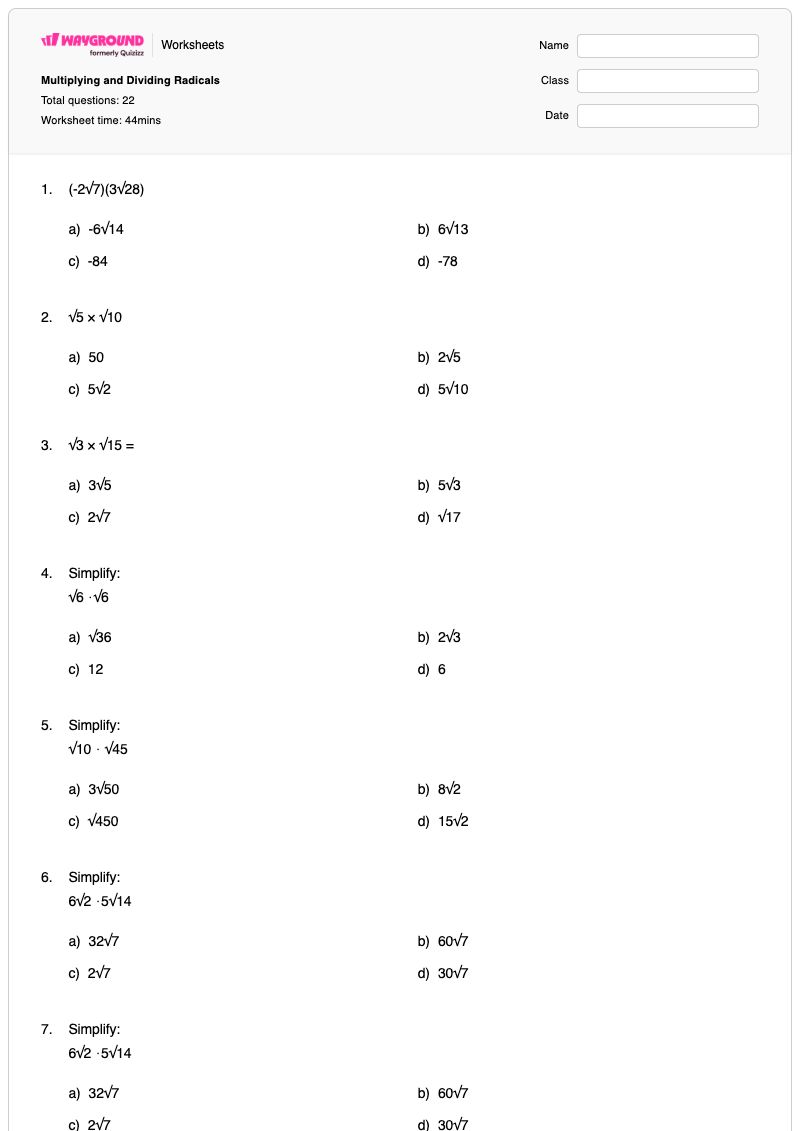
Designed for Grade 11 mathematics, this free printable worksheet gives students 22 multiple-choice questions on multiplying and simplifying radicals. Problems include products such as √5 × √10, products with numerical coefficients such as 6√2 × 5√14, negative radical products, and simplification of expressions such as √24 and 3√72. Students practise multiplying coefficients and radicands, applying radical product rules, extracting perfect-square factors, managing signs, and writing answers in simplified radical form. The answer choices also help teachers identify whether students stopped before fully simplifying or combined terms incorrectly.
Use this worksheet for guided practice after introducing radical multiplication, independent classwork, homework, or a quick skills check. Teachers can review selected problems with students by asking them to explain each simplification step rather than relying only on answer selection. The worksheet includes a complete answer key, making it useful for checking procedural accuracy and discussing common errors. It is available as a free printable resource for Grade 11 math instruction.
Worksheet settings
Font size
S
M
L
XL
Worksheets
Multiplying and Dividing Radicals
Total questions: 22
Name
Class
Date
1.
(-2√7)(3√28)
a)
-6√14
b)
6√13
c)
-84
d)
-78
2.
√5 × √10
a)
50
b)
2√5
c)
5√2
d)
5√10
3.
√3 × √15 =
a)
3√5
b)
5√3
c)
2√7
d)
√17
4.
Simplify: √6 ⋅√6
a)
√36
b)
2√3
c)
12
d)
6
5.
Simplify: √10 ⋅ √45
a)
3√50
b)
8√2
c)
√450
d)
15√2
6.
Simplify: 6√2 ⋅5√14
a)
32√7
b)
60√7
c)
2√7
d)
30√7
7.
Simplify: 6√2 ⋅5√14
a)
32√7
b)
60√7
c)
2√7
d)
30√7
8.
Simplify -2√10 ⋅ 3√20
a)
-60√2
b)
10√2
c)
√30
d)
-6√200
9.
(-2√7)(3√28)
a)
-6√14
b)
6√13
c)
-84
d)
-78
10.
Simplify √24
a)
6√2
b)
12
c)
4√6
d)
2√6
11.
Simplify 3√72
a)
-5√3
b)
40√2
c)
-32√7
d)
18√2
12.
Simplify √30 ⋅ √20
a)
√600
b)
5√2
c)
10√6
d)
2√150
13.
a)
A
b)
B
c)
C
d)
D
14.
a)
A
b)
B
c)
C
d)
D
15.
a)
A
b)
B
c)
C
d)
D
16.
a)
A
b)
B
c)
C
d)
D
17.
Simplify fully.
241
a)
2424
b)
126
c)
2426
d)
66
18.
Simplify fully.
128
a)
1296
b)
32
c)
96
d)
36
19.
Simplify fully.
35102
a)
151010
b)
3210
c)
751010
d)
15210
20.
Simplify.
25312
a)
21
b)
563
c)
1853
d)
25
21.
Simplify.
428
a)
21
b)
2
c)
326
d)
103
22.
Simplify.
4344
a)
22
b)
23
c)
36
d)
323
Answer Key
Multiplying and Dividing Radicals
Total questions: 22
1.
c) -84
2.
c) 5√2
3.
a) 3√5
4.
d) 6
5.
d) 15√2
6.
b) 60√7
7.
b) 60√7
8.
a) -60√2
9.
c) -84
10.
d) 2√6
11.
d) 18√2
12.
c) 10√6
13.
a) A
14.
a) A
15.
a) A
16.
c) C
17.
b)
126
18.
d)
36
19.
b)
3210
20.
b)
563
21.
a)
21
22.
d)
323
140 %
Browse by subjects
Browse by grades
Browse by format
FAQs
What does this multiplying and simplifying radicals worksheet cover?
This Grade 11 worksheet contains 22 multiple-choice questions that focus on multiplying radical expressions and simplifying the results. Students work with products such as √5 × √10, coefficient-and-radical products such as 6√2 × 5√14, negative factors, and radicals that require perfect-square extraction, including √24 and 3√72. Completing these items builds accuracy with radical product rules, coefficient multiplication, sign management, and fully simplified answers.
How can I use this worksheet to teach students to multiply and simplify radicals?
First model one product by multiplying the coefficients and radicands separately, then show how to factor out perfect squares before choosing the answer. Use examples such as √10 · √45 or 6√2 · 5√14 to have students explain why an unsimplified radical is not the final form. After guided practice, assign the 22 multiple-choice items independently and discuss the distractors as evidence of specific procedural errors.
What mistakes should I watch for on this radical multiplication worksheet?
Students may multiply the numbers outside the radicals but fail to multiply the radicands, or multiply the radicands without combining the numerical coefficients. They may also stop at an equivalent but unsimplified form, such as √450 instead of 15√2, overlook a negative sign in a product such as (-2√7)(3√28), or extract the wrong perfect-square factor from √24 or 3√72.
How do I assign and grade this multiplying and simplifying radicals worksheet?
Wayground provides this worksheet as a printable PDF and as a digital quiz, so you can choose paper-based practice or online completion for the 22 multiple-choice questions. It includes a complete answer key for grading the selected responses and reviewing radical simplification steps. Printable submissions can also be graded by scanning student work with the Wayground for Teachers app.
How can I differentiate this radical multiplication worksheet for my students?
In the worksheet’s Advanced Settings, adjust font spacing or choose a larger font size to make the radical expressions, coefficients, and multiple-choice options easier to read. You can also enable a dyslexia-friendly font or translate the worksheet into another language while keeping the same radical multiplication and simplification questions.
Where can I find more free worksheets like this on Wayground?
Wayground offers a broad collection of free printable worksheets and practice problems across subjects, with downloadable PDFs and answer keys to support essential skills and concepts. Browse more resources at https://wayground.com/en-us/worksheets.

 Worksheets


