Radical Equations is a Grade 12 mathematics worksheet that builds procedural fluency with solving equations containing square roots and cube roots. Across 16 items—15 multiple-choice questions and 1 multiple-select question—students identify the correct first step, apply inverse operations, solve for variables, recognize the radicand, and connect radical notation with rational exponents. The questions also require students to distinguish when equations have more than one solution and select all valid solutions when prompted.
This free printable worksheet is useful for introducing, reviewing, or checking understanding of radical-equation procedures and related vocabulary. Its mix of terminology, process-selection, equation-solving, and representation questions helps teachers see whether students understand both why a step is used and how to carry it out. A complete answer key is included for efficient checking, reteaching, or independent practice.
Worksheet settings
Font size
S
M
L
XL
Worksheets
Radical Equations
Total questions: 16
Name
Class
Date
1.
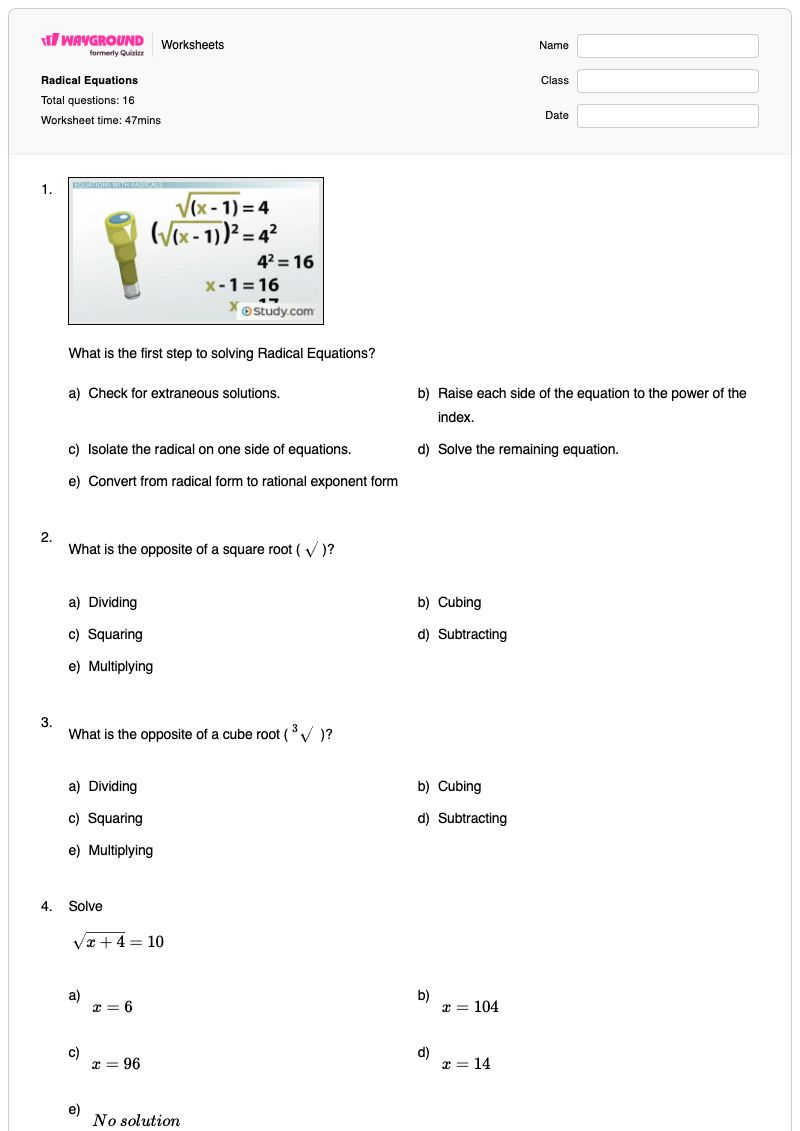
What is the first step to solving Radical Equations?
a)
Check for extraneous solutions.
b)
Raise each side of the equation to the power of the index.
c)
Isolate the radical on one side of equations.
d)
Solve the remaining equation.
e)
Convert from radical form to rational exponent form
2.
What is the opposite of a square root ( )?
a)
Dividing
b)
Cubing
c)
Squaring
d)
Subtracting
e)
Multiplying
3.
What is the opposite of a cube root ( 3 )?
a)
Dividing
b)
Cubing
c)
Squaring
d)
Subtracting
e)
Multiplying
4.
Solve
x+4=10
a)
x=6
b)
x=104
c)
x=96
d)
x=14
e)
Nosolution
5.
Solve
32x+3+6=3
a)
x=−15
b)
x=−18
c)
x=12
d)
x=−3
e)
Nosolution
6.
First step to solving: 33x−4+5=1
a)
Subtract 5 from both sides
b)
Add 5 to both sides
c)
Take the cubic root from both sides
d)
Translate left 4 and up 5
e)
Bring the 1 over to the left side
7.
Solve the equation.
a)
n = 27
b)
n = 18
c)
n = -18
d)
n = 36
e)
n = 12
8.
Question 1
a)
10
b)
8
c)
16
d)
4
e)
9
9.
Solve for x
a)
x=27
b)
x=-3
c)
x=81
d)
x=3
e)
x=-27
10.
Solve for m
a)
m=2
b)
m=-2 and m=18
c)
m=2 and m=-18
d)
m=-2 and m=-18
e)
m=2 and m=18
11.
Solve the equation.
a)
25
b)
-29
c)
-3
d)
3
e)
92/3
12.
Solve the equation.
a)
16
b)
-16
c)
8
d)
-8
e)
32
13.
Which expression with a fractional exponent best represents √7 ?
a)
71/2
b)
71/4
c)
71/3
d)
21/7
e)
27
14.
The number under the radical sign is called the ______.
a)
divisor
b)
radicand
c)
root
d)
exponent
e)
index
15.
Rewrite in rational exponent form
a)
44/3
b)
43/4
c)
24/3
d)
23/4
e)
Cannot because the cubic root of 4 is not an integer
16.
How would we say this if converted to radical form?
a)
"Thirty-two to the three-fifths"
b)
"Fifth root of thirty-two raised to the third power"
c)
"Third root of thirty-two raised to the fifth power"
d)
"Quintic root of thirty-two raised to the fifth power"
e)
"Thirty-two and three-fifths"
Answer Key
Radical Equations
Total questions: 16
1.
c)
Isolate the radical on one side of equations.
2.
c)
Squaring
3.
b)
Cubing
4.
c)
x=96
5.
a)
x=−15
6.
a)
Subtract 5 from both sides
7.
d)
n = 36
8.
a) 10
9.
d)
x=3
10.
e)
m=2 and m=18
11.
b)
-29
, a)
25
12.
a)
16
13.
a)
71/2
14.
b) radicand
15.
a) 44/3
16.
b)
"Fifth root of thirty-two raised to the third power"
140 %
Browse by subjects
Browse by grades
Browse by format
FAQs
What does this Radical Equations worksheet help Grade 12 students practice?
This worksheet helps students solve equations involving square roots and cube roots by isolating the radical, applying the corresponding inverse power, and solving for the variable. Its 15 multiple-choice and 1 multiple-select item also cover radical vocabulary, identifying the radicand, converting radicals to rational exponents, and recognizing multiple valid solutions.
How can I use this worksheet to teach solving radical equations?
Use the opening process and inverse-operation questions to establish that students should isolate the radical before raising both sides to a power. Then have students work through the equation-solving items, asking them to explain each algebraic step and verify every proposed solution in the original equation. Finish with the rational-exponent and vocabulary items to connect the procedures to the notation.
What mistakes should I watch for when students complete this radical equations worksheet?
Watch for students raising both sides to a power before isolating the radical, using squaring for a cube root, or misapplying the inverse operation. Students may also overlook a second valid solution, choose only one answer on the multiple-select item, confuse the radicand with the index, or write the fractional exponent incorrectly when rewriting a radical.
How do I assign and grade this Radical Equations worksheet?
You can assign it as a printable PDF or use it as a digital quiz on Wayground. The worksheet includes a complete answer key, and printable submissions can be graded by scanning student work with the Wayground for Teachers app. The printable format also gives students a way to practise the radical-equation steps away from a screen.
How can I differentiate this radical equations worksheet for my students?
In the worksheet’s Advanced Settings, adjust font spacing or choose a larger font size so the radical expressions, exponents, and answer choices are easier to distinguish. You can also enable a dyslexia-friendly font or translate the worksheet’s instructions and equation prompts into another language while preserving its multiple-choice and multiple-select format.
Where can I find more worksheets like this on Wayground?
Wayground offers a comprehensive collection of free printable worksheets and practice problems across subjects, with downloadable PDFs and answer keys to support essential skills and concepts. Browse more resources at https://wayground.com/en-us/worksheets.

 Worksheets


