

Wayground
Earth's Interior - Printable Science Worksheets grade 8 - Wayground

Earth's Interior

Andi Kur

Created by Andi Kur

19 questions

8th Grade

Science

Updated Oct 2026

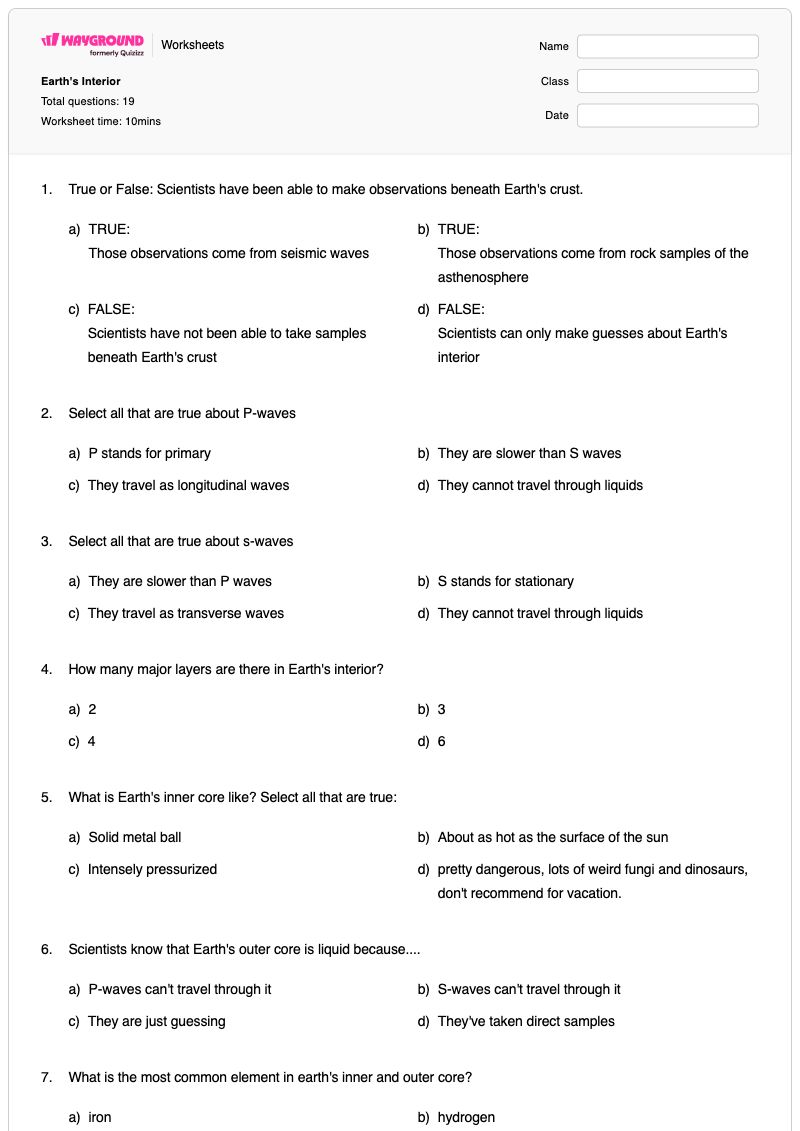
This Grade 8 science worksheet helps students explain how scientists investigate Earth’s interior using seismic waves and distinguish the properties of P-waves and S-waves. Across 19 questions—16 multiple-choice and 3 multiple-select—students identify wave types, compare how they travel through solids and liquids, and use wave behavior to determine that Earth’s outer core is liquid. Students also review the four major layers of Earth and connect each layer with its composition, physical state, movement, temperature, pressure, and role in Earth systems. Questions address the iron-rich core, the outer core’s magnetic field, mantle convection, the asthenosphere’s plastic consistency, the crust’s thin and brittle structure, earthquake locations, and the mechanical nature of seismic waves. This free printable worksheet includes a complete answer key for checking understanding or supporting review.

Worksheet settings

Font size

S
M
L
XL
WaygroundWorksheets

Earth's Interior

Total questions: 19

Name
Class
Date
1.

True or False: Scientists have been able to make observations beneath Earth's crust.

a)

TRUE:

Those observations come from seismic waves

b)

TRUE:

Those observations come from rock samples of the asthenosphere

c)

FALSE:

Scientists have not been able to take samples beneath Earth's crust

d)

FALSE:

Scientists can only make guesses about Earth's interior

2.

Select all that are true about P-waves

a)

P stands for primary

b)

They are slower than S waves

c)

They travel as longitudinal waves

d)

They cannot travel through liquids

3.

Select all that are true about s-waves

a)

They are slower than P waves

b)

S stands for stationary

c)

They travel as transverse waves

d)

They cannot travel through liquids

4.

How many major layers are there in Earth's interior?

a)

2

b)

3

c)

4

d)

6

5.

What is Earth's inner core like? Select all that are true:

a)

Solid metal ball

b)

About as hot as the surface of the sun

c)

Intensely pressurized

d)

pretty dangerous, lots of weird fungi and dinosaurs, don't recommend for vacation.

6.

Scientists know that Earth's outer core is liquid because....

a)

P-waves can't travel through it

b)

S-waves can't travel through it

c)

They are just guessing

d)

They've taken direct samples

7.

What is the most common element in earth's inner and outer core?

a)

iron

b)

hydrogen

c)

potassium

d)

gold

8.

Which layer of Earth's interior generates its magnetic field?

a)

Mantle

b)

Crust

c)

Outer core

d)

Inner core

9.

This layer is solid to semi-solid and is slowly circulating because of convection

a)

Mantle

b)

Crust

c)

Inner core

d)

Outer core

10.

The asthenosphere has a consistency much like...

a)

Sand on the beach

b)

Canola oil

c)

Carmel candy

d)

Melted chocolate

11.

Which of Earth's layers is defined as thin & brittle?

a)

Crust

b)

Mantle

c)

Inner core

d)

Outer core

12.

Which layer of the Earth can be described as "plastic and flowing"?

a)

Asthenosphere

b)

Inner core

c)

outer core

d)

crust

13.

Where do Earthquakes occur?

a)

At the boundary between tectonic plates

b)

Randomly across the crust

c)

In the center of tectonic plates where there is the most mass

d)

Under cities with heavy buildings

14.

What kind of waves are seismic waves?

a)

Kinetic

b)

Mechanical

c)

Electromagnetic

d)

Elastic

15.

What would happen if a p-wave were to pass from a solid to a liquid?

a)

It would slow down because the molecules are spaced further apart.

b)

It would speed up because it has more room to move between molecules.

c)

It would stop because p-waves can't pass through liquids.

d)

It would maintain a constant speed.

16.

What would happen if an s-wave were to pass from a solid to a liquid?

a)

It would slow down because the molecules are spaced further apart.

b)

It would speed up because it has more room to move between molecules.

c)

It would stop because s-waves can't pass through liquids.

d)

It would maintain a constant speed.

17.
How are scientist able to estimate the thickness of each layer of the Earth?By studying __________
a)
 radio waves
b)
sonar waves
c)
laser waves
d)
seismic waves
18.
This is the plastic layer of the mantle on which pieces of the lithosphere move.
a)
Lithosphere
b)
Asthenosphere
c)
Mesosphere
d)
Crust
19.
This layer is divided into pieces called tectonic plates.
a)
Mesosphere
b)
Asthenosphere
c)
Mantle
d)
Lithosphere
WaygroundAnswer Key

Earth's Interior

Total questions: 19

1.
a)

TRUE:

Those observations come from seismic waves

2.
a)

P stands for primary

, c)

They travel as longitudinal waves

3.
a)

They are slower than P waves

, c)

They travel as transverse waves

, d)

They cannot travel through liquids

4.
c)

4

5.
a)

Solid metal ball

, b)

About as hot as the surface of the sun

, c)

Intensely pressurized

6.
b)

S-waves can't travel through it

7.
a)

iron

8.
c)

Outer core

9.
a)

Mantle

10.
c)

Carmel candy

11.
a)

Crust

12.
a)

Asthenosphere

13.
a)

At the boundary between tectonic plates

14.
b)

Mechanical

15.
a)

It would slow down because the molecules are spaced further apart.

16.
c)

It would stop because s-waves can't pass through liquids.

17.
d) seismic waves
18.
b) Asthenosphere
19.
d) Lithosphere

FAQs

What does the Earth's Interior worksheet cover?

This Grade 8 science worksheet uses 16 multiple-choice and 3 multiple-select questions to assess Earth’s four major interior layers and how seismic waves reveal their properties. Students identify P-wave and S-wave behavior, use S-waves’ inability to travel through liquids to explain the outer core’s state, and connect each layer with characteristics such as composition, convection, and magnetic-field generation.

How can I use this worksheet to teach Earth’s interior?

Introduce the worksheet by reviewing a simple cross-section of Earth and modeling how P-waves and S-waves move through different materials. As students complete the multiple-select items, have them justify every option they select, then use the outer-core and p-wave questions to discuss how scientists infer conditions they cannot directly sample. Finish by asking students to connect the mantle, asthenosphere, crust, and core questions to the four-layer model.

What mistakes should I watch for on the Earth's Interior worksheet?

Students may confuse P-waves with S-waves by selecting that P-waves cannot travel through liquids or that S-waves are longitudinal; the worksheet distinguishes P-waves as primary and longitudinal, while S-waves are transverse and cannot travel through liquids. They may also confuse the mantle with the asthenosphere, or select the inner core instead of the liquid outer core when identifying the source of Earth’s magnetic field. On multiple-select questions, remind students to evaluate each option independently rather than choosing only one statement.

How do I assign and grade this Earth's Interior worksheet?

The Earth's Interior worksheet is available on Wayground as a printable PDF and as a digital quiz, and it includes a complete answer key for all 19 questions. You can grade printable submissions by scanning student work with the Wayground for Teachers app, while the digital quiz can be assigned through Wayground for online completion and grading.

How can I differentiate this Earth's Interior worksheet for my students?

In the worksheet’s Advanced Settings, adjust font spacing or choose a larger font size to make the multiple-choice and multiple-select items easier to read. You can also enable a dyslexia-friendly font or translate the worksheet into another language, while keeping the seismic-wave and Earth-layer question structure intact.

Where can I find more worksheets like this on Wayground?

Wayground offers a comprehensive collection of free printable worksheets and practice problems across all subjects. Teachers can browse downloadable PDFs with answer keys at https://wayground.com/en-us/worksheets to find additional resources for building essential skills and concepts.