


Wayground
Virginia Earth Science Earth's composition - Printable Science Worksheets grade 8 - Wayground

Virginia Earth Science Earth's composition

Anonymous Anonymous

Created by Anonymous Anonymous

8 questions

8th Grade

Science

Updated Jul 2025

Virginia Earth Science: Earth’s Composition is a Grade 8 science worksheet that helps students identify the structure and composition of Earth’s layers. Across eight items, students use multiple-choice questions, dropdown sentence completions, and a matching activity to connect the crust, mantle, outer core, and inner core with their materials, temperatures, density, and physical states. Students also compare continental and oceanic crust, distinguish the lithosphere from the asthenosphere, and explain how mantle convection currents move Earth’s plates. The questions reinforce why pressure keeps the inner core’s nickel and iron solid despite its extreme heat and how plate movement contributes to earthquakes, mountain building, and volcanoes. This free printable worksheet includes a complete answer key for independent practice, guided instruction, review, or assessment.

Worksheet settings

Font size

S
M
L
XL
WaygroundWorksheets

Virginia Earth Science Earth's composition

Total questions: 8

Name
Class
Date
1.

iF the crust is the outer layer of the earth and is made of the lightest materials such as the rocks basalt and granites.

That means that the rocks basalt and granite

a)

float up in the mantle to the surface of the earth

b)

sink down in the mantle

c)

stay in the same place

2.

The mantle is ​ (a)   than the crust and has the ability to ​ (b)   .

The mantle is the ​ (c)   .

The mantle is composed of ​ (d)   .

Choose from the below words
much hotter
flow
largest and thickest layer
very hot, dense flowing rock
3.

The material in the mantle flows because of ​ (a)   currents.

This causes the brittle crust to move as it ​ (b)   of the mantle.

It is also made up of two parts:

​ (c)   which is the top portion of the mantle as well as the crust.

​ (d)   which is the lower part of the mantle that has convection currents.

Choose from the below words
convection
floats on the top
Lithosphere
Asthenosphere
4.

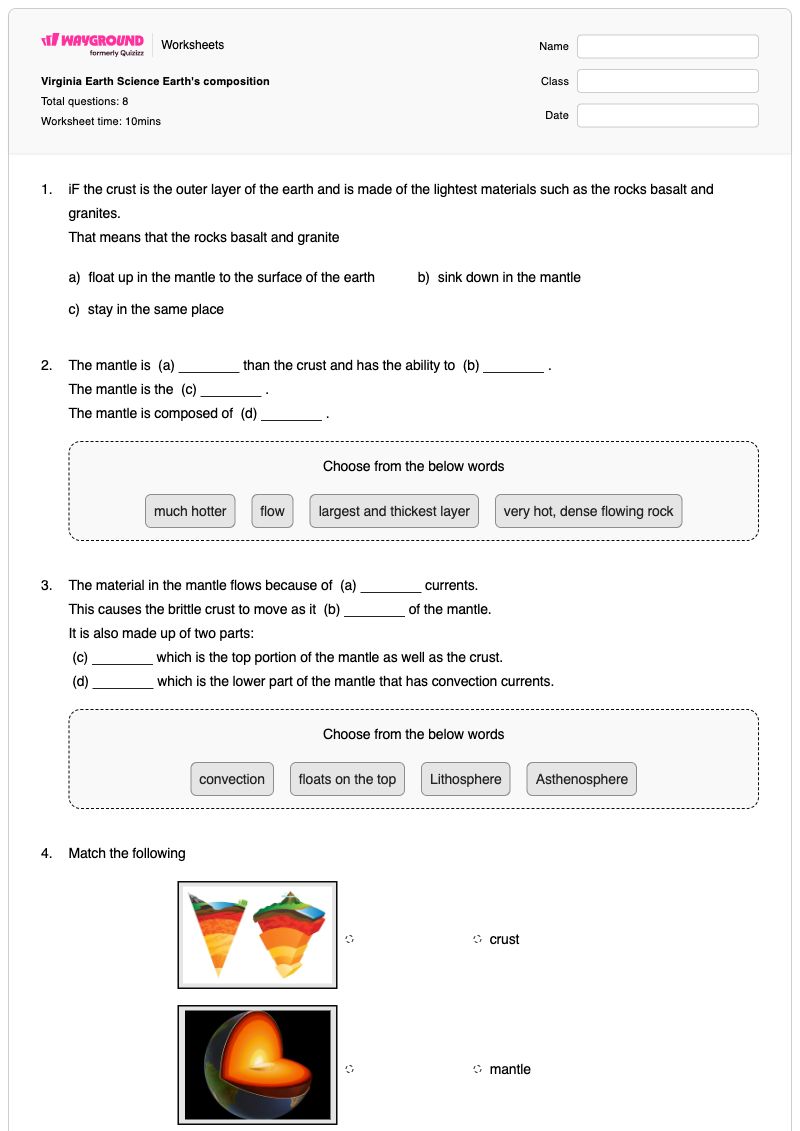
Match the following

The brown layer

crust

The red portion

mantle

top portion of the mantle

lithosphere

lower part of the mantle

Asthenosphere

5.

The ​ (a)   is even hotter, consists of heavy metals ( ​ (b)   ) and is liquid.

The ​ (c)   is hotter still with ​ (d)   so great that the heavy metals it is made of ( nickel & iron ) that they are in the ​ (e)   in spite of having the hottest temperatures.

Choose from the below words
outer core
nickel & iron
inner core
pressures
solid state
6.

Even though the inner core is still hotter than the outer core, what keeps nickel and iron in the solid state?

a)

Heat

b)

Pressure

c)

Cool

7.

The ​ (a)   is thicker than the oceanic crust but ​ (b)   , it is made up of mostly Granite which is less dense.

The Oceanic crust is thinner but ​ (c)   . It is made up of mostly ​ (d)   which is more dense.

Choose from the below words
continental crust
lighter
heavier
basalt
8.

Convection currents are a ​ (a)   caused by the ​ (b)   from the bottom to the top of the mantle.

It is because these currents that the ​ (c)   in the past and are moving today.

These plate movements cause ​ (d)   , mountain building, and volcanoes.

Choose from the below words
circular current
difference in temperatures
plates of the Earth have moved
Earthquakes
WaygroundAnswer Key

Virginia Earth Science Earth's composition

Total questions: 8

1.
a)

float up in the mantle to the surface of the earth

2.
much hotter, flow, largest and thickest layer, very hot, dense flowing rock
3.
convection, floats on the top, Lithosphere, Asthenosphere
4.

 - 

crust

, 

 - 

mantle

, 

 - 

lithosphere

, 

 - 

Asthenosphere

5.
outer core, nickel & iron, inner core, pressures, solid state
6.
b)

Pressure

7.
continental crust, lighter, heavier, basalt
8.
circular current, difference in temperatures, plates of the Earth have moved, Earthquakes

FAQs

What does the Virginia Earth Science Earth’s Composition worksheet cover?

This Grade 8 worksheet covers the composition and structure of Earth’s crust, mantle, outer core, and inner core. Its eight questions use multiple choice, dropdown sentence completion, and matching to have students compare layer materials and properties, distinguish the lithosphere from the asthenosphere, and connect mantle convection to plate movement.

How can I use this worksheet to teach Earth’s layers and convection?

Introduce the worksheet by having students organize Earth’s layers from the crust to the inner core, then discuss how temperature, density, pressure, and physical state change with depth. As students complete the dropdown items, ask them to explain why the mantle can flow, why the inner core remains solid, and how convection currents relate to moving plates.

What mistakes should I watch for when students complete this Earth’s composition worksheet?

Watch for students confusing the lithosphere with the asthenosphere, or selecting the asthenosphere as the rigid layer that moves. Students may also reverse the outer and inner core, confuse pressure with heat as the reason the inner core is solid, or switch the density and rock-type comparisons for continental and oceanic crust. Review the matching item carefully as well as the dropdown sentence completions, because each term must fit the surrounding statement.

How do I assign and grade this Earth’s composition worksheet?

This worksheet is available as a printable PDF and as a digital quiz on Wayground, and it includes a complete answer key. You can grade digital responses in Wayground or scan printable student work with the Wayground for Teachers app. The printable option also supports classrooms that are reducing screen time.

How can I differentiate this Earth’s composition worksheet for my students?

Use the worksheet’s Advanced Settings to adjust font spacing or increase the font size so the layer descriptions and dropdown sentence-completion text are easier to read. You can also apply a dyslexia-friendly font or translate the worksheet into another language, while keeping the multiple-choice, dropdown, and matching formats intact.

Where can I find more worksheets like this on Wayground?

Wayground offers a broad collection of free printable worksheets and practice problems across subjects, with downloadable PDFs and answer keys to support mastery of essential skills and concepts. Browse more resources at https://wayground.com/en-us/worksheets.