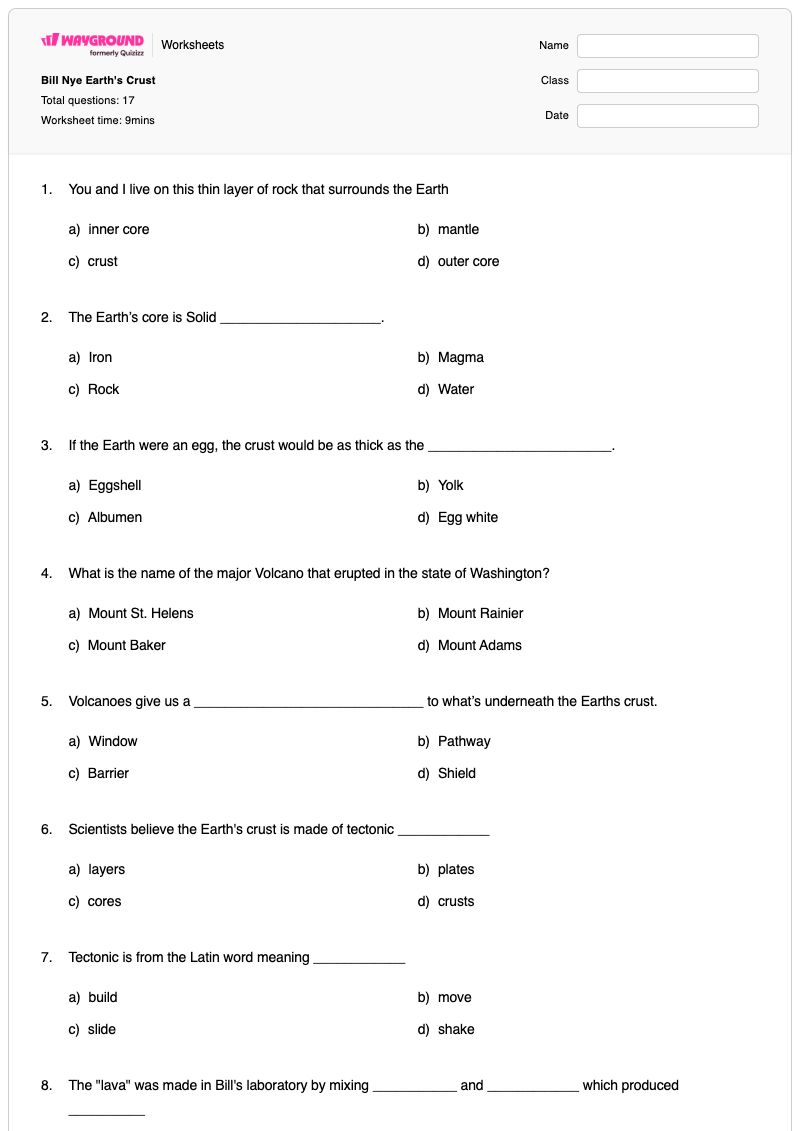
Bill Nye Earth's Crust is a Grade 7 science worksheet with 17 multiple-choice questions about Earth’s crust, interior, and tectonic plate movement. Students identify the crust as Earth’s thin outer layer, distinguish the mantle and core, use an eggshell comparison to understand crust thickness, and recall that the solid core is made of iron. The questions also connect volcanoes and geysers to processes beneath the crust, including the vinegar-and-baking-soda demonstration that produces carbon dioxide.
This free printable worksheet helps students review how tectonic plates move and how their movement relates to volcanoes, mountains, and earthquakes. It also checks understanding of Pangea, the meaning of “tectonic,” the movement of North America away from Europe, and Mount St. Helens. The multiple-choice format is useful for guided review, independent practice, or a quick content check, and a complete answer key supports efficient scoring.
Worksheet settings
Font size
S
M
L
XL
Worksheets
Bill Nye Earth's Crust
Total questions: 17
Name
Class
Date
1.
You and I live on this thin layer of rock that surrounds the Earth
a)
inner core
b)
mantle
c)
crust
d)
outer core
2.
The Earth’s core is Solid _____________________.
a)
Iron
b)
Magma
c)
Rock
d)
Water
3.
If the Earth were an egg, the crust would be as thick as the ________________________.
a)
Eggshell
b)
Yolk
c)
Albumen
d)
Egg white
4.
What is the name of the major Volcano that erupted in the state of Washington?
a)
Mount St. Helens
b)
Mount Rainier
c)
Mount Baker
d)
Mount Adams
5.
Volcanoes give us a ______________________________ to what’s underneath the Earths crust.
a)
Window
b)
Pathway
c)
Barrier
d)
Shield
6.
Scientists believe the Earth's crust is made of tectonic ____________
a)
layers
b)
plates
c)
cores
d)
crusts
7.
Tectonic is from the Latin word meaning ____________
a)
build
b)
move
c)
slide
d)
shake
8.
The "lava" was made in Bill's laboratory by mixing ___________ and ____________ which produced __________
a)
vinegar, water, oxygen
b)
vinegar, water, carbon dioxide
c)
vinegar, baking soda, oxygen
d)
vinegar, baking soda, carbon dioxide
9.
A _____________ is like a volcano, except it is boiling water.
a)
geyser
b)
earthquake
c)
hurricane
d)
shower
10.
The plates are floating on the Earth's ___________
a)
inner core
b)
mantle
c)
outer core
d)
crust
11.
Scientists believe that at one time all the plates were once a piece called __________ or "whole Earth"
a)
Pandemic
b)
Panorama
c)
Panamerica
d)
Pangea
12.
Where tectonic plates spread apart we get _____________
a)
volcanoes
b)
earthquakes
c)
mountains
d)
caves
13.
Where tectonic plates come together we get _____________
a)
volcanoes
b)
earthquakes
c)
mountains
d)
caves
14.
North America is moving away from Europe at about ___________ every year.
a)
2 mm
b)
2 cm
c)
2 feet
d)
2 miles
15.
Shifting tectonic plates cause_____________
a)
volcanoes
b)
earthquakes
c)
mountains
d)
caves
16.
_____________ are hollowed out spaces in the Earth's crust
a)
volcanoes
b)
earthquakes
c)
mountains
d)
caves
17.
The Earth's core is _________ kilometers in diameter
a)
80
b)
280
c)
2800
d)
28,000
Answer Key
Bill Nye Earth's Crust
Total questions: 17
1.
c)
crust
2.
a)
Iron
3.
a)
Eggshell
4.
a)
Mount St. Helens
5.
a)
Window
6.
b)
plates
7.
a)
build
8.
d)
vinegar, baking soda, carbon dioxide
9.
a)
geyser
10.
b)
mantle
11.
d)
Pangea
12.
a)
volcanoes
13.
c)
mountains
14.
b)
2 cm
15.
b)
earthquakes
16.
d)
caves
17.
c)
2800
140 %
Browse by subjects
Browse by grades
Browse by format
FAQs
What does the Bill Nye Earth's Crust worksheet cover?
This Grade 7 science worksheet uses 17 multiple-choice questions to review Earth’s crust, the mantle and core, and tectonic plate movement. Students connect plate boundaries with volcanoes, mountains, and earthquakes while also identifying related examples such as Pangea, Mount St. Helens, geysers, and the vinegar-and-baking-soda demonstration.
How can I use this worksheet to teach Earth’s crust and tectonic plates?
Introduce the crust, mantle, and core with the worksheet’s eggshell comparison, then have students explain why the crust is described as a thin outer layer. After students complete the multiple-choice items, discuss how plates floating on the mantle spread apart or come together and how those movements produce volcanoes, mountains, and earthquakes.
What mistakes should I watch for when students complete this worksheet?
Students may confuse the crust with the mantle or core, especially when identifying the layer on which the plates float. Watch for errors matching plate movement to landforms or hazards, confusing Pangea with the other choices, selecting 2 mm instead of 2 cm for North America’s movement, and choosing oxygen rather than carbon dioxide in the vinegar-and-baking-soda demonstration.
How do I assign and grade this Earth's Crust worksheet?
Wayground provides this worksheet as a printable PDF and as a digital quiz, and it includes a complete answer key for the 17 multiple-choice questions. For printable submissions, scan student work with the Wayground for Teachers app to grade it efficiently.
How can I differentiate this Earth's Crust worksheet for my students?
Use the worksheet’s Advanced Settings to adjust font spacing or choose a larger font size so the multiple-choice questions and answer choices are easier to read. You can also enable a dyslexia-friendly font or translate the worksheet into another language when those options support access to the Earth’s crust and tectonic plate content.
Where can I find more worksheets like this on Wayground?
Wayground offers a broad collection of free printable worksheets and practice problems across subjects, with downloadable PDFs and answer keys to support essential skills and concepts. Browse more resources at https://wayground.com/en-us/worksheets.


 Worksheets