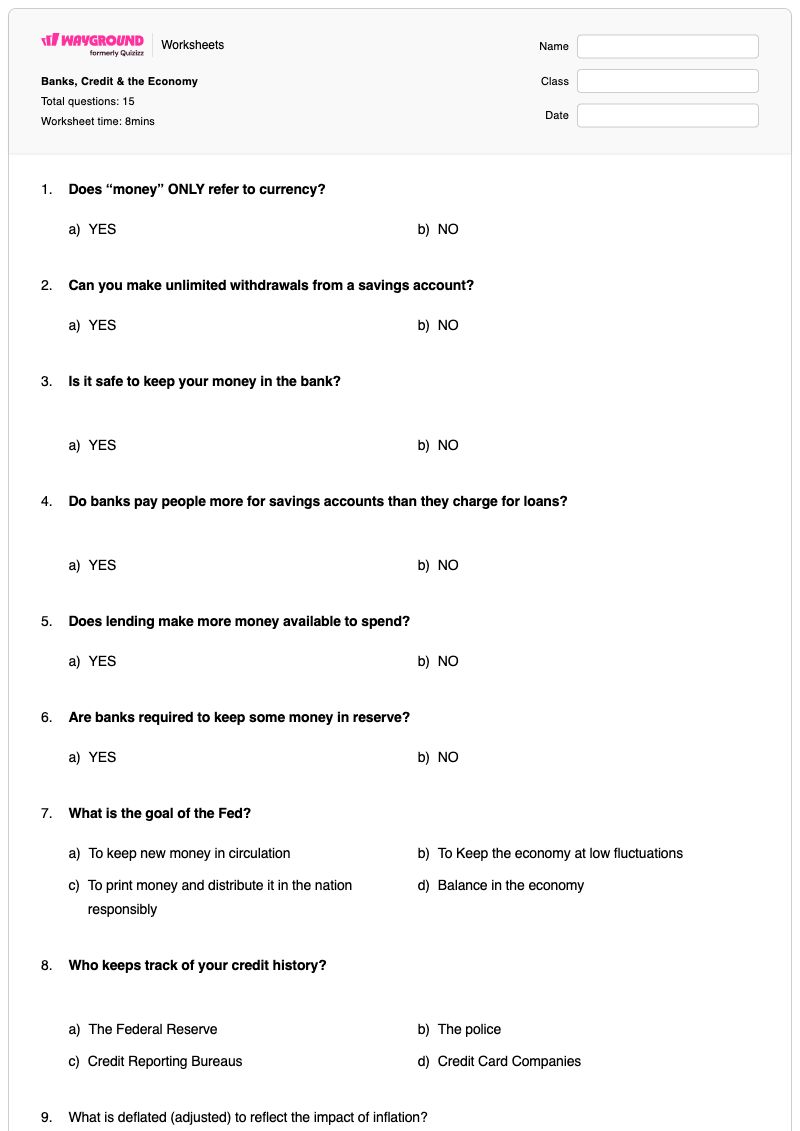
Banks, Credit & the Economy is a Grade 11 social studies worksheet that builds understanding of how banks, credit, inflation, and economic measurement are connected. Students work through 15 questions—14 multiple-choice items and one multiple-select item—covering money beyond currency, savings-account withdrawals, bank reserves, lending, interest rates, credit reporting bureaus, the Federal Reserve’s goal, real versus nominal data, inflation’s costs, price stability, GDP, and payday loans.
The yes-or-no and multiple-choice format asks students to distinguish related financial and economic terms and apply them to practical questions, while the multiple-select item checks whether they can identify both reasons price stability matters. Use this free printable worksheet to review essential vocabulary, check conceptual understanding, or prompt discussion before a unit assessment. It includes a complete answer key for efficient review and grading, and is suitable for independent practice, homework, or a classroom economics check-in.
Worksheet settings
Font size
S
M
L
XL
Worksheets
Banks, Credit & the Economy
Total questions: 15
Name
Class
Date
1.
Does “money” ONLY refer to currency?
a)
YES
b)
NO
2.
Can you make unlimited withdrawals from a savings account?
a)
YES
b)
NO
3.
Is it safe to keep your money in the bank?
a)
YES
b)
NO
4.
Do banks pay people more for savings accounts than they charge for loans?
a)
YES
b)
NO
5.
Does lending make more money available to spend?
a)
YES
b)
NO
6.
Are banks required to keep some money in reserve?
a)
YES
b)
NO
7.
What is the goal of the Fed?
a)
To keep new money in circulation
b)
To Keep the economy at low fluctuations
c)
To print money and distribute it in the nation responsibly
d)
Balance in the economy
8.
Who keeps track of your credit history?
a)
The Federal Reserve
b)
The police
c)
Credit Reporting Bureaus
d)
Credit Card Companies
9.
What is deflated (adjusted) to reflect the impact of inflation?
a)
Nominal Data
b)
Market Data
c)
Real Data
d)
Prospective Data
10.
What has to be considered when looking at prices over time?
a)
Inflation
b)
Deflation
c)
quality of the goods
d)
The perspective of the buyer
11.
What causes using a credit card cost more than paying for something straight out?
a)
Collateral
b)
Interest Rates
c)
Late fees
d)
Finders' Fees
12.
Shoe-leather costs, menu costs, the misallocation of goods and services, distortion of money’s ability to act as a standard measure of value, and the arbitrary redistribution of wealth are all examples of:
a)
Cost of Inflation
b)
Real Economic Data
c)
Effects of Inflation
d)
Nominal Economic Data
13.
Why is price stability important?
a)
It is something people can talk about
b)
producers and consumers are better able to plan for the future
c)
keeps economic growth and employment stable
d)
Banks decide how much money to loan out based on it.
14.
The total value of goods produced and services provided in a country during one year is called.
a)
GNP
b)
RED
c)
GDP
d)
NEP
15.
Which type of loan charges a huge amount of interest to pay it back?
a)
Bank or Credit Union Loan
b)
Pawn Shop Loan
c)
Pay Day Loan
d)
Title Loan
Answer Key
Banks, Credit & the Economy
Total questions: 15
1.
b)
NO
2.
b)
NO
3.
a)
YES
4.
b)
NO
5.
a)
YES
6.
a)
YES
7.
d)
Balance in the economy
8.
c)
Credit Reporting Bureaus
9.
c)
Real Data
10.
a)
Inflation
11.
b)
Interest Rates
12.
a)
Cost of Inflation
13.
b)
producers and consumers are better able to plan for the future
, c)
keeps economic growth and employment stable
14.
c)
GDP
15.
c)
Pay Day Loan
140 %
Browse by subjects
Browse by grades
Browse by format
FAQs
What does the Banks, Credit & the Economy worksheet cover?
This Grade 11 social studies worksheet uses 14 multiple-choice questions and one multiple-select question to assess how banks, credit, inflation, and economic indicators work together. Students distinguish money from currency, identify bank reserves and interest rates, connect credit reporting to credit history, classify real data, recognize inflation’s costs, explain price stability, and identify GDP and payday loans.
How can I use this worksheet to teach banks, credit, and the economy?
Use the yes-or-no items as an opening check, then ask students to justify answers about savings withdrawals, bank lending, reserves, and the safety of keeping money in a bank. Follow with the terminology questions on the Federal Reserve, credit reporting bureaus, real data, GDP, and inflation, and use the price-stability multiple-select item to discuss why both planning and stable growth matter.
What mistakes should I watch for when students complete this worksheet?
Students may treat money as only physical currency, confuse the Federal Reserve with credit reporting bureaus, or select nominal rather than real data when considering inflation-adjusted values. Watch for confusion between the interest charged on credit and other fees, between the effects and costs of inflation, and between GDP and the other abbreviated economic terms. The multiple-select price-stability item also requires choosing two correct reasons rather than one.
How do I assign and grade this Banks, Credit & the Economy worksheet?
Wayground provides this worksheet as both a printable PDF and a digital quiz, and it includes a complete answer key for all 15 items. You can grade printable submissions by scanning student work with the Wayground for Teachers app, or assign the digital quiz through Wayground for online responses and review.
How can I differentiate this worksheet for my students?
In the worksheet’s Advanced Settings, adjust font spacing or choose a larger font size to make the 15 banking and economics questions easier to read. You can also enable a dyslexia-friendly font or translate the worksheet into another language, which may help students access terms such as inflation, GDP, and credit reporting bureaus.
Where can I find more worksheets like this on Wayground?
Wayground offers a comprehensive collection of free printable worksheets and practice problems across all subjects, with downloadable PDFs and answer keys to help students master essential skills and concepts. Browse more resources at https://wayground.com/en-us/worksheets.


 Worksheets