
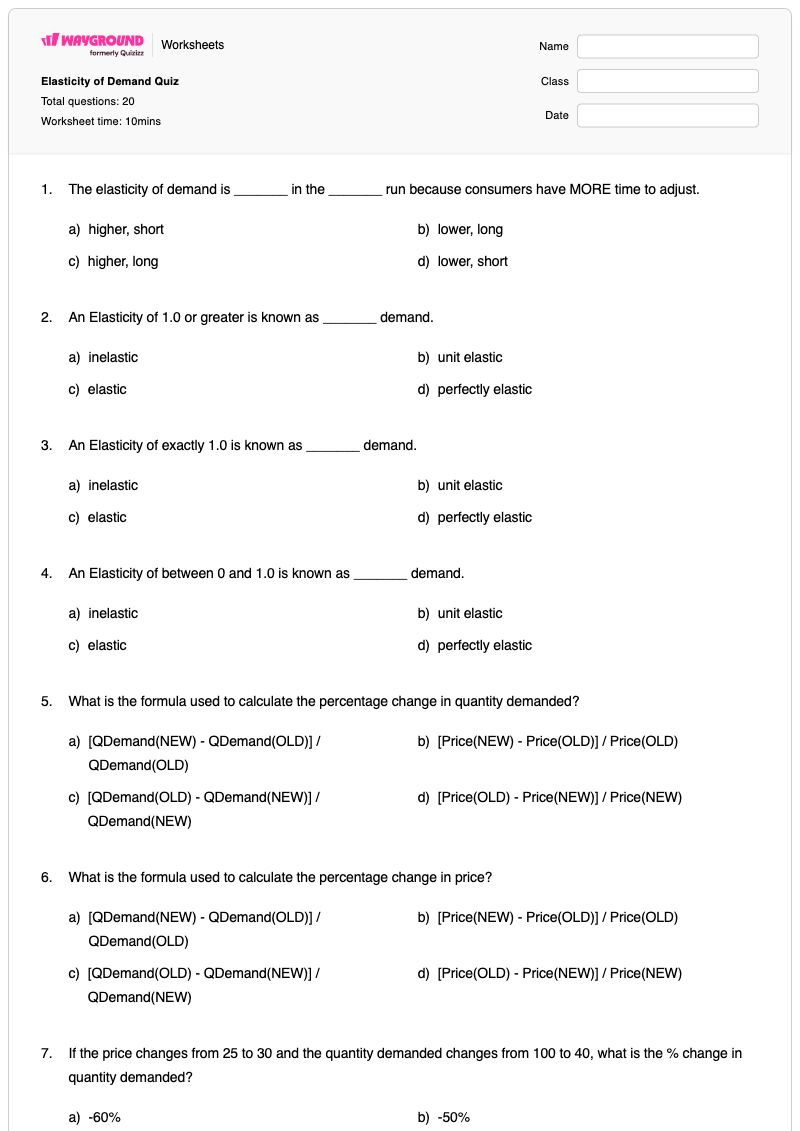

Elasticity of Demand Quiz is a Grade 12 social studies worksheet with 20 multiple-choice questions that checks students’ understanding of price elasticity of demand. Students identify elastic, unit elastic, and inelastic demand; recognize why demand is generally more elastic in the long run; and connect the availability of substitutes with elastic demand.
The worksheet also provides focused practice with percentage-change calculations. Students select the correct formulas for changes in quantity demanded and price, then interpret price-and-quantity scenarios such as a price increase from 25 to 30 or a quantity decrease from 100 to 40. This free printable worksheet includes a complete answer key and can support direct instruction, independent practice, review, or assessment after students learn the elasticity concepts and calculation steps.
Worksheet settings
Font size
S
M
L
XL
Worksheets
Elasticity of Demand Quiz
Total questions: 20
Name
Class
Date
1.
The elasticity of demand is _______ in the _______ run because consumers have MORE time to adjust.
a)
higher, short
b)
lower, long
c)
higher, long
d)
lower, short
2.
An Elasticity of 1.0 or greater is known as _______ demand.
a)
inelastic
b)
unit elastic
c)
elastic
d)
perfectly elastic
3.
An Elasticity of exactly 1.0 is known as _______ demand.
a)
inelastic
b)
unit elastic
c)
elastic
d)
perfectly elastic
4.
An Elasticity of between 0 and 1.0 is known as _______ demand.
a)
inelastic
b)
unit elastic
c)
elastic
d)
perfectly elastic
5.
What is the formula used to calculate the percentage change in quantity demanded?
a)
[QDemand(NEW) - QDemand(OLD)] / QDemand(OLD)
b)
[Price(NEW) - Price(OLD)] / Price(OLD)
c)
[QDemand(OLD) - QDemand(NEW)] / QDemand(NEW)
d)
[Price(OLD) - Price(NEW)] / Price(NEW)
6.
What is the formula used to calculate the percentage change in price?
a)
[QDemand(NEW) - QDemand(OLD)] / QDemand(OLD)
b)
[Price(NEW) - Price(OLD)] / Price(OLD)
c)
[QDemand(OLD) - QDemand(NEW)] / QDemand(NEW)
d)
[Price(OLD) - Price(NEW)] / Price(NEW)
7.
If the price changes from 25 to 30 and the quantity demanded changes from 100 to 40, what is the % change in quantity demanded?
a)
-60%
b)
-50%
c)
-40%
d)
-30%
8.
If the price changes from 25 to 30, what is the % change in price?
a)
20%
b)
25%
c)
30%
d)
15%
9.
If the price changes from 40 to 70 and the quantity demanded changes from 120 to 90, what is the % change in quantity demanded?
a)
-25%
b)
-30%
c)
-20%
d)
-15%
10.
If the price changes from 40 to 70, what is the % change in price?
a)
50%
b)
75%
c)
60%
d)
40%
11.
If the price changes from 200 to 220 and the quantity demanded changes from 80 to 64, what is the % change in quantity demanded?
a)
-20%
b)
-25%
c)
-30%
d)
-15%
12.
If the price changes from 200 to 220, what is the % change in price?
a)
10%
b)
15%
c)
20%
d)
5%
13.
If the price changes from 50 to 75 and the quantity demanded changes from 150 to 135, what is the % change in quantity demanded?
a)
-10%
b)
-15%
c)
-5%
d)
-20%
14.
If the price changes from 50 to 75, what is the % change in price?
a)
50%
b)
60%
c)
40%
d)
30%
15.
What happens to the Elasticity of Demand if there are many substitutes for a good? Is it elastic or inelastic?
a)
Elastic
b)
Inelastic
16.
Is the demand for Good X Elastic or Inelastic between $9 and $10? Use the above demand schedule to answer this.
a)
Elastic
b)
Inelastic
17.
What does it mean for a good to be elastic?
a)
It means the good is flexible in terms of quality.
b)
It means the demand for the good changes significantly with price changes.
c)
It means the good can be stretched physically.
d)
It means the good is available in large quantities.
18.
What type of demand would there be for a good that had NO substitutes? Circle One
a)
Elastic
b)
Inelastic
19.
Which way would the demand curve of Good X shift if the price of Good Y (a complementary good) increased? Circle One
a)
Left
b)
Right
20.
What happens to the Demand Curve of a Good X if the price of Good Y (a substitute good) increases? Explain why the demand curve for Good X changed.
a)
Left
b)
Right
Answer Key
Elasticity of Demand Quiz
Total questions: 20
1.
c)
higher, long
2.
c)
elastic
3.
b)
unit elastic
4.
a)
inelastic
5.
a)
[QDemand(NEW) - QDemand(OLD)] / QDemand(OLD)
6.
b)
[Price(NEW) - Price(OLD)] / Price(OLD)
7.
a)
-60%
8.
a)
20%
9.
a)
-25%
10.
b)
75%
11.
a)
-20%
12.
a)
10%
13.
a)
-10%
14.
a)
50%
15.
a)
Elastic
16.
b)
Inelastic
17.
b)
It means the demand for the good changes significantly with price changes.
18.
b)
Inelastic
19.
a)
Left
20.
b)
Right
140 %
Browse by subjects
Browse by grades
Browse by format
FAQs
What does the Elasticity of Demand Quiz cover?
This Grade 12 worksheet uses 20 multiple-choice questions to assess how students classify demand as elastic, unit elastic, or inelastic and explain factors such as adjustment time and the availability of substitutes. It also asks students to select the correct percentage-change formulas and calculate percentage changes in price and quantity demanded from numerical scenarios.
How can I use this worksheet to teach elasticity of demand?
Introduce the classification terms and the long-run-versus-short-run distinction before assigning the conceptual multiple-choice items. Then model the quantity-demanded and price percentage-change formulas using the worksheet’s numerical examples, such as price changing from 25 to 30 and quantity demanded changing from 100 to 40. Use students’ answer choices to discuss why the original value belongs in the denominator and why a decrease in quantity demanded produces a negative percentage change.
What mistakes should I watch for when students complete this elasticity worksheet?
Watch for students selecting the price-change formula when the question asks for quantity demanded, or reversing the new and old values in either formula. Students may also divide by the new value instead of the old value, miss the negative sign when quantity demanded falls, or confuse elastic, unit elastic, and inelastic thresholds. In the conceptual items, check that they connect more time to adjust and more available substitutes with greater elasticity.
How do I assign and grade this elasticity worksheet?
The worksheet is available on Wayground as a printable PDF and as a digital quiz, and it includes a complete answer key for checking the 20 multiple-choice responses. Printable submissions can be graded by scanning student work with the Wayground for Teachers app. The PDF option also gives schools a way to reduce screen time when appropriate.
How can I differentiate this elasticity of demand worksheet for my students?
Because the worksheet combines formula-heavy multiple-choice items with numerical percentage-change scenarios, you can adjust font spacing and font size to make the expressions easier to read. Wayground’s Advanced Settings also let you apply a dyslexia-friendly font or translate the worksheet into another language, helping students access the terminology and answer choices.
Where can I find more worksheets like this on Wayground?
Wayground offers a broad collection of free printable worksheets and practice problems across subjects, with downloadable PDFs and answer keys to help students build essential skills and concepts. Browse more resources at https://wayground.com/en-us/worksheets.