

Wayground
Lewis - Matter (TEKS 4.6) Test HMH - Printable Science Worksheets grade 4 - Wayground

Lewis - Matter (TEKS 4.6) Test HMH

11 questions

4th - 4th Grade

Science

Lewis - Matter (TEKS 4.6) Test HMH is a Grade 4 science worksheet that assesses how students identify and compare matter, mixtures, solutions, and states of matter. Across 11 questions, students answer six multiple-choice items, complete four matching tasks, and select two correct statements in a multiple-select item. The questions use measurement evidence, models, and real-world investigations to examine mass, conservation of matter, physical properties, and changes such as rust formation. Students calculate and compare mass, explain why mixture mass is conserved, classify samples by state of matter, identify solution-related mixtures, and connect observations to evidence. The worksheet also asks students to select a method for separating mixture components and match appropriate tools for measuring and comparing materials. It is a free printable worksheet with a complete answer key for Grade 4 science review, assessment, or independent practice.

Worksheet settings

Font size

S
M
L
XL
Worksheets

Lewis - Matter (TEKS 4.6) Test HMH

Total questions: 11

Name
Class
Date
1.

Mixtures can be identified and compared. What do ALL mixtures have in common?

a)

They are a combination of substances that give off a gas.

b)

They are any type of matter that can change its shape or color.

c)

They are any type of matter that evaporates when heat is added.

d)

They are a combination of two or more substances that keep their identities.

2.

Lara uses a balance to measure the mass of some snap-together blocks. The mass of a red block is 2 g, a blue block is 5 g, and a yellow block is 10 g. She then makes a toy building using THREE of each type of block. If she measures the mass of the building, what would it MOST LIKELY be?

a)

44 g

b)

45 g

c)

46 g

d)

51 g

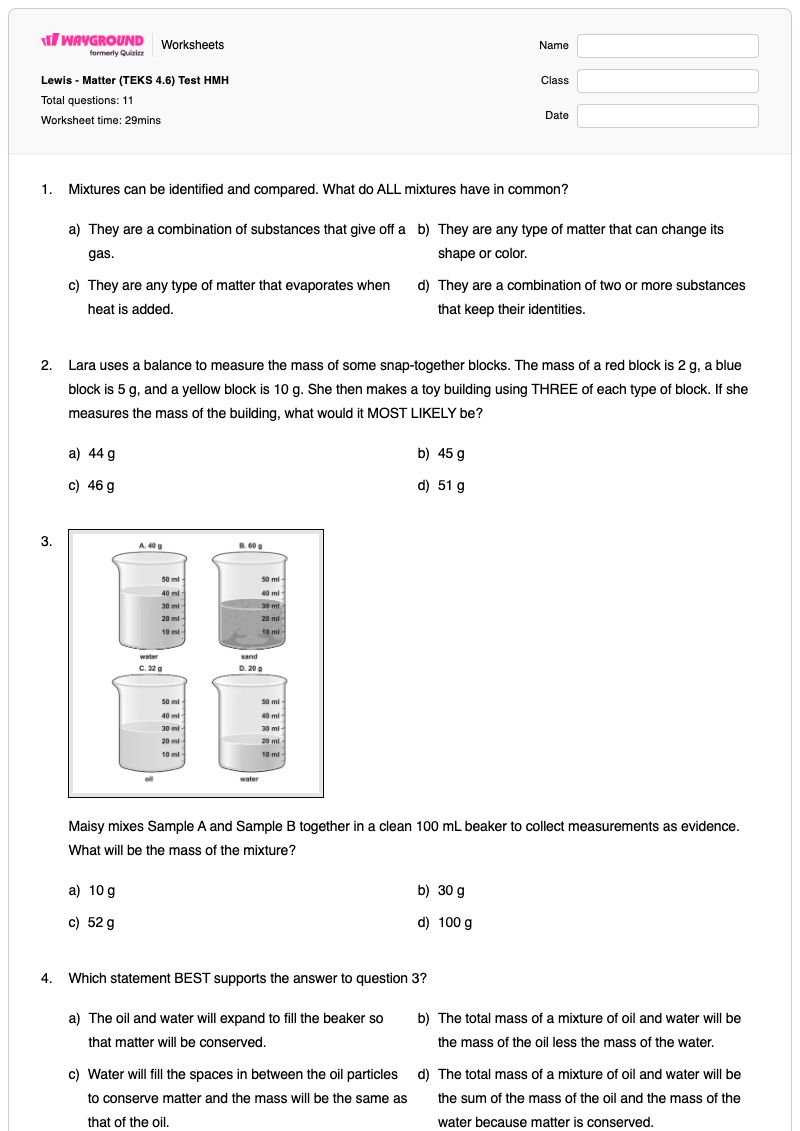
3.

Maisy mixes Sample A and Sample B together in a clean 100 mL beaker to collect measurements as evidence. What will be the mass of the mixture?

a)

10 g

b)

30 g

c)

52 g

d)

100 g

4.

Which statement BEST supports the answer to question 3?

a)

The oil and water will expand to fill the beaker so that matter will be conserved.

b)

The total mass of a mixture of oil and water will be the mass of the oil less the mass of the water.

c)

Water will fill the spaces in between the oil particles to conserve matter and the mass will be the same as that of the oil.

d)

The total mass of a mixture of oil and water will be the sum of the mass of the oil and the mass of the water because matter is conserved.

5.
Question Image

Natalia is investigating properties of water. She uses a thermometer to measure four samples of matter. She lists the results in the table below. Which sample is solid, which is liquid, and which is a gas?

Sample 1

Liquid

Sample 2

Solid

Sample 3

Gas

6.

Chantilly measured 50 grams of dish soap and 100 grams of water into two jars. Then she poured 50 grams of soap into a jar with 100 grams of water, closed the jar, and shook it up, making bubbles. She measured the mixture of soapy water. Chantilly drew this model to show her classmates what she observed.

Which statements about Chantilly’s model are evidence that matter was conserved? Pick TWO correct answers.

a)

A. The model shows that dish soap weighs more than water.

b)

B. The model shows that the bubbles weigh more than the water.

c)

C. The model shows that shaking the mixture does not change its mass.

d)

D. The model shows that mass of the soap and water is equal to the mass of the mixture.

7.

Kelsey and Mickey wondered what would happen to different metals if they were put out in the rain. They chose two pieces of metal: one was shiny and one was dull and black. Each piece weighed 283 grams. Every three days the girls would pour 28 grams of water over each piece of metal. After five weeks, they noticed that the black metal was covered in orange-colored powder. The shiny silver piece was not. They weighed both pieces of metal at the end of five weeks. After they scraped the orange powder off, the black piece of metal weighed only 241 grams.What happened to the piece of black metal, and why did it weigh less after the experiment?

a)

The black metal was iron. When iron is exposed to water, rust forms. The girls learned in class about conservation of mass. They knew that the extra weight had to be somewhere. Kelsey suggested that Mickey weigh the rust. It weighed 42 grams.

b)

The black metal was aluminum. When aluminum is exposed to air, it forms a protective layer that weighs less.

c)

The black metal was copper. When copper is exposed to water, it dissolves partially, reducing its weight.

d)

The black metal was lead. When lead is exposed to water, it reacts and forms a lighter compound.

8.

Rama has two mixtures. Mixture A is salt and water, and Mixture B is oil and water. What can Rama do to separate the parts of each mixture so they can be investigated AND how are Rama’s two mixtures different from one another?

a)

Use a paper filter.

b)

Boil and use evaporation.

c)

Freeze it and the salt and oil will separate.

d)

Weigh it.

9.

Emerald is making mixtures and she wants to compare them and classify the mixtures that are solutions. How can these mixtures be classified? Write the letter of each answer in the correct box. Not all answers will be used.

Mud

Not a solution

Salt water

Solid and liquid solution

Vinegar and water

Liquid and liquid solution

10.

Junior walks into the kitchen. How can he classify the states of matter that he sees in his kitchen?

Solid

Gas

Liquid

11.

Carlos is making mixtures of liquids and solids in the lab. How can he use tools to measure and compare the mixtures?

measuring the mass of solid objects

examining an object upclose

measuring the volume of a liquid

Answer Key

Lewis - Matter (TEKS 4.6) Test HMH

Total questions: 11

1.
d)

They are a combination of two or more substances that keep their identities.

2.
d)

51 g

3.
d)

100 g

4.
d)

The total mass of a mixture of oil and water will be the sum of the mass of the oil and the mass of the water because matter is conserved.

5.

Sample 1

 - 

Liquid

, 

Sample 2

 - 

Solid

, 

Sample 3

 - 

Gas

6.
c)

C. The model shows that shaking the mixture does not change its mass.

, d)

D. The model shows that mass of the soap and water is equal to the mass of the mixture.

7.
a)

The black metal was iron. When iron is exposed to water, rust forms. The girls learned in class about conservation of mass. They knew that the extra weight had to be somewhere. Kelsey suggested that Mickey weigh the rust. It weighed 42 grams.

8.
b)

Boil and use evaporation.

9.

Mud

 - 

Not a solution

, 

Salt water

 - 

Solid and liquid solution

, 

Vinegar and water

 - 

Liquid and liquid solution

10.

 - 

Solid

, 

 - 

Gas

, 

 - 

Liquid

11.

 - 

measuring the mass of solid objects

, 

 - 

examining an object upclose

, 

 - 

measuring the volume of a liquid

FAQs

What does this Grade 4 matter worksheet cover?

This worksheet covers identifying mixtures, comparing properties of matter, classifying states of matter, recognizing solutions, and explaining conservation of mass. Its 11 items use multiple choice, matching, and multiple select to have students calculate mass, interpret investigation evidence, classify samples, and choose how mixture components can be separated.

How can I use this worksheet to teach mixtures and conservation of mass?

Introduce the worksheet by modeling how to add the masses of separate materials, such as the snap-together blocks, before discussing why combining substances does not eliminate their mass. Then use the oil-and-water and soapy-water investigation items to have students cite evidence for conservation of matter. Finish with the classification and measurement matching tasks so students apply the ideas to states of matter, solutions, and laboratory tools.

What mistakes should I watch for when students complete this matter worksheet?

Students may multiply or add the block masses incorrectly instead of using three blocks of each color, or choose a container’s volume as the mixture’s mass. In the multiple-select item, watch for students selecting statements about relative weight instead of evidence that shaking does not change mass and that the original masses equal the mixture’s mass. Students may also confuse a material’s observed change, such as rust formation, with matter disappearing.

How do I assign and grade this matter worksheet?

You can assign this worksheet as a printable PDF or as a digital quiz on Wayground. It includes a complete answer key for the six multiple-choice, four matching, and one multiple-select question. For printable submissions, scan student work with the Wayground for Teachers app to grade it.

How can I differentiate this matter worksheet for my students?

Use the worksheet’s Advanced Settings to adjust font spacing or increase the font size for the measurement tables, matching prompts, and longer investigation questions. You can also apply a dyslexia-friendly font or translate the worksheet into another language, helping students access the mass, mixture, and states-of-matter tasks while keeping the question formats intact.

Where can I find more worksheets like this on Wayground?

Wayground offers a comprehensive collection of free printable worksheets and practice problems across all subjects, with downloadable PDFs and answer keys to support essential skills and concepts. Browse more resources at https://wayground.com/en-us/worksheets.