
Classifying Elements Compounds and Mixtures is a Grade 6–8 science worksheet that helps students distinguish elements, compounds, and mixtures by their composition. Across 25 items, students classify substances, identify compounds such as salt, recognize that matter is made of atoms, and distinguish pure substances from mixtures. Multiple-choice and multiple-select questions also address homogeneous and heterogeneous mixtures, while picture-based items require students to interpret what types of substances are present.
This free printable worksheet with an answer key supports science instruction, independent practice, review, or formative assessment. It gives teachers a focused way to check whether students understand the difference between chemically combined elements in a compound and physically combined substances in a mixture. The classification prompts and visual questions provide opportunities for students to apply definitions rather than only recall vocabulary.
Worksheet settings
Font size
S
M
L
XL
Worksheets
Classifying Elements Compounds and Mixtures
Total questions: 25
Name
Class
Date
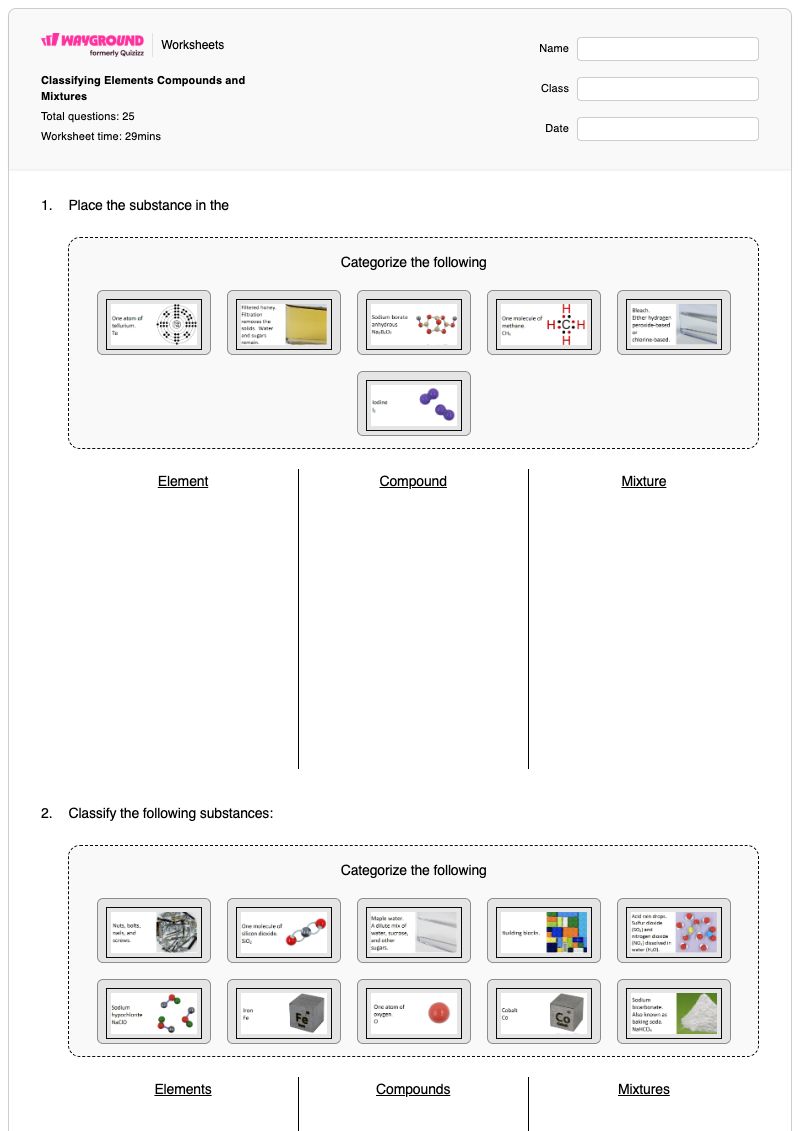
1.
Place the substance in the
Categorize the following
Element
Compound
Mixture
2.
Classify the following substances:
Categorize the following
Elements
Compounds
Mixtures
3.
What is a substance made of two or more elements that are chemically combined called?
a)
A. element
b)
B. compound
c)
C. mixture
d)
D. solution
4.
Is salt (NaCI) a compound or an element?
a)
Compound
b)
element
5.
What is the definition of a compound?
a)
The smallest part of any substance which can exist on its own
b)
Two or more atoms chemically joined together (can be the same or can be different)
c)
A simple substance in which all the atoms are identical
d)
Two or more different elements chemically joined together
6.
All matter is made of .....
a)
energy
b)
atoms
c)
air
d)
chemistry
7.
Two or more physically combined substances form
a)
a compound.
b)
an acid.
c)
an element.
d)
a mixture.
8.
What is an example of a mixture?
a)
Table salt
b)
Water
c)
Oxygen
d)
Air
9.
A compound is made of ________ atoms.
a)
big
b)
similar
c)
different
10.
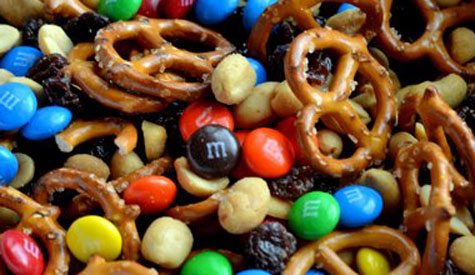
What kind of mixture is shown in the picture?
a)
Homogeneous Mixture
b)
Heterogeneous Mixture
11.
What type of mixture is this?
a)
homogenous mixture
b)
chemical
c)
heterogeneous mixture
d)
solid mix
12.
Which of the following are pure substances?
a)
Elements
b)
Compounds
c)
Mixtures
13.
Element, mixture, or compound?
a)
element
b)
mixture
c)
compound
14.
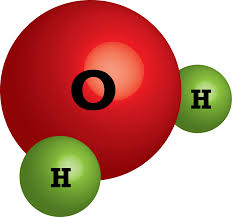
What do you see in this picture?
a)
A pure element
b)
A pure compound
c)
A mixture of two elements
d)
A mixture of two compounds
e)
A mixture of an element and a compound
15.
What do you see in this picture?
a)
A pure element
b)
A pure compound
c)
A mixture of two elements
d)
A mixture of two compounds
e)
A mixture of an element and a compound
16.
Which of the above figures is/are considered a mixture
a)
A. K only
b)
B. M only
c)
C. L and M only
d)
D. K, L and M
17.
Which of diagram represents(s) an element?
a)
A. W only
b)
B. Z only
c)
C. X and Z only
d)
D. X, Y and Z only
18.
Matter is best described as anything that has _________________ only
a)
A. masse
b)
B. mass and velocity
c)
C. mass and takes up space
d)
D. mass, density and exerts pressure
19.
identify the model
a)
element
b)
compound
c)
mixture of element
d)
mixture of compounds
e)
mixture of elements and compounds
20.
identify the model
a)
element
b)
compound
c)
mixture of elements
d)
mixture of compounds
e)
mixture of elements and compounds
21.
How many Oxygen atoms are in H2O?
a)
1
b)
2
c)
0
d)
4
22.
How many elements are in C6H12O6?
a)
1
b)
2
c)
3
d)
4
23.
How many atoms are there TOTAL in H2SO4 ?
a)
6
b)
5
c)
7
d)
3
24.
How many atoms of Hydrogen are in this compound?
a)
1
b)
2
c)
3
d)
4
25.
Which of the following is a compound?
a)
Co
b)
O2
c)
C
d)
CO2
Answer Key
Classifying Elements Compounds and Mixtures
Total questions: 25
1.
Element
Compound
Mixture
2.
Elements
Compounds
Mixtures
3.
b)
B. compound
4.
a)
Compound
5.
d)
Two or more different elements chemically joined together
6.
b) atoms
7.
d)
a mixture.
8.
d)
Air
9.
c)
different
10.
a)
Homogeneous Mixture
11.
c) heterogeneous mixture
12.
b)
Compounds
, a)
Elements
13.
c)
compound
14.
c)
A mixture of two elements
15.
e)
A mixture of an element and a compound
16.
b)
B. M only
17.
a)
A. W only
18.
c)
C. mass and takes up space
19.
b)
compound
20.
c)
mixture of elements
21.
a)
1
22.
c) 3
23.
c)
7
24.
b)
2
25.
d) CO2
140 %
Browse by subjects
Browse by grades
Browse by format
FAQs
What does this worksheet cover, and how does it help students classify elements, compounds, and mixtures?
This Grade 6–8 science worksheet uses 2 classification items, 22 multiple-choice questions, and 1 multiple-select question to examine elements, compounds, mixtures, and pure substances. Students apply composition-based definitions to classify substances, identify homogeneous and heterogeneous mixtures, and interpret pictures showing elements and compounds together. The varied question formats reinforce the difference between chemically combined substances and physically combined substances.
How can I use this worksheet to teach the difference between elements, compounds, and mixtures?
Introduce the classification task by reviewing that elements contain one type of atom, compounds contain two or more different elements chemically joined, and mixtures contain substances physically combined. Have students explain the reasoning behind sample classifications before they complete the multiple-choice items, then use the picture-based questions to discuss how a visual representation can show a pure substance or a combination of substances. Finish by using the multiple-select item to revisit why both elements and compounds are pure substances, while mixtures are not.
What mistakes should I watch for when students complete this elements, compounds, and mixtures worksheet?
Students may confuse a compound with a mixture because both can contain more than one substance; check whether they recognize chemical joining versus physical combination. They may also classify salt as an element instead of a compound, overlook that air is a mixture, or select only one answer when identifying the pure substances in the multiple-select item. In the picture-based questions, watch for confusion between homogeneous and heterogeneous mixtures and between a pure substance and a mixture containing elements or compounds.
How do I assign and grade this elements, compounds, and mixtures worksheet?
The worksheet is available as a printable PDF and as a digital quiz on Wayground, with a complete answer key for the classification, multiple-choice, and multiple-select items. You can grade printable submissions by scanning student work with the Wayground for Teachers app, or review responses through the digital quiz. The printable PDF also gives schools an option for reducing screen time.
How can I differentiate this worksheet for my students?
Use the worksheet’s Advanced Settings to adjust font spacing and font size so the classification prompts, answer choices, and picture-based questions are easier to navigate. You can also select a dyslexia-friendly font or translate the worksheet into another language when that better supports access to the elements, compounds, and mixtures tasks. These changes apply to the worksheet file itself while preserving its original question formats.
Where can I find more worksheets like this on Wayground?
Wayground offers a comprehensive collection of free printable worksheets and practice problems across all subjects, including downloadable PDFs and answer keys that help students master essential skills and concepts. Browse more resources at https://wayground.com/en-us/worksheets.