

Wayground
Vocabulary B9: Evidence of Evolution - Printable Science Worksheets 10th - 10th Grade - Wayground

Vocabulary B9: Evidence of Evolution

Jedy Hodge

By Jedy Hodge

15 questions

10th - 10th Grade

Science

Updated Mar 2026

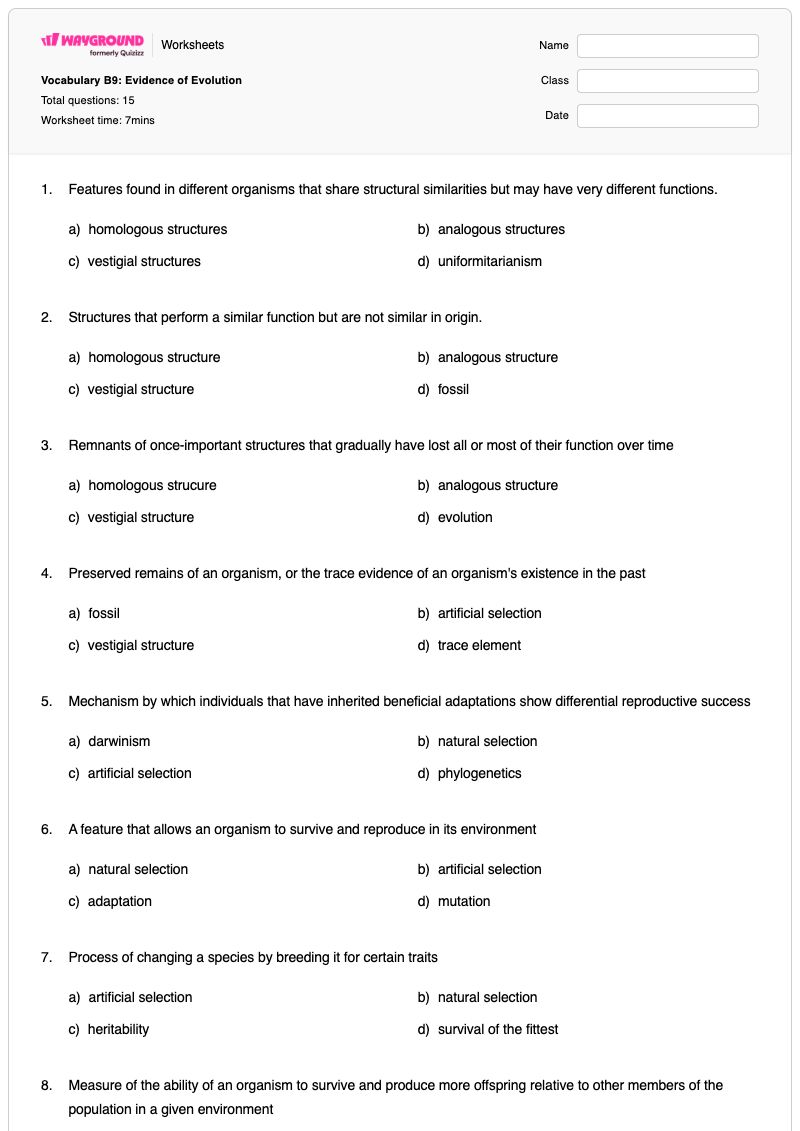
Vocabulary B9: Evidence of Evolution is a Grade 10 biology worksheet that builds students’ command of essential evolution vocabulary through 15 multiple-choice questions. Students identify definitions and examples related to homologous, analogous, and vestigial structures; fossils; natural and artificial selection; adaptations; fitness; embryology; and extinction. The worksheet also asks students to distinguish directional, disruptive, and stabilizing selection from descriptions and a pictured selection pattern. These items help students connect each term to its defining characteristic, such as similar function versus shared origin or extreme versus intermediate phenotypes. This free printable worksheet is useful for vocabulary review, independent practice, or a quick formative check, and it includes a complete answer key for efficient grading.

Worksheet settings

Font size

S
M
L
XL
WaygroundWorksheets

Vocabulary B9: Evidence of Evolution

Total questions: 15

Name
Class
Date
1.

Features found in different organisms that share structural similarities but may have very different functions.

a)

homologous structures

b)

analogous structures

c)

vestigial structures

d)

uniformitarianism

2.

Structures that perform a similar function but are not similar in origin.

a)

homologous structure

b)

analogous structure

c)

vestigial structure

d)

fossil

3.

Remnants of once-important structures that gradually have lost all or most of their function over time

a)

homologous strucure

b)

analogous structure

c)

vestigial structure

d)

evolution

4.

Preserved remains of an organism, or the trace evidence of an organism's existence in the past

a)

fossil

b)

artificial selection

c)

vestigial structure

d)

trace element

5.

Mechanism by which individuals that have inherited beneficial adaptations show differential reproductive success

a)

darwinism

b)

natural selection

c)

artificial selection

d)

phylogenetics

6.

A feature that allows an organism to survive and reproduce in its environment

a)

natural selection

b)

artificial selection

c)

adaptation

d)

mutation

7.

Process of changing a species by breeding it for certain traits

a)

artificial selection

b)

natural selection

c)

heritability

d)

survival of the fittest

8.

Measure of the ability of an organism to survive and produce more offspring relative to other members of the population in a given environment

a)

survival

b)

fitness

c)

reproductive potential

d)

adaptation

9.
What is the study of organisms at the early stages of development?
a)
DNA studies
b)
embryology 
c)
extinction
d)
fossil record
10.
The study of the early stages of development that is one evidence of evolution is:
a)
Homologous Structures
b)
Embryology
c)
Vestigial Organs
11.
What type of selection is depicted in the picture?
What type of selection is depicted in the picture? 
a)
stabilizing 
b)
directional 
c)
disruptive 
d)
the answer is not here
12.
individuals with alleles for an extreme type are more likely to survive and reproduce

individuals with alleles for an extreme type are more likely to survive and reproduce

a)

stabilizing selection

b)

directional selection

c)

disruptive selection

d)

genetic drift

13.
the selection pressure favors the extreme phenotypes, dividing the population into 2 distinct groups

the selection pressure favors the extreme phenotypes, dividing the population into 2 distinct groups

a)

directional selection

b)

stabilizing selection

c)

geographic selection

d)

disruptive selection

14.
Individuals with intermediate traits are more likely to survive and reproduce

Individuals with intermediate traits are more likely to survive and reproduce

a)

stabilizing selection

b)

directional selection

c)

adaptive radiation

d)

disruptive selection

15.

The process in which an animal cannot reproduce any more and dies out is known as _________________________.

a)

Speciation

b)

Extinction

c)

Evolution

d)

Natural Selection

WaygroundAnswer Key

Vocabulary B9: Evidence of Evolution

Total questions: 15

1.
a)

homologous structures

2.
b)

analogous structure

3.
c)

vestigial structure

4.
a)

fossil

5.
b)

natural selection

6.
c)

adaptation

7.
a)

artificial selection

8.
b)

fitness

9.
b) embryology 
10.
b) Embryology
11.
b) directional 
12.
b)

directional selection

13.
d)

disruptive selection

14.
a)

stabilizing selection

15.
b)

Extinction

FAQs

What does the Evidence of Evolution worksheet cover?

This Grade 10 biology worksheet uses 15 multiple-choice questions to assess vocabulary connected to evidence of evolution, including homologous, analogous, and vestigial structures, fossils, embryology, adaptations, fitness, and extinction. It also requires students to identify natural versus artificial selection and distinguish directional, disruptive, and stabilizing selection from descriptions and a pictured pattern.

How can I use this worksheet to teach evidence of evolution vocabulary?

Introduce the terms with a comparison chart, then have students explain why each definition points to a particular term before completing the multiple-choice items. For the selection questions, ask students to describe whether the favored traits are extreme, intermediate, or split into two groups, and use the pictured directional-selection item to connect the visual pattern to the definition.

What mistakes should I watch for when students complete this evolution worksheet?

Students may confuse homologous structures, which share structural origin, with analogous structures, which have similar functions without the same origin. They may also mix up natural and artificial selection, or confuse directional selection with stabilizing selection by overlooking whether an extreme or an intermediate phenotype is favored. Watch for students choosing embryology or fossils based only on the phrase “evidence of evolution” rather than matching the term to its definition.

How do I assign and grade this Evidence of Evolution worksheet?

You can assign this worksheet as a printable PDF or as a digital quiz on Wayground. It includes a complete answer key, and printable submissions can be graded by scanning student work with the Wayground for Teachers app. The printable format also provides an option for schools that want to reduce screen time while reviewing evolution vocabulary.

How can I differentiate this evolution vocabulary worksheet for my students?

Use the worksheet’s Advanced Settings to adjust font spacing and font size so the 15 multiple-choice vocabulary and selection items are easier to scan. You can also enable a dyslexia-friendly font or translate the worksheet into another language, supporting access to definitions such as fitness, embryology, and disruptive selection without changing the questions.

Where can I find more worksheets like this on Wayground?

Wayground offers a comprehensive collection of free printable worksheets and practice problems across subjects, with downloadable PDFs and answer keys to help students master essential skills and concepts. Browse more resources at https://wayground.com/en-us/worksheets.