

Wayground
Limiting Factors - Printable Science Worksheets - Wayground

Limiting Factors

16 questions

7th - 7th Grade

Science

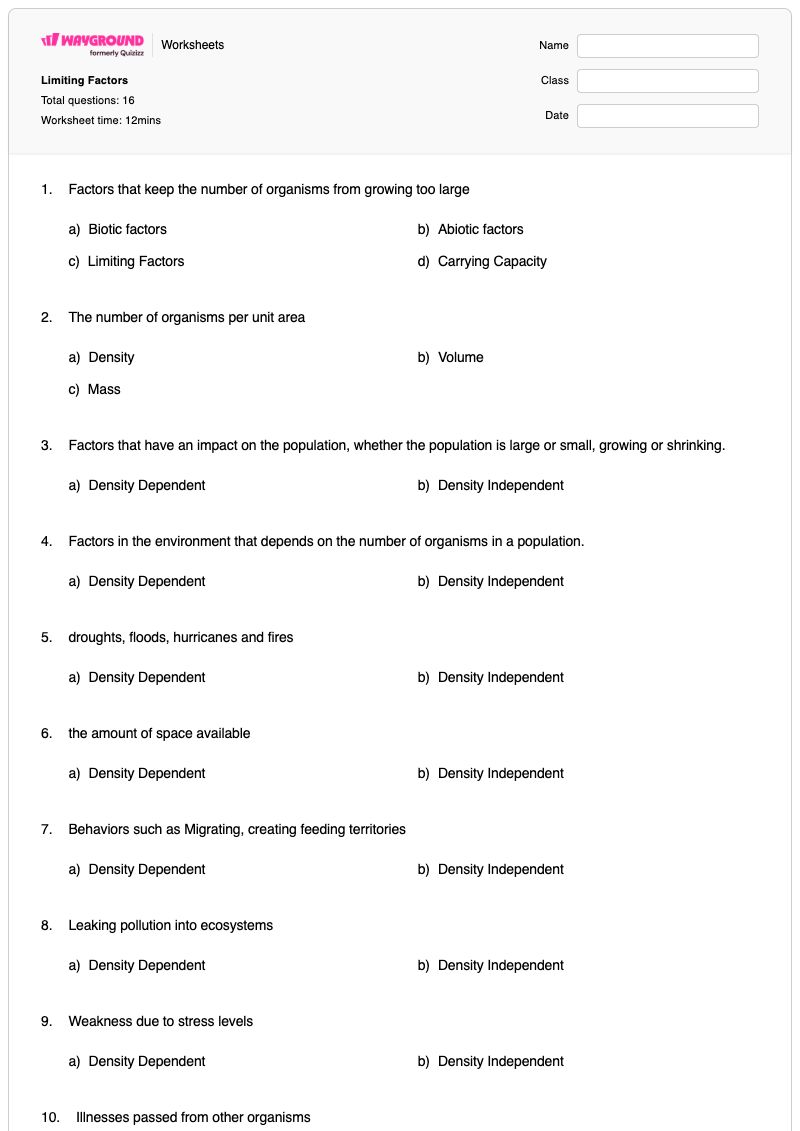
This Grade 7 science worksheet builds understanding of limiting factors that control population growth. Across 16 multiple-choice questions, students identify the meaning of limiting factors and density, distinguish density-dependent from density-independent factors, and classify examples such as droughts, floods, pollution, disease, parasitism, competition, predator-prey relationships, sunlight, and available space. The worksheet is designed for middle school ecology lessons, review, independent practice, or a quick formative assessment. Its example-based questions require students to connect definitions to real environmental conditions rather than recall vocabulary in isolation. Use the included answer key to review classifications, address misconceptions, and reinforce how population conditions relate to environmental factors. This is a free printable worksheet with an answer key.

Worksheet settings

Font size

S
M
L
XL
Worksheets

Limiting Factors

Total questions: 16

Name
Class
Date
1.

Factors that keep the number of organisms from growing too large

a)

Biotic factors

b)

Abiotic factors

c)

Limiting Factors

d)

Carrying Capacity

2.

The number of organisms per unit area

a)

Density

b)

Volume

c)

Mass

3.

Factors that have an impact on the population, whether the population is large or small, growing or shrinking.

a)

Density Dependent

b)

Density Independent

4.

Factors in the environment that depends on the number of organisms in a population.

a)

Density Dependent

b)

Density Independent

5.

droughts, floods, hurricanes and fires

a)

Density Dependent

b)

Density Independent

6.

the amount of space available

a)

Density Dependent

b)

Density Independent

7.

Behaviors such as Migrating, creating feeding territories

a)

Density Dependent

b)

Density Independent

8.

Leaking pollution into ecosystems

a)

Density Dependent

b)

Density Independent

9.

Weakness due to stress levels

a)

Density Dependent

b)

Density Independent

10.

Illnesses passed from other organisms

a)

Density Dependent

b)

Density Independent

11.

Changes in temperature or climate

a)

Density Dependent

b)

Density Independent

12.

The amount of Sunlight in an ecosystem

a)

Density Dependent

b)

Density Independent

13.

When an organism lives in or on another organism and causes harm to the host organism

a)

Density Dependent

b)

Density Independent

14.

2 or more different types of organisms using the same resources

a)

Density Dependent

b)

Density Independent

15.

Cheetah vs gazelle

a)

Density Dependent

b)

Density Independent

16.

Camouflage or warning colors

a)

Density Dependent

b)

Density Independent

Answer Key

Limiting Factors

Total questions: 16

1.
c)

Limiting Factors

2.
a)

Density

3.
b)

Density Independent

4.
a)

Density Dependent

5.
b)

Density Independent

6.
a)

Density Dependent

7.
b)

Density Independent

8.
b)

Density Independent

9.
a)

Density Dependent

10.
a)

Density Dependent

11.
b)

Density Independent

12.
b)

Density Independent

13.
a)

Density Dependent

14.
a)

Density Dependent

15.
a)

Density Dependent

16.
b)

Density Independent

FAQs

What does the Limiting Factors worksheet cover?

This Grade 7 science worksheet uses 16 multiple-choice questions to assess limiting factors, population density, and the difference between density-dependent and density-independent factors. Students apply these classifications to examples including natural disasters, pollution, disease, parasitism, competition, predator-prey interactions, sunlight, and available space, building skill in connecting ecology vocabulary to population conditions.

How can I use this worksheet to teach density-dependent and density-independent limiting factors?

Introduce the key definitions of limiting factors and density, then have students explain whether each factor depends on the number of organisms in a population. Use the worksheet’s example items—such as droughts, disease, competition, pollution, and predator-prey relationships—as discussion prompts before students complete the multiple-choice questions independently. Review the classifications afterward and ask students to justify the choices they found most difficult.

What mistakes should I watch for when students complete this limiting factors worksheet?

Students may confuse density with carrying capacity or treat all environmental changes as density-dependent. Watch for incorrect classifications of examples such as droughts, floods, temperature changes, and sunlight versus disease, parasitism, competition, and limited space. They may also focus on whether an event is harmful instead of deciding whether its effect depends on population size.

How do I assign and grade this limiting factors worksheet?

The worksheet is available as a printable PDF and as a digital quiz on Wayground, so you can choose the format that fits your lesson. It includes a complete answer key for the 16 multiple-choice questions, and printable submissions can be graded by scanning student work with the Wayground for Teachers app. The printable option can also support schools that are reducing screen time.

How can I differentiate this limiting factors worksheet for my students?

Use the worksheet’s Advanced Settings to adjust font spacing and font size so the definitions and multiple-choice options are easier to read. You can also enable a dyslexia-friendly font or translate the worksheet into another language, which may help students access the ecology vocabulary and example-based classification items.

Where can I find more worksheets like this on Wayground?

Wayground offers a comprehensive collection of free printable worksheets and practice problems across all subjects, with downloadable PDFs and answer keys to help students master essential skills and concepts. Browse more resources at https://wayground.com/en-us/worksheets.