

Wayground
Ocean Productivity  - Printable Science Worksheets - Wayground

Ocean Productivity

17 questions

9th - 9th Grade

Science

Ocean Productivity is a free Grade 9 science printable worksheet with an answer key that helps students connect ocean circulation, nutrient availability, photosynthesis, and marine food webs. Across 17 questions—15 multiple choice and 2 multiple select—students identify upwelling, explain how wind moves warm surface water, and distinguish wind-driven surface currents from density-driven deep ocean currents. Students also use foundational biology and ecology concepts to explain why nutrients and light affect ocean productivity. The worksheet asks them to recognize cold water as denser than warm water, identify phytoplankton as the basis of the marine food chain, interpret energy flow in a food chain, identify photosynthesis products and requirements, and determine when productivity may be lowest. It is suited to Grade 9 review, formative assessment, or independent practice after instruction on ocean systems and productivity.

Worksheet settings

Font size

S
M
L
XL
Worksheets

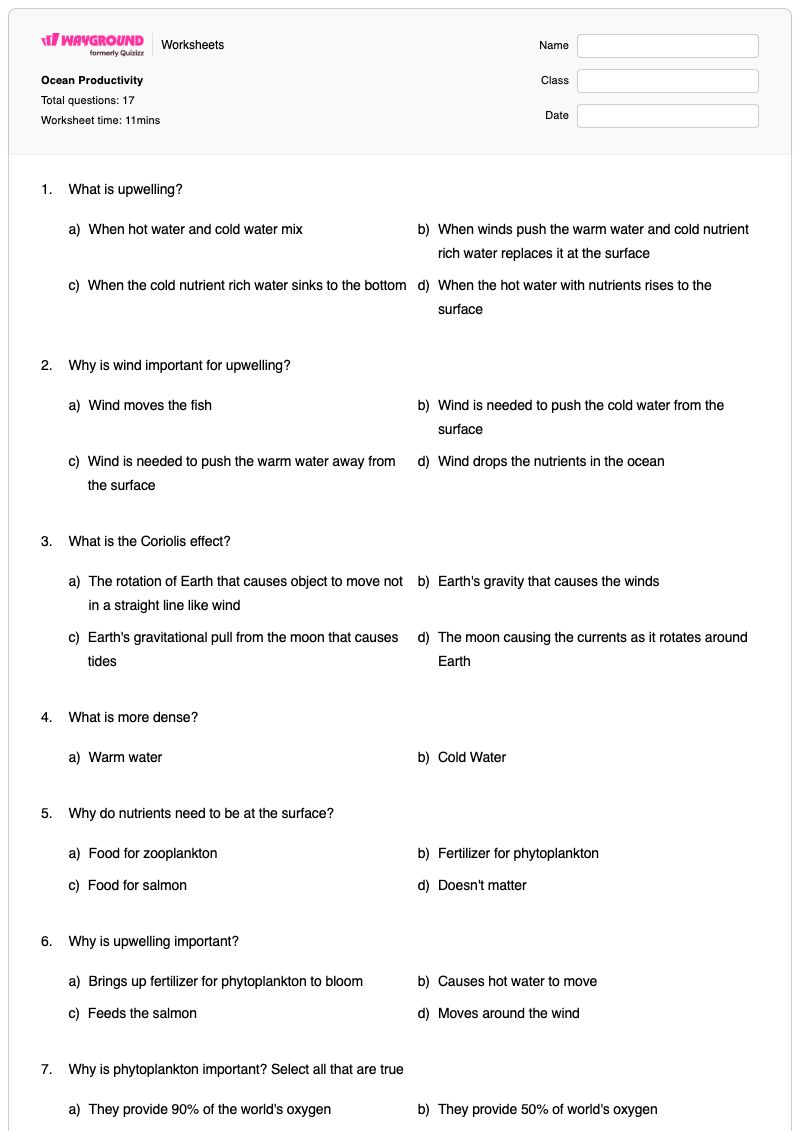
Ocean Productivity

Total questions: 17

Name
Class
Date
1.

What is upwelling?

a)

When hot water and cold water mix

b)

When winds push the warm water and cold nutrient rich water replaces it at the surface

c)

When the cold nutrient rich water sinks to the bottom

d)

When the hot water with nutrients rises to the surface

2.

Why is wind important for upwelling?

a)

Wind moves the fish

b)

Wind is needed to push the cold water from the surface

c)

Wind is needed to push the warm water away from the surface

d)

Wind drops the nutrients in the ocean

3.

What is the Coriolis effect?

a)

The rotation of Earth that causes object to move not in a straight line like wind

b)

Earth's gravity that causes the winds

c)

Earth's gravitational pull from the moon that causes tides

d)

The moon causing the currents as it rotates around Earth

4.

What is more dense?

a)

Warm water

b)

Cold Water

5.

Why do nutrients need to be at the surface?

a)

Food for zooplankton

b)

Fertilizer for phytoplankton

c)

Food for salmon

d)

Doesn't matter

6.

Why is upwelling important?

a)

Brings up fertilizer for phytoplankton to bloom

b)

Causes hot water to move

c)

Feeds the salmon

d)

Moves around the wind

7.

Why is phytoplankton important? Select all that are true

a)

They provide 90% of the world's oxygen

b)

They provide 50% of world's oxygen

c)

They eat orca whales

d)

They are the basis of the marine food chain

8.

What does the food chain show?

a)

Flow of energy in an ecosystem

b)

Flow of forces in an ecosystem

c)

Flow of matter in an ecosystem

d)

Life cycles

9.

Deep ocean currents are caused by

a)

Wind

b)

Differences in densities

c)

Differences in temperature

d)

Cold and warm air currents

10.

Surface currents in the ocean are caused by

a)

Hot and cold temperatures

b)

Differences in Density

c)

Wind

d)

Hurricanes

11.

What is produced during photosynthesis?

a)

Carbon dioxide, water and Oxygen

b)

Glucose, water and Oxygen

c)

Caron dioxide, water and Glucose

d)

Carbon dioxide, water and light

12.

What are the two most significant factors affecting photosynthesis in the ocean

a)

Temperature

b)

Carbon Dioxide

c)

Nutrients

d)

Light

13.

Which time of the year would have the potential for the lowest productivity?

a)

Winter

b)

Spring

c)

Summer

d)

Fall

14.

What factors are likely to limit the growth and productivity of plants and algae if there is not enough available?

a)

bacteria and viruses

b)

light and nutrients

c)

hydrogen ions

d)

epiphytes

15.

Producers like plants and algae require these for photosynthesis to occur:

a)

carbon dioxide and water

b)

glucose and oxygen

c)

oxygen and water

d)

carbon dioxide and oxygen

16.

This color of light is absorbed closest to the surface and cannot be seen in deeper water.

a)

blue

b)

red

c)

green

d)

yellow

17.

A secondary consumer only gains ____ of the energy of the total available energy of the primary consumer that it eats.

a)

30%

b)

50%

c)

90%

d)

10%

Answer Key

Ocean Productivity

Total questions: 17

1.
b)

When winds push the warm water and cold nutrient rich water replaces it at the surface

2.
c)

Wind is needed to push the warm water away from the surface

3.
a)

The rotation of Earth that causes object to move not in a straight line like wind

4.
b)

Cold Water

5.
b)

Fertilizer for phytoplankton

6.
a)

Brings up fertilizer for phytoplankton to bloom

7.
b)

They provide 50% of world's oxygen

, d)

They are the basis of the marine food chain

8.
a)

Flow of energy in an ecosystem

9.
b)

Differences in densities

10.
c)

Wind

11.
b)

Glucose, water and Oxygen

12.
c)

Nutrients

, d)

Light

13.
a)

Winter

14.
b)

light and nutrients

15.
a)

carbon dioxide and water

16.
b)

red

17.
d)

10%

FAQs

What does the Ocean Productivity worksheet cover, and how does it help students learn the concept?

This Grade 9 science worksheet uses 15 multiple-choice and 2 multiple-select questions to connect upwelling with ocean productivity. Students identify how wind moves warm surface water so cold, nutrient-rich water rises, distinguish wind-driven surface currents from density-driven deep currents, and explain how nutrients and light support phytoplankton growth. Questions about photosynthesis, food-chain energy flow, and seasonal productivity help students link physical ocean processes to marine ecosystems.

How can I use this worksheet to teach ocean productivity?

Introduce the worksheet by having students trace the sequence from wind-driven upwelling to nutrient availability, phytoplankton growth, and marine food-web support. Before assigning it, discuss why cold water is denser than warm water and contrast wind-driven surface currents with density-driven deep currents. Use the multiple-select questions as discussion prompts: ask students to justify both factors affecting photosynthesis in the ocean and both roles of phytoplankton rather than selecting only one answer.

What mistakes should I watch for when students complete the Ocean Productivity worksheet?

Students may reverse the direction of upwelling by choosing that cold, nutrient-rich water sinks instead of recognizing that it replaces warm surface water. They may also confuse wind-driven surface currents with density-driven deep currents or mistake temperature for the main pair of ocean photosynthesis factors identified in the worksheet: nutrients and light. On the multiple-select items, check that students select all supported roles of phytoplankton and both relevant productivity factors, not just one option.

How do I assign and grade the Ocean Productivity worksheet?

The worksheet is available as a printable PDF and as a digital quiz on Wayground, and it includes a complete answer key for all 17 questions. Printable submissions can be graded by scanning student work with the Wayground for Teachers app. The PDF option also supports schools that want to reduce screen time while students review ocean productivity concepts.

How can I differentiate the Ocean Productivity worksheet for my students?

Use the worksheet’s Advanced Settings to adjust font spacing and font size when the scientific vocabulary or answer choices need more visual room. You can also apply a dyslexia-friendly font to the questions about upwelling, currents, photosynthesis, and phytoplankton, or translate the worksheet into another language to support comprehension of the ocean-science terminology.

Where can I find more worksheets like this on Wayground?

Wayground offers a comprehensive collection of free printable worksheets and practice problems across all subjects, with downloadable PDFs and answer keys to help students master essential skills and concepts. Browse more worksheets at https://wayground.com/en-us/worksheets.