

Wayground
Child Development - Stages & Areas - Printable Physical Education Worksheets 7th Grade - Wayground

Child Development - Stages & Areas

Jennifer Sachs

Created by Jennifer Sachs

16 questions

7th Grade

Physical Education

Updated Dec 2025

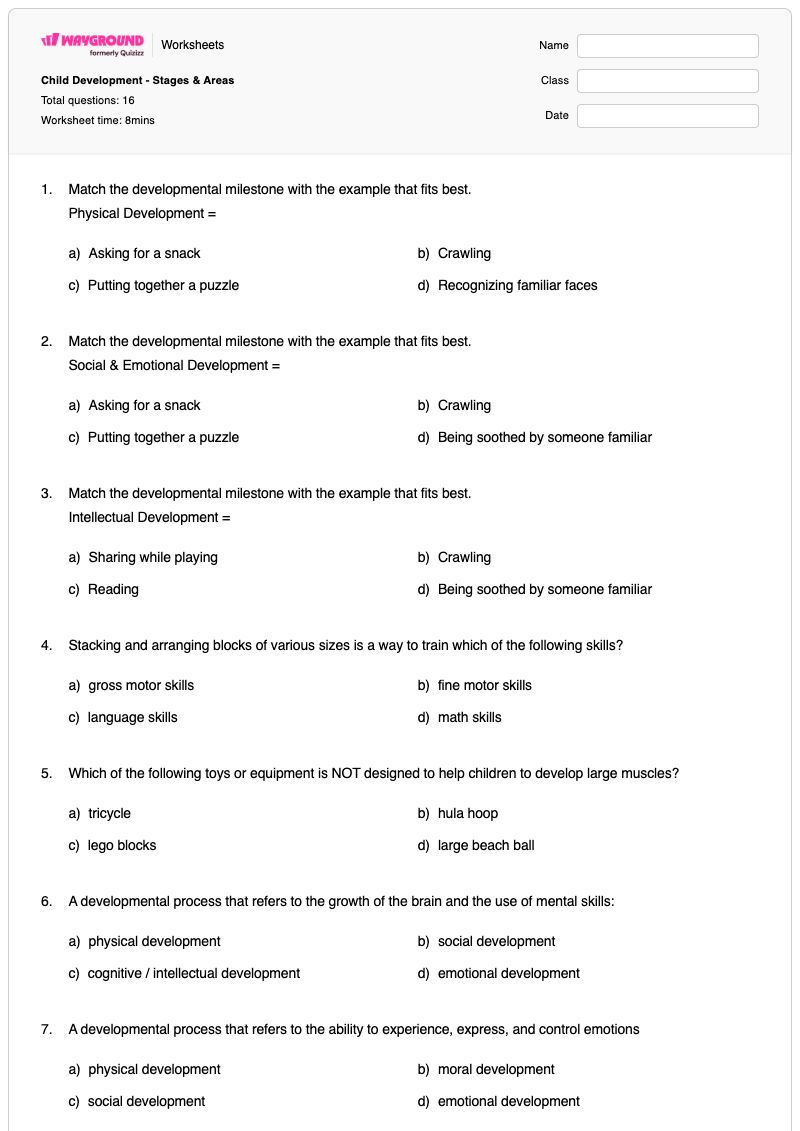
Child Development - Stages & Areas is a free printable Grade 7 Life Skills worksheet with an answer key that helps students identify major areas and stages of child development. Through 16 multiple-choice questions, students classify examples as physical, social, emotional, or cognitive/intellectual development and connect activities such as crawling, reading, block play, and using a tricycle with the skills they support. The worksheet also checks students’ understanding of fine and gross motor skills, emotional expression, social relationships, individual differences in development, and common age-stage labels, including infants, toddlers, school agers, and adolescents. It is useful for introducing or reviewing child development vocabulary, reinforcing distinctions between closely related concepts, and checking whether students can apply definitions to everyday examples rather than simply memorize terms.

Worksheet settings

Font size

S
M
L
XL
WaygroundWorksheets

Child Development - Stages & Areas

Total questions: 16

Name
Class
Date
1.

Match the developmental milestone with the example that fits best.

Physical Development =

a)

Asking for a snack

b)

Crawling

c)

Putting together a puzzle

d)

Recognizing familiar faces

2.

Match the developmental milestone with the example that fits best.

Social & Emotional Development =

a)

Asking for a snack

b)

Crawling

c)

Putting together a puzzle

d)

Being soothed by someone familiar

3.

Match the developmental milestone with the example that fits best.

Intellectual Development =

a)

Sharing while playing

b)

Crawling

c)

Reading

d)

Being soothed by someone familiar

4.

Stacking and arranging blocks of various sizes is a way to train which of the following skills?

a)

gross motor skills

b)

fine motor skills

c)

language skills

d)

math skills

5.

Which of the following toys or equipment is NOT designed to help children to develop large muscles?

a)

tricycle

b)

hula hoop

c)

lego blocks

d)

large beach ball

6.

A developmental process that refers to the growth of the brain and the use of mental skills:

a)

physical development

b)

social development

c)

cognitive / intellectual development

d)

emotional development

7.

A developmental process that refers to the ability to experience, express, and control emotions

a)

physical development

b)

moral development

c)

social development

d)

emotional development

8.

A developmental process that refers to the physical growth of a person's body:

a)

physical development

b)

social development

c)

cognitive / intellectual development

d)

emotional development

9.

There are general patterns to how children develop, but each child is...

a)

unique

b)

the same

c)

born knowing to say "no"

d)

knowledgeable at birth

10.

The social stage of child development deals with...

a)

walking

b)

running

c)

eating on their own

d)

getting along with others

11.

The emotional stage of child development deals with...

a)

how children learn

b)

how children grow

c)

teaching a child to eat

d)

having feelings of happy, sad, mad, fearful

12.

Children ages about one or walking age through age two are known as...

a)

toddlers

b)

preschoolers

c)

infants

d)

adoslescents

13.

Children ages birth through about one are known as...

a)

toddlers

b)

preschoolers

c)

infants

d)

adoslescents

14.

Children ages 5 - 11 are known as...

a)

toddlers

b)

preschoolers

c)

school agers

d)

adoslescents

15.

Children ages 11+ are known as...

a)

toddlers

b)

preschoolers

c)

school agers

d)

adoslescents

16.

Children ages three or four...

a)

toddlers

b)

preschoolers

c)

school agers

d)

adoslescents

WaygroundAnswer Key

Child Development - Stages & Areas

Total questions: 16

1.
b)

Crawling

2.
d)

Being soothed by someone familiar

3.
c)

Reading

4.
b)

fine motor skills

5.
c)

lego blocks

6.
c)

cognitive / intellectual development

7.
d)

emotional development

8.
a)

physical development

9.
a)

unique

10.
d)

getting along with others

11.
d)

having feelings of happy, sad, mad, fearful

12.
a)

toddlers

13.
c)

infants

14.
c)

school agers

15.
d)

adoslescents

16.
b)

preschoolers

FAQs

What does the Child Development - Stages & Areas worksheet cover?

This Grade 7 Life Skills worksheet uses 16 multiple-choice questions to assess how students identify physical, social, emotional, and cognitive/intellectual development. Students apply those categories to examples such as crawling, reading, being soothed by a familiar person, and getting along with others, while also distinguishing fine from gross motor skills and identifying age stages.

How can I use this worksheet to teach child development stages and areas?

Introduce the four development areas with a simple class chart, then have students explain why each example belongs in a particular category before completing the multiple-choice items. Use the questions about infants, toddlers, school agers, and adolescents as a follow-up sorting activity, asking students to justify each age-stage label and discuss why children may develop on individual timelines.

What mistakes should I watch for when students complete this child development worksheet?

Watch for students confusing physical development with fine or gross motor skills, such as choosing gross motor skills for stacking blocks or identifying LEGO blocks as equipment for large-muscle development. Students may also mix up social development with emotional development, or confuse the age labels for infants, toddlers, school agers, and adolescents.

How do I assign and grade this child development worksheet?

You can assign Child Development - Stages & Areas as a printable PDF or as a digital quiz on Wayground. It includes a complete answer key, and printable submissions can be graded by scanning student work with the Wayground for Teachers app. The printable format can also support schools that are reducing screen time.

How can I differentiate this child development worksheet for my students?

In the worksheet’s Advanced Settings, adjust font spacing or choose a larger font size to make the 16 multiple-choice questions and answer choices easier to read. You can also enable a dyslexia-friendly font or translate the worksheet into another language, which may help students access its child development vocabulary and age-stage labels.

Where can I find more worksheets like this on Wayground?

Wayground offers a broad collection of free printable worksheets and practice problems across subjects, with downloadable PDFs and answer keys to help students master essential skills and concepts. Browse more resources at https://wayground.com/en-us/worksheets.