

Wayground
IB SEHS Topic 5 - Skill in Sports - Printable Physical Education Worksheets 12th Grade - Wayground

IB SEHS Topic 5 - Skill in Sports

Ayla Parham-Cortez

Created by Ayla Parham-Cortez

40 questions

12th Grade

Physical Education

Updated Apr 2026

This Grade 12 Science worksheet supports IB Sports, Exercise and Health Sciences Topic 5: Skill in Sports. It contains 40 multiple-choice questions that ask students to classify motor skills, identify technique and ability, apply Welford’s information-processing model, recognize sensory receptors, and distinguish reaction time from response time. Students also interpret examples involving swimming, baseball, hockey, gymnastics, tennis, basketball, golf, and other sporting contexts. The questions further assess students’ understanding of skill transfer, including bilateral transfer and principles-to-skills transfer, as well as Hick’s Law, short-term memory, perceptual skill, and signal intensity. Completing the set helps students connect terminology and models to practical sports examples rather than recalling definitions in isolation. This is a free printable worksheet with a complete answer key, suitable for Grade 12 review, guided practice, or checking understanding before an IB SEHS assessment.

Worksheet settings

Font size

S
M
L
XL
WaygroundWorksheets

IB SEHS Topic 5 - Skill in Sports

Total questions: 40

Name
Class
Date
1.
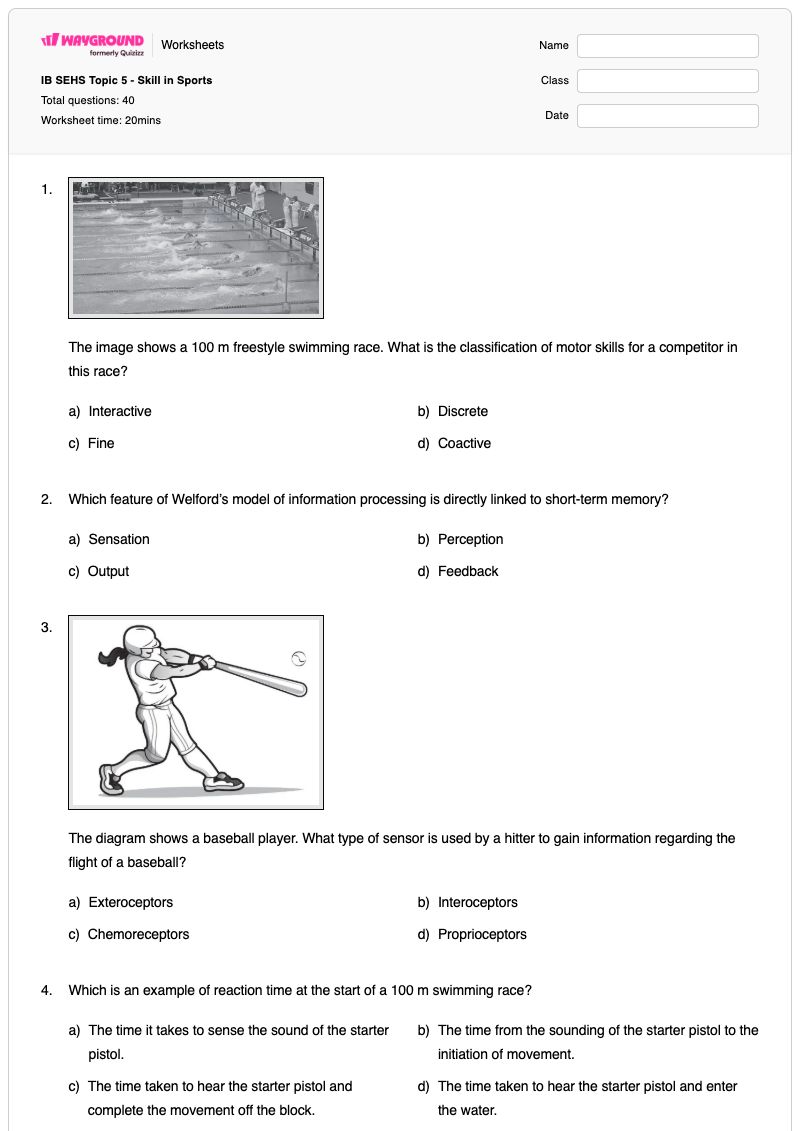
The image shows a 100 m freestyle swimming race. What is the classification of motor skills for a competitor in this race?

The image shows a 100 m freestyle swimming race. What is the classification of motor skills for a competitor in this race?

a)

Interactive

b)

Discrete

c)

Fine

d)

Coactive

2.

Which feature of Welford’s model of information processing is directly linked to short-term memory?

a)

Sensation

b)

Perception

c)

Output

d)

Feedback

3.
The diagram shows a baseball player. What type of sensor is used by a hitter to gain information regarding the flight of a…

The diagram shows a baseball player. What type of sensor is used by a hitter to gain information regarding the flight of a baseball?

a)

Exteroceptors

b)

Interoceptors

c)

Chemoreceptors

d)

Proprioceptors

4.

Which is an example of reaction time at the start of a 100 m swimming race?

a)

The time it takes to sense the sound of the starter pistol.

b)

The time from the sounding of the starter pistol to the initiation of movement.

c)

The time taken to hear the starter pistol and complete the movement off the block.

d)

The time taken to hear the starter pistol and enter the water.

5.
The diagram shows a gymnast performing a tuck somersault. What type of transfer occurs when a gymnast learns that forming a…

The diagram shows a gymnast performing a tuck somersault.

What type of transfer occurs when a gymnast learns that forming a tuck in a somersault will reduce the moment of inertia and allow them to spin faster?

a)

Skill to skill

b)

Practice to performance

c)

Stage to stage

d)

Principles to skills

6.
The diagram shows a field hockey player. What is the correct classification of motor skills for dribbling in hockey?

The diagram shows a field hockey player. What is the correct classification of motor skills for dribbling in hockey?

a)

Gross - Serial - Open

b)

Fine - Serial - Closed

c)

Gross - Discrete - Open

d)

Fine - Discrete - Closed

7.

Which phrase describes technique?

a)

Learned movements that are specific to a certain task

b)

The way in which a specific sports skill is performed

c)

The general capacity of an individual to perform well

d)

Characteristics that allow for effective learning

8.

What is the relationship between ability, skill and technique?

a)

Skill = ability + technique

b)

Technique = ability + skill

c)

Skill = ability x technique

d)

Technique = ability - skill

9.

What is response time?

a)

The amount of time between the stimulus and the initiation of the movement

b)

The amount of time between the stimulus and the completion of movement

c)

Response time = movement time - reaction time

d)

The amount of time from the initiation of a movement to the completion of a movement

10.
The graphs represent how reaction time changes when additional possible outcomes are introduced into a situation. Which…

The graphs represent how reaction time changes when additional possible outcomes are introduced into a situation. Which graph Represents Hick's Law?

a)

A

b)

B

c)

C

d)

D

11.

Which type of transfer is best demonstrated when a baseball player learns to hit a ball both left handed and right handed?

a)

Skill to skill

b)

Stage to stage

c)

Bilateral

d)

Practice to performance

12.

Which is an example of perceptual skill?

a)

Knowledge of team tactics

b)

Shooting in basketball

c)

Assessing the putting green in golf

d)

Receiving a serve in tennis

13.

What does ability refer to?

a)

The production of goal-orientated movements

b)

The way in which a sports skill is performed

c)

A learned skill that is specific to the task

d)

The general trait or capacity of the individual

14.

Why are yellow balls used in tennis?

a)

To increase signal intensity

b)

To limit background noise

c)

To improve the efficiency of sense organs

d)

To improve memory retrieval

15.

What is the average capacity of short-term memory?

a)

1 bit of information

b)

2±7 bits of information

c)

7±2 bits of information

d)

Unlimited

16.

What is Hick’s Law?

a)

Increase in reaction time with increased number of choices

b)

Decrease in reaction time with increased number of choices

c)

Increase in movement time with increased number of choices

d)

Decrease in movement time with increased number of choices

17.

Which describes practice to performance transfer in tennis?

a)

Hitting against a ball machine

b)

Understanding the biomechanics of hitting

c)

Training for strength to improve hitting

d)

Hitting right-handed and left-handed

18.

What is an example of an open skill?

a)

A serve in tennis

b)

A free throw in basketball

c)

A javelin throw

d)

A pass in soccer

19.

What is an example of a perceptual motor ability?

a)

Strength

b)

Reaction Time

c)

Flexibility

d)

Endurance

20.

Which is an example of information received through proprioceptors?

a)

Recognition of a cool temperature

b)

Recognition of wind resistance

c)

Detection of blood glucose concentration

d)

Detection of the location of one’s body in space

21.

What is rehearsal in memory improvement?

a)

Grouping information into larger sets

b)

Storing information through repetition

c)

Associating information with prior experiences

d)

Remembering specific details

22.

What is movement time?

a)

Response time - reaction time

b)

Response time + reaction time

c)

Response time × reaction time

d)

Response time ÷ reaction time

23.

What is the role of selective attention?

a)

To filter relevant information from noise

b)

To hold all information for seconds

c)

To store relevant information for years

d)

To pass all information to the long-term memory

24.
Which graph shows a negatively accelerated learning curve?

Which graph shows a negatively accelerated learning curve?

a)

A

b)

B

c)

C

d)

D

25.

Which type of presentation involves the repetitive practice of a single part of a skill?

a)

Whole

b)

Whole-part-whole

c)

Progressive part

d)

Part

26.

Which motor skill classifications apply when an athlete runs a 100 m race?

a)

Gross, interactive, externally paced

b)

Fine, individual, internally paced

c)

Gross, coactive, externally paced

d)

Fine, coactive, internally paced

27.
What is measured by the drop test?

What is measured by the drop test?

a)

Reaction time

b)

Response time

c)

Movement time

d)

Coordination

28.

As a golfer hits the ball they feel a sharp pain in the right bicep; this is an example of which types of feedback?

a)

Knowledge of result, negative, terminal

b)

Knowledge of result, positive, concurrent

c)

Knowledge of performance, negative, concurrent

d)

Knowledge of performance, positive, terminal

29.

A teacher introduced fencing to a group of judo athletes. Actions in judo are initiated by the foot whereas fencing actions are initiated by the hand. The judo athletes were slow to master the fencing skills.

What learning transfer took place?

a)

Positive

b)

Negative

c)

Bilateral

d)

Stage to Stage

30.
A coach is teaching a large group of students in a potentially dangerous situation, for example shot put training. What is…

A coach is teaching a large group of students in a potentially dangerous situation, for example shot put training.

What is the safest teaching style to use?

a)

Command

b)

Reciprocal

c)

Problem-solving

d)

Mental

31.

What type of skill is used to decide and perform a pass in soccer?

a)

Cognitive skill

b)

Perceptual skill

c)

Motor skill

d)

Perceptual motor skill

32.
Which classifies the release of an arrow in archery?

Which classifies the release of an arrow in archery?

a)

Fine-closed-continuous

b)

Fine-individual-discrete

c)

Gross-closed-discrete

d)

Gross-individual-continuous

33.

What is a characteristic of short-term sensory store?

a)

It contains motor programmes

b)

It can convert information into a knowledge structure

c)

It has a high capacity for storing information

d)

It is relatively permanent area for storing information

34.

Which describes the associative stage of learning?

a)

Performers' movements are regularly practiced and refined

b)

Performers consistently complete actions with fluency

c)

Performers' movements are erratic and lack fluency

d)

Performers regularly focus on irrelevant stimuli for movements that require perception.

35.

What type of transfer occurs from a 3 versus 3 training game to a 5 versus 5 competitive basketball game?

a)

Skill to skill

b)

Abilities to skill

c)

Practice to perfomance

d)

Stage to stage

36.

What is skill?

a)

A general trait or capacity of an individual

b)

A procedure for completing a task

c)

The way an action is learned

d)

The consistent production of goal-oriented movements

37.

What is an example of a serial skill?

a)

Riding a bicycle

b)

Playing tennis

c)

Hitting a golf ball

d)

Performing a gymnastics routine

38.

What is coding in memory improvement?

a)

Remembering short and specific details rather than long and vague information

b)

Presenting information in a clear and logical format

c)

Associating information with images

d)

Storing information through repetition

39.

Which describes knowledge of results feedback?

a)

The coach describing the quality of a performance

b)

The coach providing technique information after a performance

c)

A basketball player seeing that the ball went into the basket

d)

A basketball player analyzing their technique on replay

40.

When is massed practice most suitable?

a)

For performers with low motivation

b)

For performers with high motication

c)

For performers practicing open skills

d)

For performers practicing closed skills

WaygroundAnswer Key

IB SEHS Topic 5 - Skill in Sports

Total questions: 40

1.
d)

Coactive

2.
b)

Perception

3.
a)

Exteroceptors

4.
b)

The time from the sounding of the starter pistol to the initiation of movement.

5.
d)

Principles to skills

6.
a)

Gross - Serial - Open

7.
b)

The way in which a specific sports skill is performed

8.
a)

Skill = ability + technique

9.
b)

The amount of time between the stimulus and the completion of movement

10.
c)

C

11.
c)

Bilateral

12.
c)

Assessing the putting green in golf

13.
d)

The general trait or capacity of the individual

14.
a)

To increase signal intensity

15.
c)

7±2 bits of information

16.
a)

Increase in reaction time with increased number of choices

17.
a)

Hitting against a ball machine

18.
d)

A pass in soccer

19.
b)

Reaction Time

20.
d)

Detection of the location of one’s body in space

21.
b)

Storing information through repetition

22.
a)

Response time - reaction time

23.
a)

To filter relevant information from noise

24.
c)

C

25.
d)

Part

26.
c)

Gross, coactive, externally paced

27.
a)

Reaction time

28.
c)

Knowledge of performance, negative, concurrent

29.
b)

Negative

30.
a)

Command

31.
d)

Perceptual motor skill

32.
b)

Fine-individual-discrete

33.
c)

It has a high capacity for storing information

34.
a)

Performers' movements are regularly practiced and refined

35.
c)

Practice to perfomance

36.
d)

The consistent production of goal-oriented movements

37.
d)

Performing a gymnastics routine

38.
c)

Associating information with images

39.
c)

A basketball player seeing that the ball went into the basket

40.
b)

For performers with high motication

FAQs

What does this IB SEHS Skill in Sports worksheet cover?

This worksheet uses 40 multiple-choice questions to assess how students classify sports skills and apply information-processing concepts in practical examples. Students identify classifications such as coactive and gross-serial-open skills, distinguish ability from skill and technique, analyze reaction time and response time, and recognize transfer types, perceptual skills, sensory receptors, Hick’s Law, and short-term memory concepts.

How can I use this worksheet to teach skill in sports?

Introduce the key terms and models first, then have students explain why each sporting example fits its answer rather than selecting an option by recall alone. For example, ask students to compare the swimming-start questions on reaction time and response time, or justify why hockey dribbling is classified across gross, serial, and open dimensions. Use the answer key to prompt discussion of the reasoning behind transfer, technique, and information-processing items.

What mistakes should I watch for when students complete this worksheet?

Students may confuse reaction time with response time, or select the entire movement rather than the interval from stimulus to movement initiation when answering the swimming-start item. They may also mix up ability, skill, and technique; confuse exteroceptors with other sensor types; or overlook that a motor-skill classification can combine dimensions such as gross, serial, and open. Check that students distinguish bilateral transfer from other transfer categories and read the graph-based Hick’s Law item carefully.

How do I assign and grade this Skill in Sports worksheet?

The worksheet is available as a printable PDF and as a digital quiz on Wayground, so you can assign the 40 multiple-choice questions in the format that suits your class. It includes a complete answer key, and printable submissions can be graded by scanning student work with the Wayground for Teachers app.

How can I differentiate this worksheet for my students?

Under the worksheet’s Advanced Settings, adjust font spacing and font size to make the 40 multiple-choice items easier to scan, particularly where answer choices contain several skill-classification terms. You can also enable a dyslexia-friendly font or translate the worksheet into another language when that supports access to the sports-science terminology and information-processing questions.

Where can I find more worksheets like this on Wayground?

Wayground offers a comprehensive collection of free printable worksheets and practice problems across subjects, with downloadable PDFs and answer keys to help students master essential skills and concepts. Browse more resources at https://wayground.com/en-us/worksheets.