

Wayground
Understanding Electric Motors - Printable Physical Education Worksheets 10th Grade - Wayground

Understanding Electric Motors

Austin Ebert

Created by Austin Ebert

15 questions

10th Grade

Physical Education

Updated Sep 2026

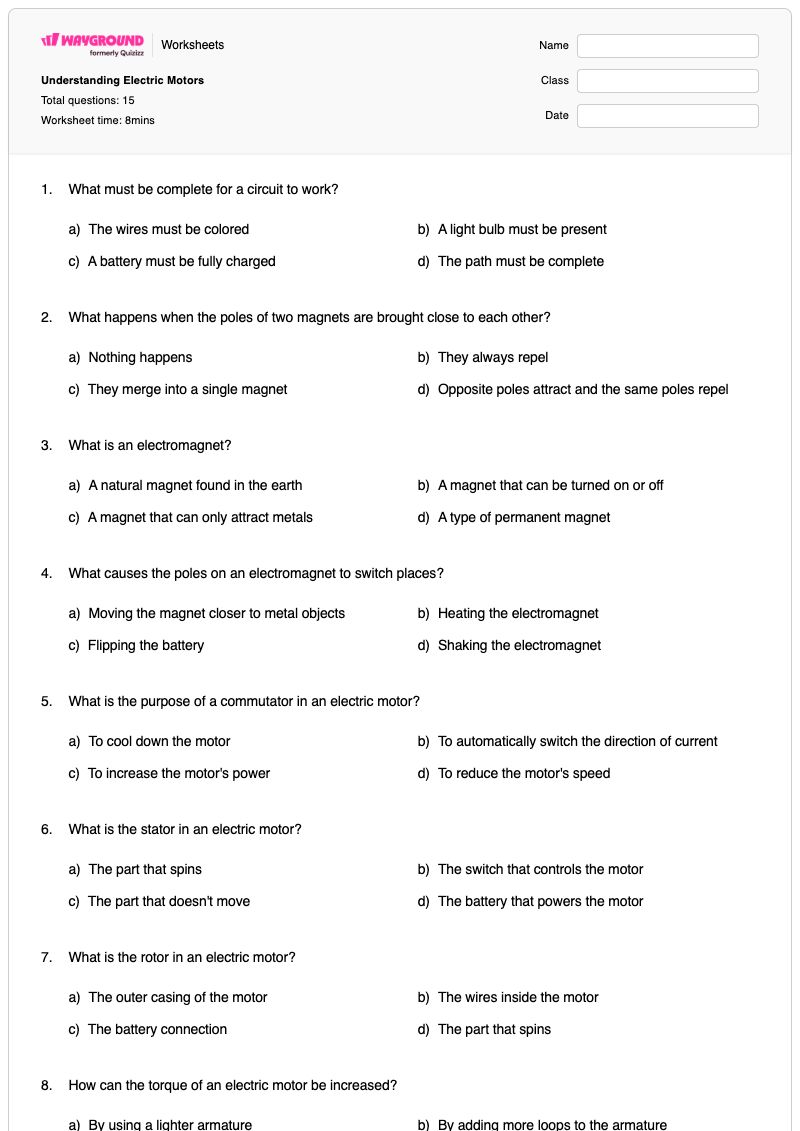
Understanding Electric Motors is a Grade 10 physics worksheet that uses 15 multiple-choice questions to build foundational knowledge of circuits, magnets, electromagnets, and DC motor operation. Students identify the conditions for a complete circuit, explain how reversing a battery changes current and magnetic polarity, and distinguish the roles of the stator, rotor, armature, brushes, and commutator. The questions also connect motor design to performance: students identify how additional armature loops and wire wrapping strengthen electromagnets, explain how the commutator supports continuous one-direction rotation, and recognize torque-related design choices. This free printable worksheet is useful for checking understanding after instruction, reviewing motor components, or preparing students for more detailed work with electromagnetic force. It includes a complete answer key for efficient marking and feedback.

Worksheet settings

Font size

S
M
L
XL
WaygroundWorksheets

Understanding Electric Motors

Total questions: 15

Name
Class
Date
1.

What must be complete for a circuit to work?

a)

The wires must be colored

b)

A light bulb must be present

c)

A battery must be fully charged

d)

The path must be complete

2.

What happens when the poles of two magnets are brought close to each other?

a)

Nothing happens

b)

They always repel

c)

They merge into a single magnet

d)

Opposite poles attract and the same poles repel

3.

What is an electromagnet?

a)

A natural magnet found in the earth

b)

A magnet that can be turned on or off

c)

A magnet that can only attract metals

d)

A type of permanent magnet

4.

What causes the poles on an electromagnet to switch places?

a)

Moving the magnet closer to metal objects

b)

Heating the electromagnet

c)

Flipping the battery

d)

Shaking the electromagnet

5.

What is the purpose of a commutator in an electric motor?

a)

To cool down the motor

b)

To automatically switch the direction of current

c)

To increase the motor's power

d)

To reduce the motor's speed

6.

What is the stator in an electric motor?

a)

The part that spins

b)

The switch that controls the motor

c)

The part that doesn't move

d)

The battery that powers the motor

7.

What is the rotor in an electric motor?

a)

The outer casing of the motor

b)

The wires inside the motor

c)

The battery connection

d)

The part that spins

8.

How can the torque of an electric motor be increased?

a)

By using a lighter armature

b)

By adding more loops to the armature

c)

By using a smaller battery

d)

By using fewer wires

9.

What is the role of brushes in an electric motor?

a)

To clean the commutator

b)

To maintain electrical contact with the commutator

c)

To lubricate the motor

d)

To cool down the motor

10.

What type of motor was primarily discussed in the video?

a)

Servo motor

b)

AC motor

c)

Stepper motor

d)

DC motor

11.

What happens when you flip the battery in a circuit?

a)

The current flows the other way

b)

The device connected to the circuit turns off

c)

The current stops flowing

d)

The circuit breaks

12.

What is the effect of wrapping more wires around the armature loops?

a)

Has no effect on the motor

b)

Decreases the motor's efficiency

c)

Makes the electromagnets stronger

d)

Makes the electromagnets weaker

13.

What is the function of the armature in an electric motor?

a)

To spin and create motion

b)

To act as a permanent magnet

c)

To supply power to the motor

d)

To hold the motor together

14.

How does reversing the polarity of an electromagnet affect it?

a)

It loses its magnetic properties

b)

It becomes a permanent magnet

c)

North becomes south and vice versa

d)

It stops being a magnet

15.

What is the significance of the commutator's design in an electric motor?

a)

It makes the motor more energy-efficient

b)

It prevents the motor from overheating

c)

It switches the direction of current automatically

d)

It allows the motor to spin in one direction only

WaygroundAnswer Key

Understanding Electric Motors

Total questions: 15

1.
d)

The path must be complete

2.
d)

Opposite poles attract and the same poles repel

3.
b)

A magnet that can be turned on or off

4.
c)

Flipping the battery

5.
b)

To automatically switch the direction of current

6.
c)

The part that doesn't move

7.
d)

The part that spins

8.
b)

By adding more loops to the armature

9.
b)

To maintain electrical contact with the commutator

10.
d)

DC motor

11.
a)

The current flows the other way

12.
c)

Makes the electromagnets stronger

13.
a)

To spin and create motion

14.
c)

North becomes south and vice versa

15.
c)

It switches the direction of current automatically

FAQs

What does the Understanding Electric Motors worksheet cover?

This Grade 10 physics worksheet uses 15 multiple-choice questions to assess how circuits, electromagnets, and DC motor components work together. Students identify the functions of the commutator, brushes, stator, rotor, and armature, and connect battery reversal and additional armature loops to changes in current direction, magnetic polarity, strength, and motor motion.

How can I use this worksheet to teach electric motors?

Introduce the worksheet by reviewing the complete-circuit requirement and the attraction and repulsion of magnetic poles. Then use the questions in sequence to connect battery reversal to electromagnet polarity, and to explain how the commutator, brushes, stator, rotor, and armature produce continuous motion in a DC motor. Ask students to justify component-function answers rather than selecting choices by memorization.

What mistakes should I watch for when students complete this electric motors worksheet?

Students may confuse the stator, which does not move, with the rotor and armature, which spin and create motion. They may also mistake the commutator for a cooling or speed-control part, or overlook that flipping the battery reverses current and switches electromagnet poles. Check that students distinguish stronger electromagnets and increased torque from unrelated changes such as using fewer wires or a smaller battery.

How do I assign and grade this electric motors worksheet?

Understanding Electric Motors is available as a printable PDF and as a digital quiz on Wayground, with a complete answer key for all 15 multiple-choice questions. Printable submissions can be graded by scanning student work with the Wayground for Teachers app, while the digital version can be assigned through the platform for online completion.

How can I differentiate this electric motors worksheet for my students?

Use the worksheet’s Advanced Settings to increase font size or adjust font spacing so the 15 multiple-choice questions and component terms are easier to read. You can also enable a dyslexia-friendly font or translate the worksheet into another language when students need additional reading support.

Where can I find more worksheets like this on Wayground?

Wayground offers a broad collection of free printable worksheets and practice problems across subjects, with downloadable PDFs and answer keys to support mastery of essential skills and concepts. Browse more resources at https://wayground.com/en-us/worksheets.