Food Chain vs Food Web is a science worksheet for students in Grades 4–8 that builds understanding of how organisms obtain and transfer energy. Students distinguish food chains from food webs, identify predators, prey, and producers, recognize an omnivore in a pictured ecosystem, and interpret predator–prey population changes. They also analyze energy flow through a sequence and identify the organisms that provide energy to a shark.
The worksheet contains 10 questions: 9 multiple-choice items and 1 multiple-select item. Several questions use a food-web picture, requiring students to apply vocabulary and relationships to a visual model rather than recall definitions alone. This free printable worksheet includes a complete answer key, making it useful for science practice, review, or an accessible check of understanding across upper elementary and middle school grades.
Worksheet settings
Font size
S
M
L
XL
Worksheets
Food Chain vs Food Web
Total questions: 10
Name
Class
Date
1.
A community of organisms where there are several interrelated food chains.
a)
food chain
b)
food web
c)
predator
d)
prey
2.
An animal that hunts other animals for food
a)
food chain
b)
food web
c)
predator
d)
prey
3.
An organism that is killed and eaten by another organism
a)
food chain
b)
food web
c)
predator
d)
prey
4.
A series of events in which one organism eats another and obtains energy.
a)
food chain
b)
food web
c)
predator
d)
prey
5.
Choose which sequence shows the correct flow of energy among the organisms
a)
grass-snake-eagle-mouse
b)
eagle-snake-mouse-grass
c)
grass-mouse-snake-eagle
6.
In a predator-prey relationship, if the predator population increases, what would happen to the prey population?
a)
increase
b)
decrease
c)
stay the same
7.
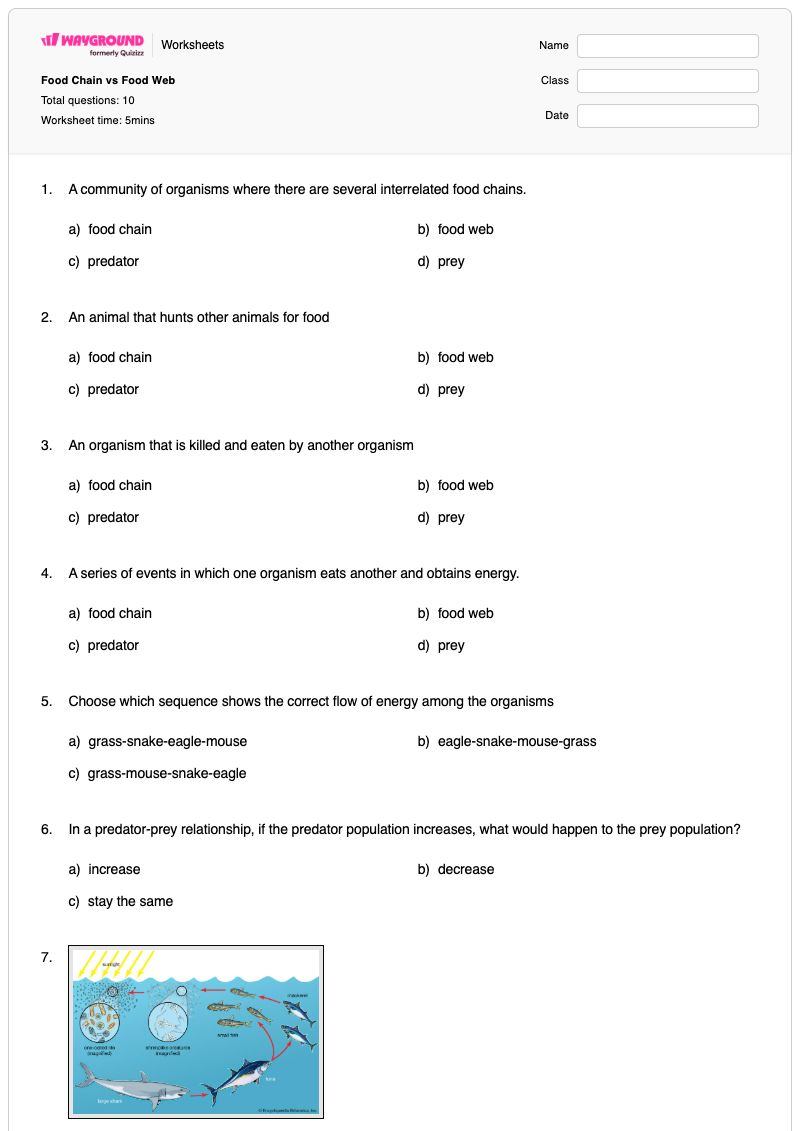
What does the picture represent?
a)
food chain
b)
food web
8.
Which is a producer in the picture?
a)
one-celled life
b)
shark
9.
Which of the following is an omnivore in the picture?
a)
mackeral
b)
small fish
10.
What sources does the shark get its energy from?
a)
tuna
b)
mackeral
c)
ocean water
Answer Key
Food Chain vs Food Web
Total questions: 10
1.
b)
food web
2.
c)
predator
3.
d)
prey
4.
a)
food chain
5.
c)
grass-mouse-snake-eagle
6.
b)
decrease
7.
b)
food web
8.
a)
one-celled life
9.
b)
small fish
10.
a)
tuna
, b)
mackeral
140 %
Browse by subjects
Browse by grades
Browse by format
FAQs
What does the Food Chain vs Food Web worksheet cover?
This Grade 4–8 science worksheet uses 9 multiple-choice questions and 1 multiple-select question to assess food chains, food webs, predators, prey, producers, and omnivores. Students sequence organisms to show energy flow, interpret a pictured food web, predict how a growing predator population affects prey, and identify the energy sources for a shark.
How can I use this worksheet to teach the difference between a food chain and a food web?
Introduce the vocabulary by modeling a single food chain and then show how several connected chains form a food web. Before students complete the picture-based questions, have them trace arrows or feeding relationships and explain which organism provides energy to the next. Use the sequence and predator–prey questions to discuss why energy flow and population changes are related.
What mistakes should I watch for when students complete this worksheet?
Students may reverse predator and prey, select food chain when several connected chains are shown, or place organisms in the wrong order when tracing energy flow from grass to mouse to snake to eagle. In the pictured food web, they may misidentify the one-celled life as a producer or the small fish as an omnivore. For the multiple-select item, remind students to choose both tuna and mackeral as shark energy sources, not ocean water.
How do I assign and grade this worksheet?
Wayground provides this worksheet as a printable PDF and as a digital quiz, with a complete answer key for all 10 items. Grade digital responses in Wayground, or scan printable student work with the Wayground for Teachers app to speed up grading. The printable format also supports classrooms that are reducing screen time.
How can I differentiate this food chain and food web worksheet for my students?
Use the worksheet’s Advanced Settings to adjust font spacing and font size so the vocabulary and food-web choices are easier to read. You can also enable a dyslexia-friendly font or translate the worksheet into another language, helping students access the definitions, sequence question, and pictured ecosystem items.
Where can I find more worksheets like this on Wayground?
Wayground offers a broad collection of free printable worksheets and practice problems across subjects, with downloadable PDFs and answer keys to support mastery of essential skills and concepts. Browse more resources at https://wayground.com/en-us/worksheets.


 Worksheets