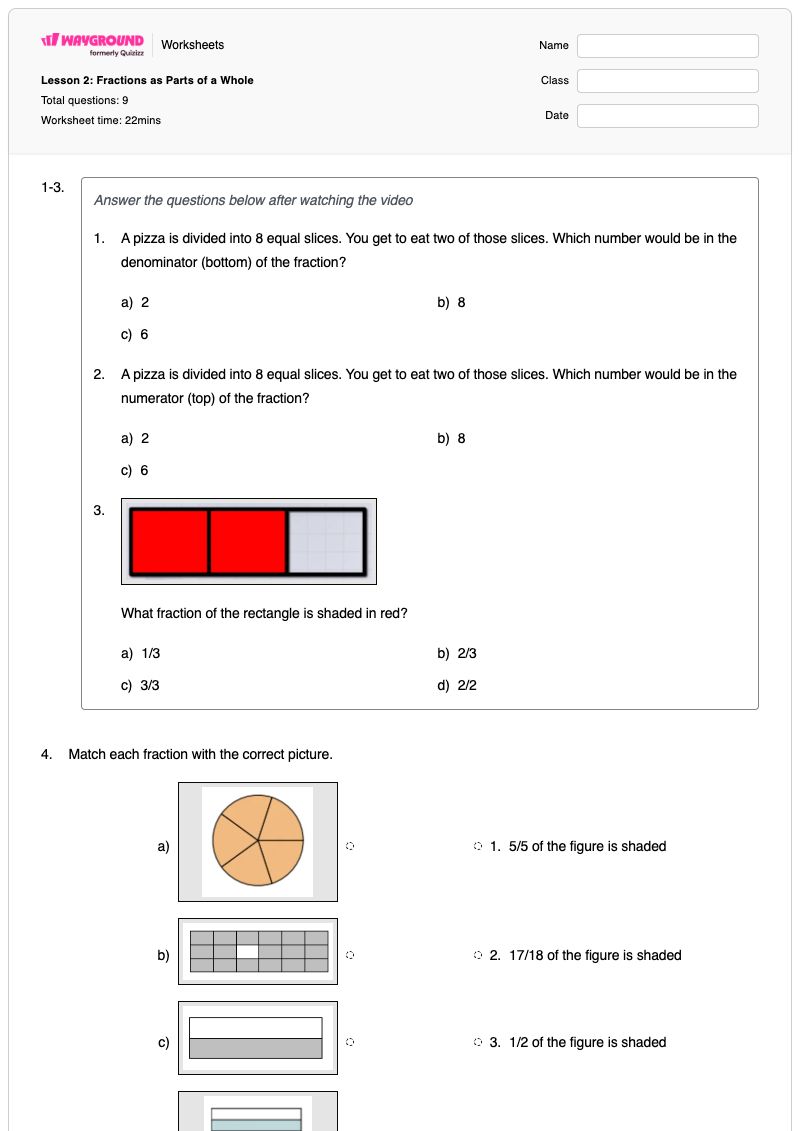
Lesson 2: Fractions as Parts of a Whole helps students in Grades 1–5 identify and represent fractions using equal parts of a whole. Students determine numerators and denominators in familiar models such as pizzas, rectangles, plus signs, and stars; identify shaded fractions; match fractions to pictures; and select equivalent representations such as 3/6 and 1/2.
The 13-item mathematics worksheet combines comprehension-video prompts, multiple-choice and multiple-select questions, a matching task, drawing activities, and self-reflection on two learning targets. Students apply fraction vocabulary to visual models, compare shaded parts with the total number of equal parts, and draw models for given fractions, including 2/3. This free printable worksheet includes a complete answer key and is suitable for guided instruction, independent practice, or a quick check of students’ understanding of fractions as parts of a whole.
Worksheet settings
Font size
S
M
L
XL
Worksheets
Lesson 2: Fractions as Parts of a Whole
Total questions: 9
Name
Class
Date
1-3.
Answer the questions below after watching the video
1.
A pizza is divided into 8 equal slices. You get to eat two of those slices. Which number would be in the denominator (bottom) of the fraction?
a)
2
b)
8
c)
6
2.
A pizza is divided into 8 equal slices. You get to eat two of those slices. Which number would be in the numerator (top) of the fraction?
a)
2
b)
8
c)
6
3.
What fraction of the rectangle is shaded in red?
a)
1/3
b)
2/3
c)
3/3
d)
2/2
4.
Match each fraction with the correct picture.
5/5 of the figure is shaded
17/18 of the figure is shaded
1/2 of the figure is shaded
1/8 of figure is NOT shaded
2/8 of figure is NOT shaded
5.
Answer the questions below after watching the video
5.
What fraction of plus signs are shaded in?
a)
6/12
b)
4/12
c)
8/12
6.
What fraction of the stars are shaded in?
a)
3/6
b)
3/5
c)
1/2
d)
2/6
7.
Shade in in 94 of the circles.
8.
Shade in 2/3 of the circles.
9.
What fraction of the figure is shaded? Select all that apply.
a)
512
b)
2
c)
251
d)
511
10.
After this lesson, you should be able to understand a fraction represents a part of a whole. Rate your level of understanding of this learning target from 1-4 based on this scale:
1 - I do not understand this at all
2 - I understand this a little but I need some help
3 - I understand this. I could can do it by myself
4 - I understand this and could teach it to someone else
a)
1
b)
2
c)
3
d)
4
11.
After this lesson, you should be able to draw a model to represent a fraction. Rate your level of understanding of this learning target from 1-4 based on this scale:
1 - I do not understand this at all
2 - I understand this a little but I need some help
3 - I understand this. I could can do it by myself
4 - I understand this and could teach it to someone else
a)
1
b)
2
c)
3
d)
4
Answer Key
Lesson 2: Fractions as Parts of a Whole
Total questions: 9
1-3.
1.
b)
8
2.
a)
2
3.
b)
2/3
4.
-
5/5 of the figure is shaded
, -
17/18 of the figure is shaded
, -
1/2 of the figure is shaded
, -
1/8 of figure is NOT shaded
, -
2/8 of figure is NOT shaded
5.
5.
c)
8/12
6.
a)
3/6
, c)
1/2
7.
n/a
8.
n/a
9.
c)
251
, d)
511
10.
n/a
11.
n/a
140 %
Browse by subjects
Browse by grades
Browse by format
FAQs
What does the Lesson 2: Fractions as Parts of a Whole worksheet cover?
This worksheet teaches students to identify the numerator and denominator and connect fractions to equal parts of a whole. Its 13 items use visual multiple-choice and multiple-select questions, fraction-picture matching, and drawing tasks so students identify shaded fractions, recognize equivalent forms such as 3/6 and 1/2, and model a fraction such as 2/3.
How can I use this worksheet to teach fractions as parts of a whole?
Begin by modeling one pizza or shape divided into equal parts, naming the total number of parts as the denominator and the selected or shaded parts as the numerator. Then work through the worksheet’s picture questions and matching task, asking students to explain how they counted each part before completing the multiple-select and drawing items independently. Use the final learning-target ratings to discuss whether students can identify a fraction and draw its model.
What mistakes should I watch for when students complete this fraction worksheet?
Watch for students reversing the numerator and denominator in the pizza examples, counting only shaded parts, or using unequal parts as a fraction model. In the multiple-select items, students may miss that 3/6 and 1/2 represent the same shaded amount or select a fraction with the wrong total. For the drawing tasks, check that students shade the requested number of equal parts, especially when modeling 2/3.
How do I assign and grade this fractions worksheet?
On Wayground, assign the worksheet as a printable PDF or as a digital quiz, depending on whether students will mark the visual fraction models by hand or on screen. It includes a complete answer key for the multiple-choice, matching, and select-all-that-apply items; review the drawing responses and learning-target ratings with students. Printable submissions can also be graded by scanning student work with the Wayground for Teachers app.
How can I differentiate this worksheet for my students?
Use the worksheet’s Advanced Settings to adjust font spacing or increase the font size so the fraction choices, visual models, and drawing prompts are easier to navigate. You can also select a dyslexia-friendly font or translate the worksheet into another language. These options preserve the worksheet’s fraction-identification, matching, multiple-select, and drawing tasks while changing how the file is presented.
Where can I find more worksheets like this on Wayground?
Wayground offers a comprehensive collection of free printable worksheets and practice problems across subjects, with downloadable PDFs and answer keys to help students master essential skills and concepts. Browse more resources at https://wayground.com/en-us/worksheets.

 Worksheets


