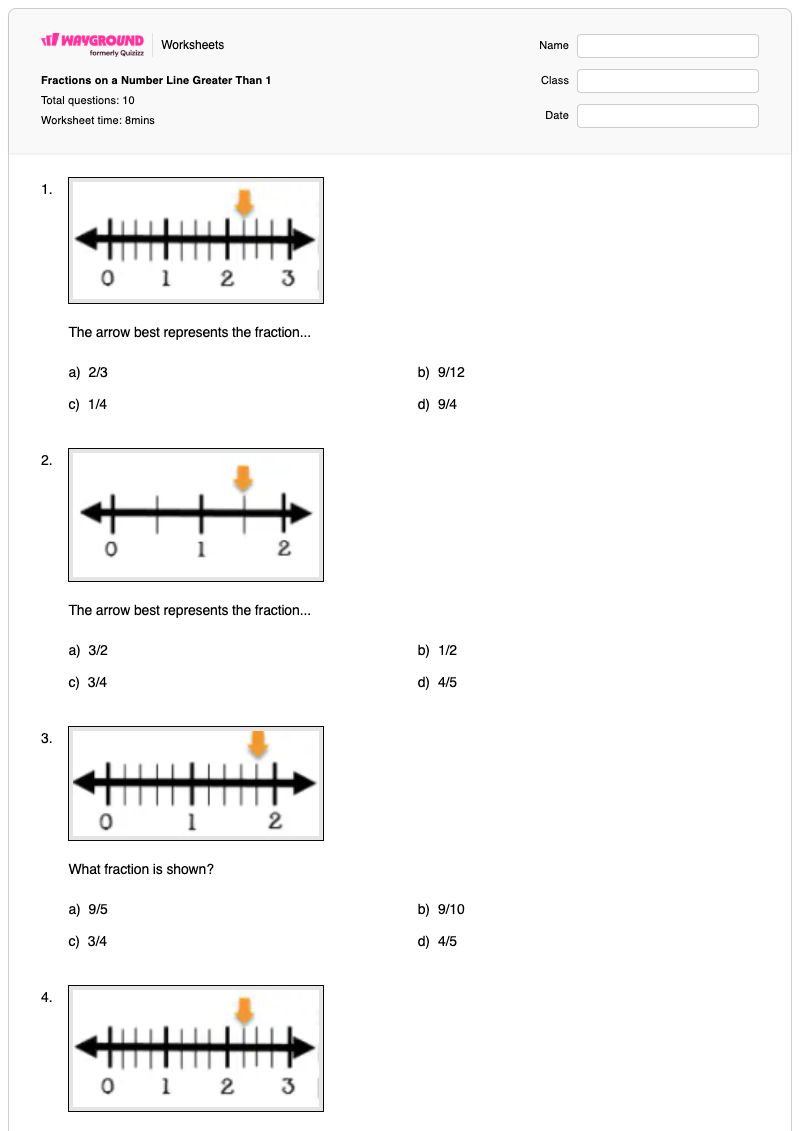
Fractions on a Number Line Greater Than 1 is a Grade 3 mathematics worksheet that helps students interpret fraction locations on number lines. Across 10 multiple-choice questions, students identify fractions shown by arrows, points, an “x,” and a blue dot; recognize partitions into halves, thirds, and other equal parts; and connect improper fractions such as 9/4 and 9/5 to positions beyond one whole. The questions also ask students to compare a marked fraction with three wholes and identify that 8/8 represents one whole.
This free printable worksheet gives students focused practice reading number-line models and matching visual representations to fraction notation. It is useful for introducing or reviewing how the denominator describes equal partitions, how the numerator counts those parts, and how fractions can represent whole numbers or values greater than one. Teachers receive a complete answer key for checking student understanding and discussing reasoning behind each multiple-choice choice.
Worksheet settings
Font size
S
M
L
XL
Worksheets
Fractions on a Number Line Greater Than 1
Total questions: 10
Name
Class
Date
1.
The arrow best represents the fraction...
a)
2/3
b)
9/12
c)
1/4
d)
9/4
2.
The arrow best represents the fraction...
a)
3/2
b)
1/2
c)
3/4
d)
4/5
3.
What fraction is shown?
a)
9/5
b)
9/10
c)
3/4
d)
4/5
4.
The fraction shown is more than, less than, or equal to 3 wholes?
a)
more than
b)
less than
c)
equal to
d)
0
5.
The number line shows partitions of
a)
Thirds
b)
Fourths
c)
Halves
d)
Twos
6.
On the number line what whole number is represented by the fraction 8/8?
a)
Eight
b)
One
c)
Zero
d)
1/2
7.
The lines on the bottom represent units. What fraction does the arrow show?
a)
3/12
b)
9/3
c)
10/3
8.
What fraction is represented with an 'x' on the number line?
a)
1/8
b)
2/9
c)
1/9
d)
1/4
9.
What fraction is represented at point A?
a)
4/5
b)
3/1
c)
3/4
d)
1/3
10.
What fraction does the blue dot represent?
a)
3/4
b)
3/8
c)
7/8
d)
5/8
Answer Key
Fractions on a Number Line Greater Than 1
Total questions: 10
1.
d) 9/4
2.
a) 3/2
3.
a) 9/5
4.
b) less than
5.
c) Halves
6.
b) One
7.
b)
9/3
8.
a) 1/8
9.
c) 3/4
10.
c) 7/8
140 %
Browse by subjects
Browse by grades
Browse by format
FAQs
What does the Fractions on a Number Line Greater Than 1 worksheet cover?
This Grade 3 worksheet uses 10 multiple-choice questions to have students read fraction positions on number lines and match them with fraction notation. Students identify marked fractions such as 9/4, 3/2, and 9/5, recognize equal partitions, compare a fraction with three wholes, and identify 8/8 as one whole. Completing these items builds accuracy in interpreting both fractions less than one and improper fractions beyond one whole.
How can I use this worksheet to teach fractions on a number line?
Begin by modeling how the denominator tells students how many equal intervals make one whole and how the numerator counts those intervals. Then work through one marked-point example, such as 3/4 or 7/8, before discussing how the same counting process locates improper fractions such as 9/4 beyond one. Use the multiple-choice options to ask students why distractors represent the wrong number of parts, wholes, or intervals.
What mistakes should I watch for when students complete this fraction number-line worksheet?
Watch for students counting tick marks instead of the intervals between them, or reversing the roles of the numerator and denominator when reading a marked point. Students may also treat 8/8 as eight wholes rather than one whole, overlook that 9/4 is greater than one, or select a fraction that matches the visual spacing but not the number of equal partitions. Ask students to explain both the denominator and the counted intervals when reviewing their choices.
How do I assign and grade this fractions number-line worksheet?
The worksheet is available as a printable PDF and as a digital quiz on Wayground, and it includes a complete answer key for the 10 multiple-choice questions. For printable submissions, you can scan student work with the **Wayground for Teachers** app to streamline grading. The PDF option also supports classrooms that want to reduce screen time while students practice reading fraction models.
How can I differentiate this fractions on a number line worksheet for my students?
Use the worksheet’s Advanced Settings to adjust font spacing and font size so the number-line questions and answer choices are easier to read. You can also apply a dyslexia-friendly font or translate the worksheet into another language when that supports access to the fraction vocabulary and directions. These changes preserve the worksheet’s visual fraction tasks while adapting its presentation.
Where can I find more worksheets like this on Wayground?
Wayground offers a comprehensive collection of free printable worksheets and practice problems across all subjects, with downloadable PDFs and answer keys to support mastery of essential skills and concepts. Browse more resources at https://wayground.com/en-us/worksheets.


 Worksheets



