
This free printable worksheet helps students in Grades 9–12 mathematics interpret exponential and logarithmic functions through 20 multiple-choice questions. Students identify exponential growth and decay from graphs, match equations to graphs, determine horizontal and vertical asymptotes, and recognize that logarithmic functions are inverses of exponential functions.
The worksheet also checks students’ ability to describe transformations, including translations and vertical stretches, and to determine the domain and range of a logarithmic function. Items such as f(x) = log₅(x + 4) − 2 require students to connect an equation with its vertical asymptote and restricted domain, while graph-based questions reinforce visual interpretation. Use the included answer key for efficient review, independent practice, or formative assessment.
Worksheet settings
Font size
S
M
L
XL
Worksheets
Exponential and Logarithmic Functions
Total questions: 20
Name
Class
Date
1.
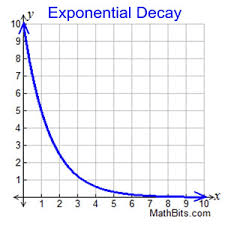
Is the pictured graph growth, decay, or linear or none?
a)
Growth
b)
Decay
c)
Linear
d)
None
2.
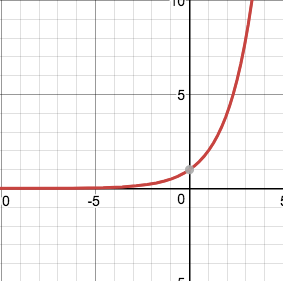
What is the asymptote of y = 2x ?
a)
y = 0
b)
x = 0
3.
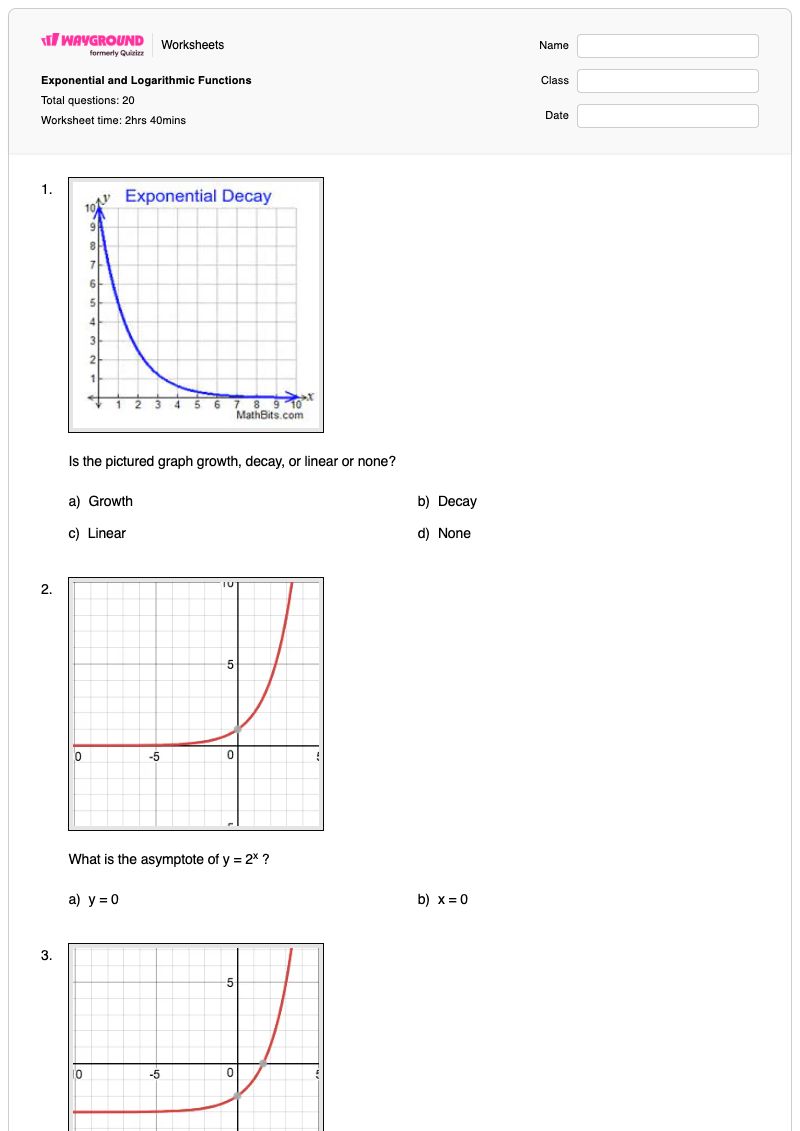
What is the asymptote of y = 2x - 3
a)
y = 0
b)
y = -3
c)
x = 0
d)
x = -3
4.
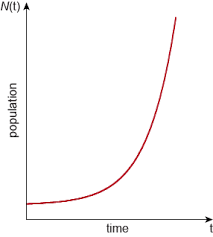
Is the pictured graph growth, decay, or linear or none?
a)
Exponential Growth
b)
Exponential Decay
c)
Linear
d)
None
5.
Which graph matches this equation?
a)
b)
c)
d)
6.
f(x)=log5(x+4) - 2
Describe the asymptote
a)
Horizontal Asymptote x = -4
b)
Vertical Asymptote x = -4
c)
Horizontal Asymptote x = 4
d)
Vertical Asymptote x = 4
7.
Which equation matches this graph?
a)
b)
c)
d)
8.
What is the asymptote?
a)
x= 2
b)
y= -2
c)
y= 2
d)
y= -1
9.
What is the transformation?
a)
Left 5
b)
Right 5
c)
Up 5
d)
Down 5
10.
Compare f(x) = 3x- 4 with the basic function g(x) = 3x
a)
4 units up
b)
4 units to the left
c)
4 units to the right
d)
4 units down
11.
Which exponential equation could represent the graph shown?
a)
f(x)=3(x−3)−2
b)
f(x)=3(x+3)−2
c)
f(x)=3(x−2)−3
d)
f(x)=3(x+2)−3
12.
Logarithmic functions are the inverse of...
a)
Linear Functions
b)
Exponential Functions
c)
Quadratic Functions
d)
Polynomial Functions
13.
Which exponential equation could represent the graph shown?
a)
f(x)=3x+2
b)
f(x)=3x−2
c)
f(x)=3(x+2)
d)
f(x)=3(x−2)
14.
f(x)=log5(x+4) - 2
Find the Domain and Range
a)
Domain: x ≥ -4
Range: all real numbers
b)
Domain: all real numbers
Range: y ≥ -4
c)
Domain: all real numbers
Range: y > -4
d)
Domain: x > -4
Range: all real numbers
15.
f(x)=2ln(x+2)
Describe the transformation
a)
Vertical Stretch by 2, translation 2 units to the left
b)
Vertical Compression by 2, translation 2 units to the left
c)
Vertical Stretch by 2, translation 2 units to the right
d)
Vertical Compression by 2, translation 2 units to the right
16.
f(x)=log5(x+4) - 2
Describe the transformation
a)
translation 4 units to the right, 2 units down
b)
translation 4 units to the left, 2 units down
c)
translation 4 units to the up, 2 units right
d)
translation 4 units to the up, 2 units left
17.
Which graph is logarithmic
a)
b)
c)
d)
18.
Determine the horizontal asymptote for the function
f(x) = 3(2)x-4 + 5
a)
x=4
b)
y=4
c)
x=5
d)
y=5
19.
Describe range of the function shown: y=log2(x+1)
a)
(-∞,∞)
b)
(-1,∞)
c)
(-1,3)
d)
(∞, -1)
20.
The common logarithm has what base?
a)
10
b)
0
c)
e
d)
-e
Answer Key
Exponential and Logarithmic Functions
Total questions: 20
1.
b) Decay
2.
a)
y = 0
3.
b)
y = -3
4.
a)
Exponential Growth
5.
b)
6.
b)
Vertical Asymptote x = -4
7.
a)
8.
b)
y= -2
9.
a) Left 5
10.
d) 4 units down
11.
a)
f(x)=3(x−3)−2
12.
b) Exponential Functions
13.
a)
f(x)=3x+2
14.
d)
Domain: x > -4
Range: all real numbers
15.
a)
Vertical Stretch by 2, translation 2 units to the left
16.
b)
translation 4 units to the left, 2 units down
17.
a)
18.
d)
y=5
19.
a)
(-∞,∞)
20.
a) 10
140 %
Browse by subjects
Browse by grades
Browse by format
FAQs
What does the Exponential and Logarithmic Functions worksheet cover?
This Grade 9–12 mathematics worksheet uses 20 multiple-choice questions to assess how students interpret exponential and logarithmic functions. Students classify graphs as exponential growth or decay, match graphs and equations, identify horizontal and vertical asymptotes, describe transformations, determine logarithmic domain and range, and connect logarithmic functions with their exponential inverses.
How can I use this worksheet to teach exponential and logarithmic functions?
Begin by reviewing a basic exponential graph and asking students how its base, shifts, and asymptote change when the equation is transformed. Then use the worksheet’s graph-matching and asymptote questions for guided discussion, asking students to justify choices such as why f(x) = log₅(x + 4) − 2 has a vertical asymptote at x = −4. Finish with the transformation and domain-and-range items as independent practice or an exit check.
What mistakes should I watch for when students complete this worksheet?
Students may confuse horizontal and vertical asymptotes, especially when reading shifted exponential and logarithmic equations. Watch for reversed signs in translations, such as interpreting x + 4 as a shift right instead of left, and for choosing x ≥ −4 rather than the correct logarithmic domain x > −4. Students may also confuse a vertical stretch by 2 with a vertical compression or mistake logarithmic functions for the inverse of a different function family.
How do I assign and grade this Exponential and Logarithmic Functions worksheet?
On Wayground, this worksheet is available as a printable PDF and as a digital quiz, and it includes a complete answer key for the 20 multiple-choice questions. For printable submissions, scan student work with the Wayground for Teachers app to simplify grading and review of responses.
How can I differentiate this worksheet for my students?
Use the worksheet’s Advanced Settings to adjust font spacing or increase the font size so the graph-and-equation multiple-choice items are easier to read. You can also apply a dyslexia-friendly font or translate the worksheet into another language, depending on students’ reading needs.
Where can I find more worksheets like this on Wayground?
Wayground offers a broad collection of free printable worksheets and practice problems across subjects, with downloadable PDFs and answer keys to support essential skills and concepts. Browse more resources at https://wayground.com/en-us/worksheets.