

Wayground
Graphing Trig Functions Review - Printable Math Worksheets 12th Grade - Wayground

Graphing Trig Functions Review

Corinne Gomez

Created by Corinne Gomez

22 questions

12th Grade

Math

Updated Jun 2026

Graphing Trig Functions Review is a Grade 12 mathematics worksheet that strengthens students’ ability to analyze and write equations for transformed trigonometric functions. Across 22 items—21 multiple-choice questions and one multiple-select question—students determine periods, amplitudes, phase shifts, and vertical shifts; match equations to graphs; and identify sine, cosine, secant, cosecant, tangent, and cotangent functions. The worksheet also asks students to determine ranges and recognize domains of reciprocal and other parent functions, including secant and cosecant. These varied questions require students to connect algebraic features with graphical behavior, distinguish transformations, and interpret restrictions such as the branches and excluded values of reciprocal functions. This free printable worksheet includes a complete answer key and is suitable for Grade 12 review, guided practice, or an independent check of understanding.

Worksheet settings

Font size

S
M
L
XL
WaygroundWorksheets

Graphing Trig Functions Review

Total questions: 22

Name
Class
Date
1.
What is the period of y = 4Cos(2x)?
a)
4π
b)
π
c)
2π
d)
π/2
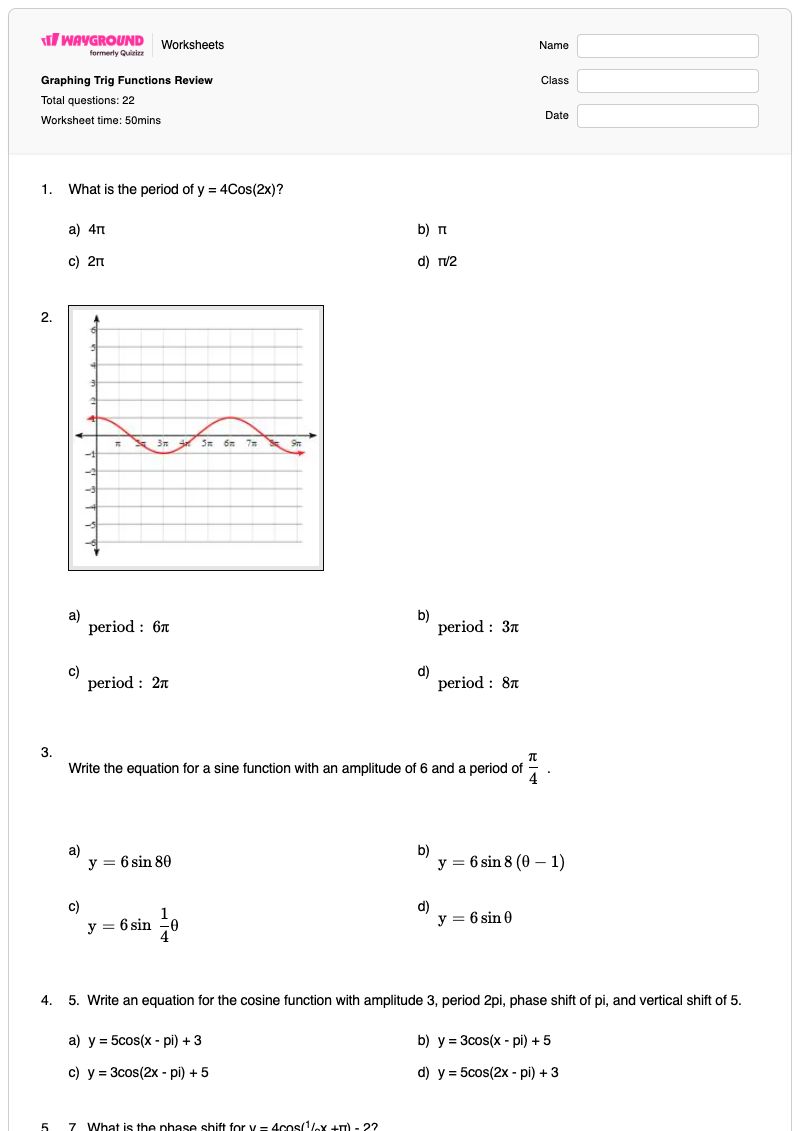
2.
Question Image
a)

period: 6πperiod:\ 6\pi

b)

period: 3πperiod:\ 3\pi

c)

period: 2πperiod:\ 2\pi

d)

period: 8πperiod:\ 8\pi

3.

Write the equation for a sine function with an amplitude of 6 and a period of π4\frac{\pi}{4}  .


a)

y=6sin⁡8θy=6\sin8\theta  

b)

y=6sin⁡8(θ−1)y=6\sin8\left(\theta-1\right)  

c)

y=6sin⁡ 14θy=6\sin\ \frac{1}{4}\theta

d)

y=6sin⁡θy=6\sin\theta  

4.
5.  Write an equation for the cosine function with amplitude 3, period 2pi, phase shift of pi, and vertical shift of 5.
a)
y = 5cos(x - pi) + 3
b)
y = 3cos(x - pi) + 5
c)
y = 3cos(2x - pi) + 5
d)
y = 5cos(2x - pi) + 3
5.
7.  What is the phase shift for y = 4cos(1/2x +π) - 2?
a)
left pi/2
b)
right pi/2
c)
right 2pi
d)
left 2pi
6.
8.  What is the period for y = 4cos(1/2x +π) - 2?
a)
pi/2
b)
pi
c)
3pi
d)
4pi
7.
10. What is the equation of the graph?
10.  What is the equation of the graph?
a)
 y = 2 cos x
b)
y = sin x
c)
y = 2 sin x
d)
y = sin 2x 
8.
13. What is the equation of the graph?
13.  What is the equation of the graph?
a)
y = -2 cos x - 3
b)
y = 3 cos x - 2
c)
y = -7 cos x - 3
d)
y = -3 cos x - 4 
9.
Determine an equation for this graph:
a)
y=sec(x)
b)
y=2sec(x)
c)
y=2csc(x)
d)
y= csc(2x)
10.
Which trig function does this graph represent?
a)
sin
b)
sec
c)
tan
d)
cot
11.
Which function below matches this graph?
a)
2+sec(x)
b)
sec2(x)
c)
2sec(x)
d)
sec(x-2)
12.
Which function below matches this graph?
a)
sec2(x)
b)
sec(x)
c)
csc2(x)
d)
2-sec(x)
13.

What's the range of y = csc x ?

a)
What's the range of y = csc x ?
b)
What's the range of y = csc x ?
c)
What's the range of y = csc x ?
d)
What's the range of y = csc x ?
14.
What is the range of the graph?

What is the range of the graph?

a)

(-∞, ∞)

b)

(-∞, -2] ∪ [2, ∞)

c)

[ -2, 2]

d)

x / x ≠ π/2 + kπ

15.
Which parent function meets the following requirements?

Which parent function meets the following requirements?

a)

tangent

b)

cotangent

c)

secant

d)

cosecant

16.
Which parent functions have the given domain?

Which parent functions have the given domain?

a)

tangent and cotangent

b)

secant and cosecant

c)

tangent and secant

d)

cotangent and cosecant

17.
Write an equation or the graph.

Write an equation or the graph.

a)

y = 2sec(x)

b)

y = 3sec(x)

c)

y = 3sec(2x)

d)

y = 3csc(x)

e)

y = 3csc(2x)

18.
What is the period of this function?

What is the period of this function?

a)


π4\frac{\pi}{4}

b)

π2\frac{\pi}{2}

c)

π\pi

d)

2π2\pi

19.
A trig function has an amplitude of 4 and a minimum value of 5.  What is its maximum value?
a)
7
b)
9
c)
11
d)
13
20.

What trigonometric functions have vertical asymptotes? Select all that apply.

a)

sine

b)

cosine

c)

tangent

d)

secant

e)

cosecant

21.

Which of the following is an asymptote for secant?

a)

x= π

b)

x = 3π / 2

c)

x = -2π

d)

x = 0

22.

If sec⁡θ>0\sec\theta>0  and  sin⁡θ<0\sin\theta<0  then  θ\theta  must be in which quadrant?

a)

I

b)

II

c)

III

d)

IV

WaygroundAnswer Key

Graphing Trig Functions Review

Total questions: 22

1.
b) π
2.
a)

period: 6πperiod:\ 6\pi

3.
a)

y=6sin⁡8θy=6\sin8\theta  

4.
b) y = 3cos(x - pi) + 5
5.
d) left 2pi
6.
d) 4pi
7.
c) y = 2 sin x
8.
a) y = -2 cos x - 3
9.
b) y=2sec(x)
10.
b) sec
11.
c) 2sec(x)
12.
a) sec2(x)
13.
b)
14.
b)

(-∞, -2] ∪ [2, ∞)

15.
d)

cosecant

16.
d)

cotangent and cosecant

17.
c)

y = 3sec(2x)

18.
b)

π2\frac{\pi}{2}

19.
d) 13
20.
c)

tangent

, d)

secant

, e)

cosecant

21.
b)

x = 3π / 2

22.
d)

IV

FAQs

What does the Graphing Trig Functions Review worksheet cover?

This Grade 12 worksheet uses 21 multiple-choice questions and one multiple-select question to practice analyzing sine, cosine, secant, and cosecant functions. Students determine periods, amplitudes, phase shifts, and vertical shifts, match equations to graphs, identify parent functions, and determine domains and ranges. The format builds fluency in connecting an equation’s parameters with the features visible on its graph.

How can I use this worksheet to teach transformations of trig functions?

Introduce the worksheet by having students identify the amplitude, period, phase shift, and vertical shift in a transformed sine or cosine equation before they answer the equation-selection items. Then ask them to justify graph matches by pointing to features such as reflected values, midline, cycle length, and vertical translation. Finish with the secant and cosecant questions so students compare reciprocal-function branches, asymptotic behavior, domains, and ranges with the familiar sine and cosine graphs.

What mistakes should I watch for on this trigonometric functions worksheet?

Watch for students confusing amplitude with vertical shift, using the coefficient of x as the period instead of applying the period formula, or reversing the direction of a phase shift when reading an expression such as a cosine function with a positive phase term. In graph-matching questions, students may select sine or cosine from general shape while overlooking a reflection or vertical translation. For secant and cosecant items, check that they distinguish the two reciprocal parent functions and use their excluded x-values and ranges rather than treating them like bounded sine or cosine graphs.

How do I assign and grade the Graphing Trig Functions Review worksheet?

On Wayground, you can assign this worksheet as a printable PDF or as a digital quiz. It includes a complete answer key for checking the 22 responses, and printable student work can be graded by scanning it with the Wayground for Teachers app. The printable format can also support schools that are reducing screen time.

How can I differentiate this graphing trigonometric functions worksheet?

Use the worksheet’s Advanced Settings to adjust font spacing and font size so the equation, graph, and answer choices are easier to follow. You can also enable a dyslexia-friendly font or translate the worksheet into another language, which can support access to its period, transformation, domain, and range questions.

Where can I find more free worksheets like this on Wayground?

Wayground offers a broad collection of free printable worksheets and practice problems across subjects, with downloadable PDFs and answer keys to help students master essential skills and concepts. Browse more worksheets at https://wayground.com/en-us/worksheets.