

Wayground
Key Features of Quadratic Functions - Printable Math Worksheets 9th Grade - Wayground

Key Features of Quadratic Functions

Elizabeth Brooks

Created by Elizabeth Brooks

9 questions

9th Grade

Math

Updated Sep 2026

This Grade 9 mathematics worksheet helps students identify and interpret the key features of quadratic functions. Across 9 questions—6 multiple-choice and 3 multiple-select—students work with vertices, axes of symmetry, y-intercepts, zeros, range statements, maximums and minimums, opening direction, and reflection over the x-axis. Several items require students to distinguish between coordinate-based features such as (0, -3), x = 3, and y = -16. The worksheet is designed for guided practice, independent review, or a quick formative assessment after introducing quadratic graphs and functions. Multiple-select questions ask students to evaluate several statements about one function at once, strengthening their ability to connect a function’s algebraic or graphical features rather than identify a single fact in isolation. This free printable worksheet includes a complete answer key and is also available digitally through Wayground.

Worksheet settings

Font size

S
M
L
XL
WaygroundWorksheets

Key Features of Quadratic Functions

Total questions: 9

Name
Class
Date
1.
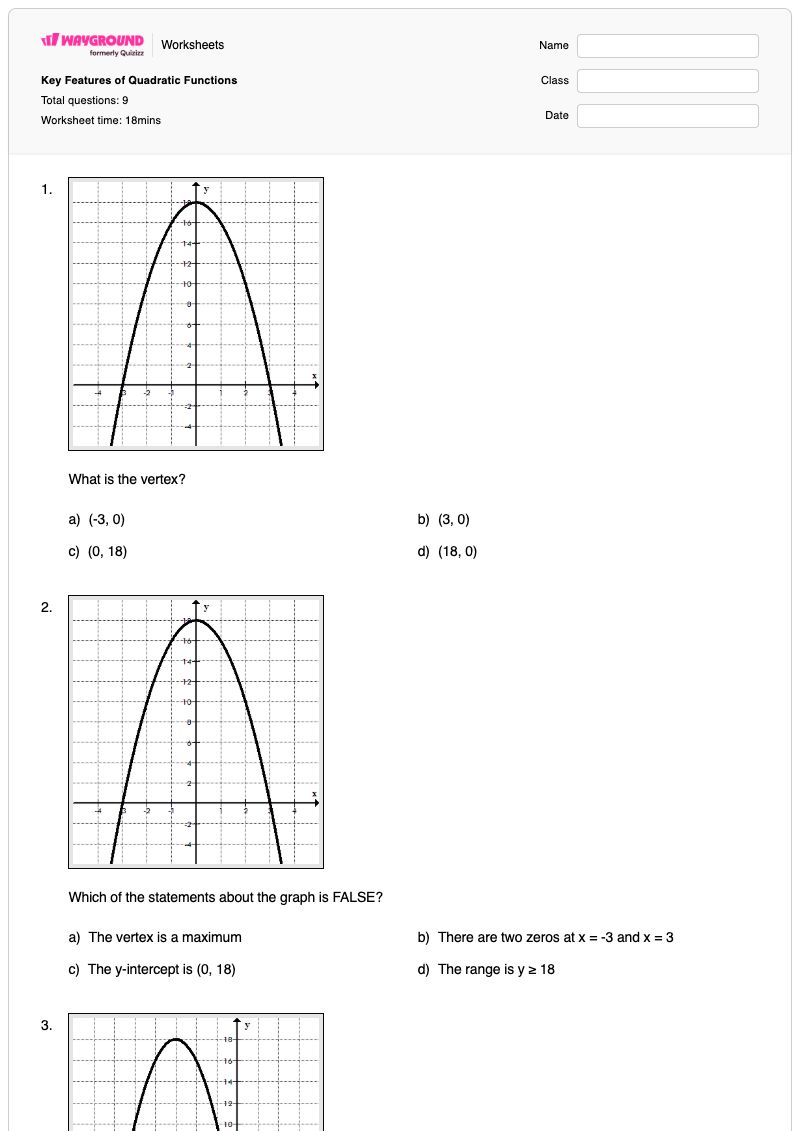
What is the vertex?

What is the vertex?

a)

(-3, 0)

b)

(3, 0)

c)

(0, 18)

d)

(18, 0)

2.
Which of the statements about the graph is FALSE?

Which of the statements about the graph is FALSE?

a)

The vertex is a maximum

b)

There are two zeros at x = -3 and x = 3

c)

The y-intercept is (0, 18)

d)

The range is y ≥ 18

3.
Which statement about the graph is FALSE?

Which statement about the graph is FALSE?

a)

The vertex is (-3, 18)

b)

The vertex is a maximum

c)

The y-intercept is y = 0

d)

The axis of symmetry is y = -3

4.

Which function has an axis of symmetry of x = 0?

a)
Which function has an axis of symmetry of x = 0?
b)
Which function has an axis of symmetry of x = 0?
c)
Which function has an axis of symmetry of x = 0?
d)

None of the above

5.

If the vertex of a parabola is (2, −3), what is the axis of symmetry?

a)

x=−3x=-3

b)

y=−3y=-3

c)

x=2x=2

d)

y=2y=2

6.
Identify the y-intercept

Identify the y-intercept

a)

(0, -3)

b)

(3, 0)

c)

(0, 3)

d)

(2, 1)

7.

Determine the key features of the given function. Pick all that apply.

f(x)= x2+10x +16f\left(x\right)=\ x^2+10x\ +16  

a)

y-intercept is located at (0, 16)

b)

y-intercept is located at (0, 10)

c)

It is a positive function with a minimum

d)

It is a negative function with a maximum

e)

Reflects over the x-axis

8.

Determine the key features of the given function. Pick all that apply.

f(x)= −x2+14x −48f\left(x\right)=\ -x^2+14x\ -48  

a)

y-intercept is located at (0, 14)

b)

y-intercept is located at (0, -48)

c)

It is a positive function with a minimum

d)

It is a negative function with a maximum

e)

Reflects over the x-axis

9.

Determine key features from the give function.

g(x)=(x−3)2−16g\left(x\right)=\left(x-3\right)^2-16  

a)

Positive function with a minimum

b)

Negative function with a maximum

c)

Vertex located at (3, -16), and an axis of symmetry at x = 3

d)

Vertex located at (3, -16) and an axis of symmetry at y = -16

e)

Reflects over the x-axis

WaygroundAnswer Key

Key Features of Quadratic Functions

Total questions: 9

1.
c)

(0, 18)

2.
d)

The range is y ≥ 18

3.
d)

The axis of symmetry is y = -3

4.
b)
5.
c)

x=2x=2

6.
a)

(0, -3)

7.
a)

y-intercept is located at (0, 16)

, c)

It is a positive function with a minimum

8.
b)

y-intercept is located at (0, -48)

, d)

It is a negative function with a maximum

, e)

Reflects over the x-axis

9.
a)

Positive function with a minimum

, c)

Vertex located at (3, -16), and an axis of symmetry at x = 3

FAQs

What does this worksheet cover, and how does it help students learn quadratic functions?

This Grade 9 worksheet focuses on identifying key features of quadratic functions, including the vertex, axis of symmetry, y-intercept, zeros, range statements, maximum or minimum, and whether the parabola opens upward or downward. Its 6 multiple-choice and 3 multiple-select questions require students to read coordinates, distinguish x-values from y-values, and evaluate several graph statements together. This builds connected understanding of how a quadratic function’s features describe its graph.

How can I use this worksheet to teach the key features of quadratic functions?

Introduce the worksheet by modeling how to locate the vertex, identify the axis of symmetry, and read the y-intercept from a quadratic graph or function. Then have students explain why a parabola has a maximum or minimum and how its opening direction supports that conclusion. Use the multiple-select items for discussion: ask students to justify every statement they select and reject distractors such as an incorrect intercept or an axis written with y instead of x.

What mistakes should I watch for when students complete this quadratic-functions worksheet?

Watch for students reversing the coordinates of the vertex or y-intercept, writing an axis of symmetry as y = a value instead of x = a value, and confusing the vertex’s x-coordinate with its y-coordinate. In the multiple-select questions, students may choose both an upward-opening minimum and a downward-opening maximum even though only one describes a given function, or overlook the reflection-over-the-x-axis statement. False-statement items also require careful attention to the wording rather than selecting a statement that merely sounds familiar.

How do I assign and grade this quadratic-functions worksheet?

The worksheet is available as a printable PDF and as a digital quiz on Wayground, with a complete answer key for all 9 questions. Assign the digital version for automatic quiz delivery and grading, or print the PDF for written practice; printable submissions can be graded by scanning student work with the Wayground for Teachers app. The printable option can also support classes that are reducing screen time.

How can I differentiate this worksheet for my students?

Use the worksheet’s Advanced Settings to adjust font spacing and font size so coordinate pairs, equations, and multiple-select choices are easier to read. You can also apply a dyslexia-friendly font or translate the worksheet into another language. These adjustments preserve the worksheet’s focus on identifying vertices, axes of symmetry, intercepts, and other quadratic-function features.

Where can I find more worksheets like this on Wayground?

Wayground offers a comprehensive collection of free printable worksheets and practice problems across subjects, with downloadable PDFs and answer keys to help students master essential skills and concepts. Browse more resources at https://wayground.com/en-us/worksheets.