This Grade 9–12 mathematics worksheet gives students focused practice with limits, rational functions, logarithmic and exponential equations involving ln(x) and e, compound interest, infinite geometric series, and polynomial division. The 13 multiple-choice questions ask students to identify dominant terms, evaluate limits, interpret a removable discontinuity, solve equations, compare monthly and continuous compounding, determine whether infinite series converge, and simplify expressions using polynomial division.
The worksheet supports review or assessment of connected algebra and precalculus skills. Students must select and apply the appropriate model or procedure, distinguish a hole from other graph features, recognize when an infinite geometric series has no sum, and use exact exponential-growth formulas in financial contexts. It is a free printable worksheet with a complete answer key, suitable for independent practice, homework, small-group review, or an in-class check of understanding.
Worksheet settings
Font size
S
M
L
XL
Worksheets
Limits, Rational Functions, ln(x) and e
Total questions: 13
Name
Class
Date
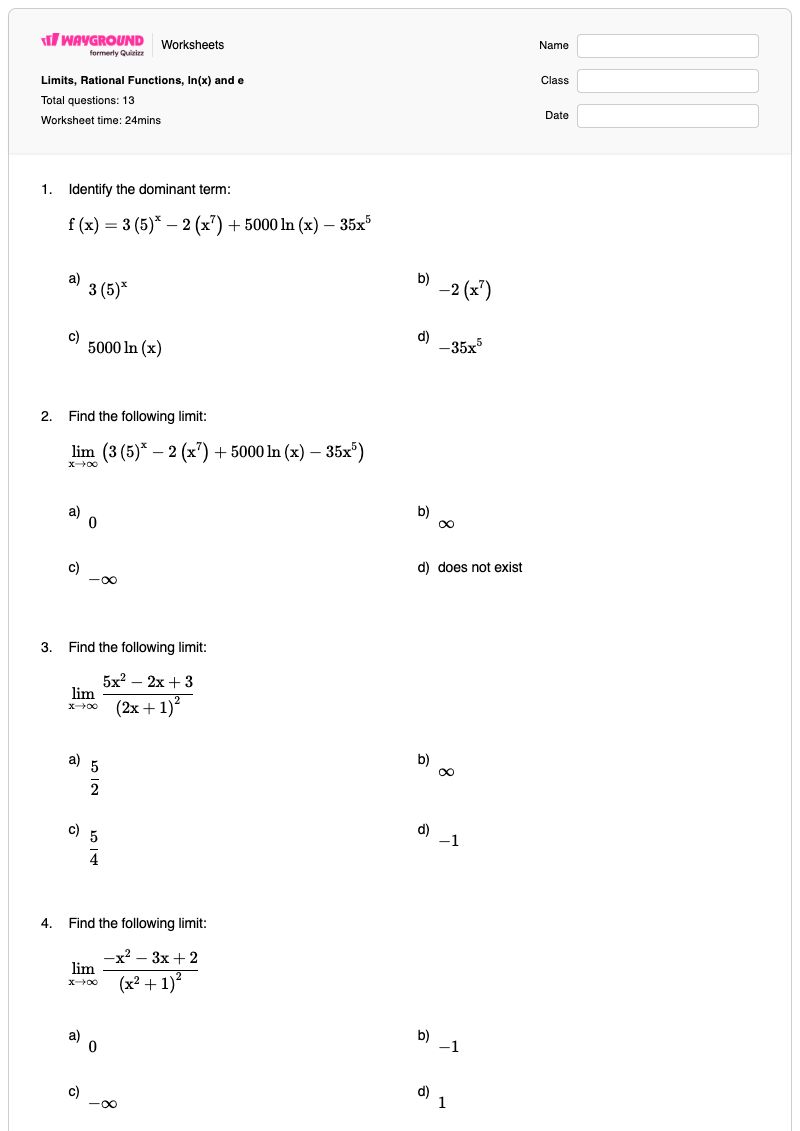
1.
Identify the dominant term:
f(x)=3(5)x−2(x7)+5000ln(x)−35x5
a)
3(5)x
b)
−2(x7)
c)
5000ln(x)
d)
−35x5
2.
Find the following limit:
x→∞lim(3(5)x−2(x7)+5000ln(x)−35x5)
a)
0
b)
∞
c)
−∞
d)
does not exist
3.
Find the following limit:
x→∞lim(2x+1)25x2−2x+3
a)
25
b)
∞
c)
45
d)
−1
4.
Find the following limit:
x→∞lim(x2+1)2−x2−3x+2
a)
0
b)
−1
c)
−∞
d)
1
5.
Find the following limit:
x→∞lim3x+13x2−2x4−1
a)
−32
b)
1
c)
∞
d)
−∞
6.
The graph of f(x)=(x−3)(x−3)(x2−2) has:
a)
a vertical asymptote at x=3
b)
a zero at x=3
c)
a hole at x=3 in the graph of y=x2−2
d)
all of these
7.
Solve the equation for x :
7ex=56
a)
x=7ln56
b)
x=ln8
c)
x=e8
d)
x=56e7
8.
Solve the equation for x :
3ln(x+2)=18
a)
x=ln(6)−2
b)
x=31e18−2
c)
x=e6−2
d)
x=3e2−18
9.
Suppose $8,000 was invested in an account with a 5.1% interest rate. How much money would there be after 15 years if the interest is compounded monthly?
a)
$16,870.61
b)
$17,109.02
c)
$17,164.11
d)
17,191.96
10.
Suppose $8,000 was invested in an account with a 5.1% interest rate. How much money would there be after 15 years if the interest is compounded continuously?
a)
$16,870.61
b)
$17,109.02
c)
$17,164.11
d)
17,191.96
11.
Find the sum of the infinite geometric series if it exists:
7+37+97+277+⋅⋅⋅
a)
10.5
b)
7.3
c)
10.37
d)
the sum does not exist
12.
Find the sum of the infinite geometric series if it exists:
1252+252+52+2⋅⋅⋅
a)
2.5
b)
0.2
c)
2.496
d)
the sum does not exist
13.
Use polynomial division to simplify:
x−33x3−11x2+7x−5
a)
3x2−2x+1
b)
3x2−2x+1+x−3−2
c)
2x2−12x−2
d)
2x2−12x−2+x−3−3
Answer Key
Limits, Rational Functions, ln(x) and e
Total questions: 13
1.
a)
3(5)x
2.
b)
∞
3.
c)
45
4.
a)
0
5.
d)
−∞
6.
c)
a hole at x=3 in the graph of y=x2−2
7.
b)
x=ln8
8.
c)
x=e6−2
9.
c)
$17,164.11
10.
d)
17,191.96
11.
a)
10.5
12.
d)
the sum does not exist
13.
b)
3x2−2x+1+x−3−2
140 %
Browse by subjects
Browse by grades
Browse by format
FAQs
What does this worksheet cover, and how does it help students build these skills?
This worksheet uses 13 multiple-choice questions to connect limit evaluation, rational-function behavior, equations involving ln(x) and e, compound interest, infinite geometric series, and polynomial division. Students build skill by choosing and applying the correct procedure in each format, including identifying a removable hole, distinguishing monthly from continuous compounding, and deciding whether an infinite series has a sum.
How can I use this worksheet to teach limits, rational functions, and ln(x) and e?
Use the early questions to review dominant terms and limit laws before discussing how rational functions can have a hole or another graph feature. Then model the ln(x) and e equation-solving items, compare the monthly and continuous investment formulas, and finish by connecting geometric-series convergence with the algebraic simplification and polynomial-division question. Ask students to explain why each incorrect option is not appropriate, rather than only naming the correct choice.
What mistakes should I watch for when students complete this worksheet?
Students may confuse a removable hole in a rational-function graph with a vertical asymptote or a zero, or substitute into a limit without first checking whether simplification is needed. In the financial questions, watch for confusing monthly compounding with continuous growth. Students may also report a sum for a divergent geometric series, mishandle ln(x) and e when solving equations, or make sign and remainder errors during polynomial division.
How do I assign and grade this worksheet?
This worksheet is available as a printable PDF and as a digital quiz on Wayground, so you can use the 13 multiple-choice items for paper practice or online assessment. It includes a complete answer key for checking limits, equations, financial-growth calculations, series, and polynomial division. For printable submissions, you can scan student work with the Wayground for Teachers app to support grading.
How can I differentiate this limits and exponential-functions worksheet for my students?
Use the worksheet’s Advanced Settings to adjust font spacing or increase the font size so the 13 multiple-choice questions and mathematical notation are easier to read. You can also enable a dyslexia-friendly font or translate the worksheet into another language when that supports access to the limits, ln(x), e, and compound-interest items.
Where can I find more worksheets like this on Wayground?
Wayground offers a comprehensive collection of free printable worksheets and practice problems across subjects, with downloadable PDFs and answer keys to help students master essential skills and concepts. Browse more resources at https://wayground.com/en-us/worksheets.


 Worksheets