

Wayground
Paragraph Writing Review - Printable ELA Worksheets grade 7 - Wayground

Paragraph Writing Review

Amanda Wright

Created by Amanda Wright

20 questions

7th Grade

ELA

Updated Oct 2026

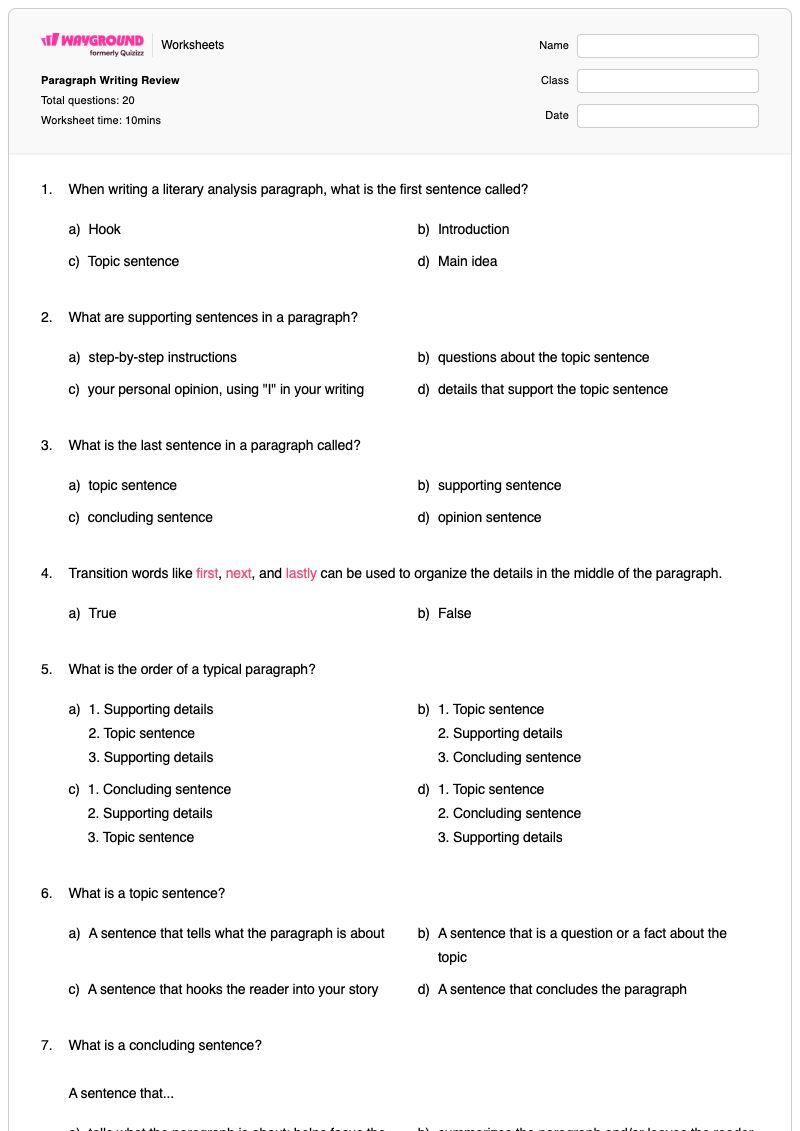
Paragraph Writing Review is a free printable English worksheet for Grade 7 students learning how to build and format a literary analysis paragraph. Its 20 multiple-choice questions review the roles of topic, supporting, and concluding sentences; the typical order of paragraph parts; transition words; paragraph length; and the difference between analysis, summary, and opinion writing. The worksheet also checks key preparation and formatting skills, including brainstorming, indentation, MLA conventions, TAG statements, title formatting, and avoiding personal pronouns in literary analysis. Students use definitions, sequencing, true-or-false statements, and answer choices to identify effective paragraph structure and academic writing practices. A complete answer key is included, making this free printable worksheet useful for review, independent practice, homework, or a quick assessment of Grade 7 English writing knowledge.

Worksheet settings

Font size

S
M
L
XL
WaygroundWorksheets

Paragraph Writing Review

Total questions: 20

Name
Class
Date
1.

When writing a literary analysis paragraph, what is the first sentence called?

a)

Hook

b)

Introduction

c)

Topic sentence

d)

Main idea

2.

What are supporting sentences in a paragraph?

a)

step-by-step instructions

b)

questions about the topic sentence

c)

your personal opinion, using "I" in your writing

d)

details that support the topic sentence

3.
What is the last sentence in a paragraph called?
a)
topic sentence
b)
supporting sentence
c)
concluding sentence
d)
opinion sentence
4.

Transition words like first, next, and lastly can be used to organize the details in the middle of the paragraph.

a)

True

b)

False

5.

What is the order of a typical paragraph?

a)

1. Supporting details

2. Topic sentence

3. Supporting details

b)

1. Topic sentence

2. Supporting details

3. Concluding sentence

c)

1. Concluding sentence

2. Supporting details

3. Topic sentence

d)

1. Topic sentence

2. Concluding sentence

3. Supporting details

6.

What is a topic sentence?

a)

A sentence that tells what the paragraph is about

b)

A sentence that is a question or a fact about the topic

c)

A sentence that hooks the reader into your story

d)

A sentence that concludes the paragraph

7.

What is a concluding sentence?


A sentence that...

a)

tells what the paragraph is about; helps focus the paragraph

b)

summarizes the paragraph and/or leaves the reader with a strong impression

c)

supports or gives more detailed information about the topic sentence

d)

introduces new information

8.

Before writing the first word of your paragraph, you should...

a)

indent one inch from the left margin

b)

brainstorm what you are going to write about

c)

set up your document with the right MLA formatting

d)

All of the above!

9.
Good paragraphs are like good _________.
a)
pizzas
b)
burgers
c)
french fries
d)
tomatoes
10.

Using personal pronouns, like "I think" or "My opinion," in a literary analysis paragraph makes your writing sound stronger.

a)

True!

b)

False!

11.

A standard paragraph, without text evidence/quotes, is about how long?

a)

3-5 sentences

b)

5-7 sentences

c)

1-2 sentences

d)

8-10 sentences

12.

A literary analysis is...

a)

a writing piece that analyzes a piece of literature

b)

an opinion-based writing piece, like a book review

c)

a summary of what you have read

d)

a creative writing piece inspired by the text

13.

What is standard MLA format?

a)

Times New Roman font

b)

Size 12 font

c)

Double-spaced

d)

All of the above

14.

The TAG statement includes

a)

Title, Author, Genre

b)

Topic and Genre

c)

Thesis Statement

d)

None of these

15.

When writing the title of a novel, it should be

a)

Italicized or Underlined

b)

In quotation marks

c)

In bold font

d)

In a bigger font

16.

If you are writing about an article or a poem, you should use what type of formatting for the title?

a)

Italics

b)

Quotation Marks

c)

Underline

d)

None of these

17.

Which acronym can help you write an organized paragraph?

a)

TAG

b)

ACES

c)

YMCA

d)

SOS

18.

In short, ACES stands for...

a)

Answer Correctly Each Sentence

b)

Answer, Cite, Explain, Sum it Up

c)

All Children Eat Sandwiches

d)

Ask, Cite, Explain, Say it again

19.

When formatting a quote in the middle of your paragraph, you don't need to include which of the following?

a)

Signal Phrase

b)

Author

c)

Page Number

d)

Title

20.

Which quote below from The Hunger Games has NOT been cited properly? Look carefully!

a)

On page 21, Katniss exclaims, "I volunteer as tribute!" (Collins).

b)

Katniss exclaims on page 21, "I volunteer as tribute!" (Collins).

c)

The text states, "I volunteer as tribute!" (Collins 21).

d)

"I volunteer as tribute!" the text states on page 21 of The Hunger Games (Collins).

WaygroundAnswer Key

Paragraph Writing Review

Total questions: 20

1.
c)

Topic sentence

2.
d)

details that support the topic sentence

3.
c) concluding sentence
4.
a)

True

5.
b)

1. Topic sentence

2. Supporting details

3. Concluding sentence

6.
a)

A sentence that tells what the paragraph is about

7.
b)

summarizes the paragraph and/or leaves the reader with a strong impression

8.
d)

All of the above!

9.
b) burgers
10.
b)

False!

11.
b)

5-7 sentences

12.
a)

a writing piece that analyzes a piece of literature

13.
d)

All of the above

14.
a)

Title, Author, Genre

15.
a)

Italicized or Underlined

16.
b)

Quotation Marks

17.
b)

ACES

18.
b)

Answer, Cite, Explain, Sum it Up

19.
d)

Title

20.
d)

"I volunteer as tribute!" the text states on page 21 of The Hunger Games (Collins).

FAQs

What does the Paragraph Writing Review worksheet cover?

This Grade 7 English worksheet uses 20 multiple-choice questions to review how to organize a literary analysis paragraph: topic sentence, supporting details, transition words, and concluding sentence. It also checks related conventions such as brainstorming, MLA formatting, TAG statements, novel-title formatting, paragraph length, and avoiding personal pronouns in analysis writing.

How can I use this worksheet to teach literary analysis paragraph structure?

Introduce the paragraph sequence—topic sentence, supporting details, and concluding sentence—before students complete the multiple-choice review. Afterward, ask students to explain why a selected sentence supports the topic sentence or how a concluding sentence summarizes the paragraph, then use the MLA, TAG, and title-formatting items to connect organization with literary-analysis expectations.

What mistakes should I watch for when students complete this paragraph-writing worksheet?

Students may confuse a topic sentence with a hook or concluding sentence, or place supporting details before the topic sentence when answering the sequencing question. Watch for confusion between analysis and summary, the belief that personal phrases such as “I think” strengthen literary analysis, and errors involving TAG, MLA requirements, or italicizing and underlining novel titles.

How do I assign and grade this Paragraph Writing Review worksheet?

The worksheet is available as a printable PDF and as a digital quiz on Wayground, and it includes a complete answer key for its 20 multiple-choice questions. You can grade printable submissions by scanning student work with the Wayground for Teachers app, while the digital quiz can be assigned through Wayground for online completion and grading.

How can I differentiate this literary analysis paragraph worksheet for my students?

Use the worksheet’s Advanced Settings to adjust font spacing and font size for the multiple-choice questions and paragraph-formatting terms. You can also select a dyslexia-friendly font or translate the worksheet into another language to make the review more accessible.

Where can I find more worksheets like this on Wayground?

Wayground offers a comprehensive collection of free printable worksheets and practice problems across all subjects, with downloadable PDFs and answer keys to support essential skills and concepts. Browse more resources at https://wayground.com/en-us/worksheets.