
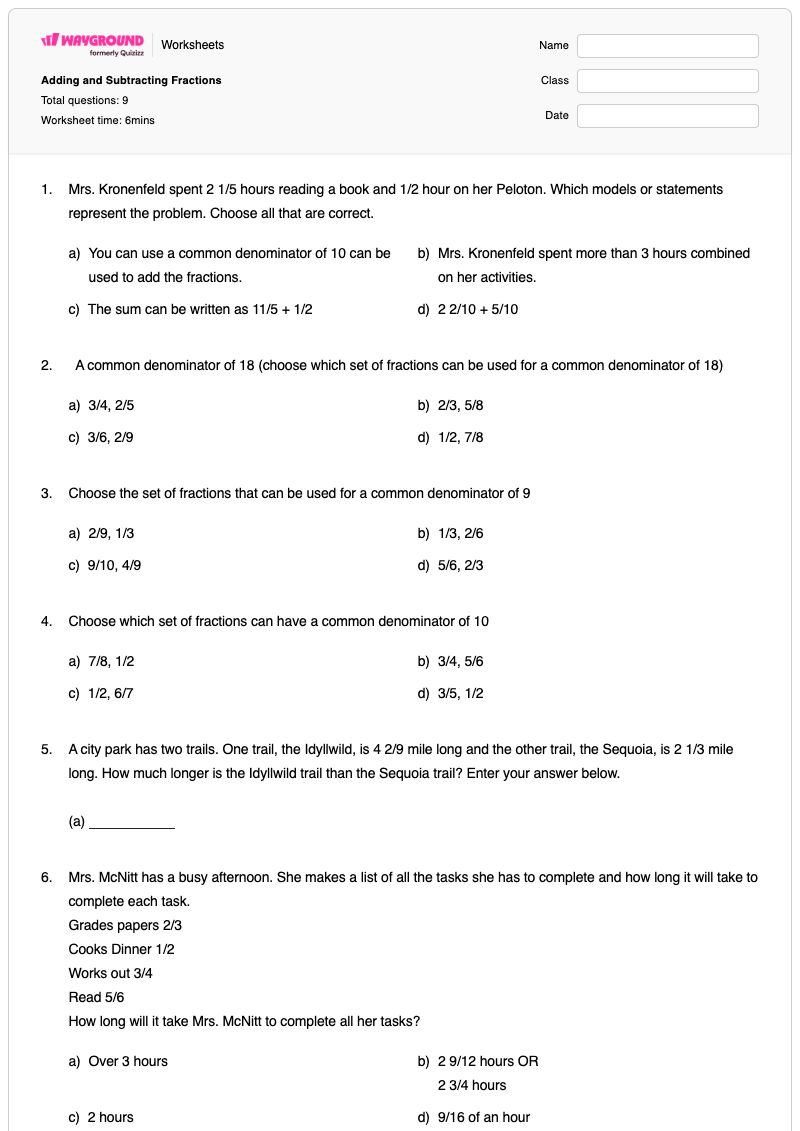

This Grade 5 mathematics worksheet helps students add and subtract fractions and mixed numbers by finding and using common denominators. Across 9 questions, students identify fraction pairs that can share denominators of 9, 10, and 18; represent a mixed-number addition problem; solve a mixed-number subtraction word problem; and add several fractions and mixed numbers. The worksheet uses multiple select, multiple choice, fill-in-the-blank, matching, and dropdown formats to check both procedural accuracy and reasoning.
Students also compare equivalent forms, such as 2 9/12 and 2 3/4, and evaluate whether a fractional estimate is reasonable in context. It is designed for Grade 5 math practice, independent work, review, or a formative check after instruction on equivalent fractions and common denominators. This free printable worksheet includes a complete answer key for efficient checking and feedback.
Worksheet settings
Font size
S
M
L
XL
Worksheets
Adding and Subtracting Fractions
Total questions: 9
Name
Class
Date
1.
Mrs. Kronenfeld spent 2 1/5 hours reading a book and 1/2 hour on her Peloton. Which models or statements represent the problem. Choose all that are correct.
a)
You can use a common denominator of 10 can be used to add the fractions.
b)
Mrs. Kronenfeld spent more than 3 hours combined on her activities.
c)
The sum can be written as 11/5 + 1/2
d)
2 2/10 + 5/10
2.
A common denominator of 18 (choose which set of fractions can be used for a common denominator of 18)
a)
3/4, 2/5
b)
2/3, 5/8
c)
3/6, 2/9
d)
1/2, 7/8
3.
Choose the set of fractions that can be used for a common denominator of 9
a)
2/9, 1/3
b)
1/3, 2/6
c)
9/10, 4/9
d)
5/6, 2/3
4.
Choose which set of fractions can have a common denominator of 10
a)
7/8, 1/2
b)
3/4, 5/6
c)
1/2, 6/7
d)
3/5, 1/2
5.
A city park has two trails. One trail, the Idyllwild, is 4 2/9 mile long and the other trail, the Sequoia, is 2 1/3 mile long. How much longer is the Idyllwild trail than the Sequoia trail? Enter your answer below.
(a)
6.
Mrs. McNitt has a busy afternoon. She makes a list of all the tasks she has to complete and how long it will take to complete each task.
Grades papers 2/3
Cooks Dinner 1/2
Works out 3/4
Read 5/6
How long will it take Mrs. McNitt to complete all her tasks?
a)
Over 3 hours
b)
2 9/12 hours OR
2 3/4 hours
c)
2 hours
d)
9/16 of an hour
7.
Match the following
6/7
2/7 + 4/7 =
3/11
9/11 - 6/11 =
15/19
8/19 + 7/19 =
5/6
2/6 + 1/2 =
3/4
1/2 + 1/4 =
8.
Mrs. McNitt says it will take her less than 1 1/4 hours to complete her tasks because they will only take 9/12 of an hour to complete. Is she correct?
Mrs. McNitt (a) correct. To solve this problem she should multiply the numerator of the fraction for each task by the factor used to create the (b) . It will take her (c) hour(s) for these tasks, which is (d) than 1 1/4 hours.
Choose from the below words
is
is not
common denominator
least common multiple
numerator
2 9/12
6/12
more
less
9.
What is 4 2/3 + 1 2/9
a)
5 4/12
b)
5 4/27
c)
5 8/9
d)
4 3/4
Answer Key
Adding and Subtracting Fractions
Total questions: 9
1.
a)
You can use a common denominator of 10 can be used to add the fractions.
, c)
The sum can be written as 11/5 + 1/2
, d)
2 2/10 + 5/10
2.
c)
3/6, 2/9
3.
a)
2/9, 1/3
4.
d)
3/5, 1/2
5.
1 8/9
6.
b)
2 9/12 hours OR
2 3/4 hours
7.
6/7
-
2/7 + 4/7 =
,
3/11
-
9/11 - 6/11 =
,
15/19
-
8/19 + 7/19 =
,
5/6
-
2/6 + 1/2 =
,
3/4
-
1/2 + 1/4 =
8.
is, common denominator, 2 9/12, more
9.
c)
5 8/9
140 %
Browse by subjects
Browse by grades
Browse by format
FAQs
What does this adding and subtracting fractions worksheet cover?
This Grade 5 worksheet covers finding common denominators, rewriting equivalent fractions, and adding or subtracting fractions and mixed numbers. Its 9 items use multiple select, multiple choice, fill-in-the-blank, matching, and dropdown formats, including problems such as 2 1/5 + 1/2, a mixed-number subtraction situation, and 4 2/3 + 1 2/9. Students must also interpret equivalent forms and check whether a fractional result is reasonable.
How can I use this worksheet to teach common denominators and fraction operations?
Introduce the worksheet by modeling how 2 1/5 can be rewritten as 2 2/10 before adding 1/2 as 5/10. Then have students explain why denominator pairs such as 3/5 and 1/2 can use 10, while pairs such as 3/4 and 2/5 cannot use 10 as a common denominator. After the selected-response items, use the trail-length subtraction and task-time addition problems to connect the procedure to mixed-number contexts and ask students to justify whether their answers are reasonable.
What mistakes should I watch for on this fractions worksheet?
Watch for students choosing a denominator that is not a multiple of both original denominators, or changing a denominator without multiplying the numerator by the same factor. They may also read 2 1/5 as 2/5 instead of rewriting it as 11/5, confuse 9/12 with 9/16, or fail to recognize that 2 9/12 equals 2 3/4. In the subtraction word problem, check that students subtract the fractional parts correctly rather than subtracting numerators and denominators independently.
How do I assign and grade this adding and subtracting fractions worksheet?
Wayground provides this worksheet as both a printable PDF and a digital quiz, and it includes a complete answer key. You can grade printed submissions by scanning student work with the Wayground for Teachers app, or use the digital quiz to review student responses.
How can I differentiate this fractions worksheet for my students?
Use the worksheet’s Advanced Settings to adjust font spacing or choose a larger font size so the fraction expressions, answer choices, and word problems are easier to read. You can also enable a dyslexia-friendly font or translate the worksheet into another language when appropriate for your learners.
Where can I find more worksheets like this on Wayground?
Wayground offers a comprehensive collection of free printable worksheets and practice problems across all subjects, with downloadable PDFs and answer keys to support essential skill and concept mastery. Browse more resources at https://wayground.com/en-us/worksheets.