

Ch 1.5: Greatest Common Factor Quiz (Spanish Version)
15 questions
6th - 6th Grade
Mathematics
This Grade 6 mathematics worksheet helps students build and apply the skills used to find the greatest common factor (GCF). In the Spanish-version content, students identify what prime factorization means, use factor trees for numbers such as 36, 48, 60, 72, and 90, list common factors for pairs of numbers, and use Venn diagrams to organize shared factors. They also determine the GCF of pairs including 16 and 24, 36 and 48, and 54 and 72.
The worksheet contains 15 items: 14 multiple-choice questions and one open-ended factor-tree task. It is designed for Grade 6 math practice, review, or formative assessment, with questions that move from recognizing prime factorization and common factors to applying those ideas to GCF problems. This is a free printable worksheet with a complete answer key, making it practical for independent work, small-group instruction, or checking student understanding after a lesson.
Worksheet settings
Font size
S
M
L
XL
Worksheets
Ch 1.5: Greatest Common Factor Quiz (Spanish Version)
Total questions: 15
Name
Class
Date
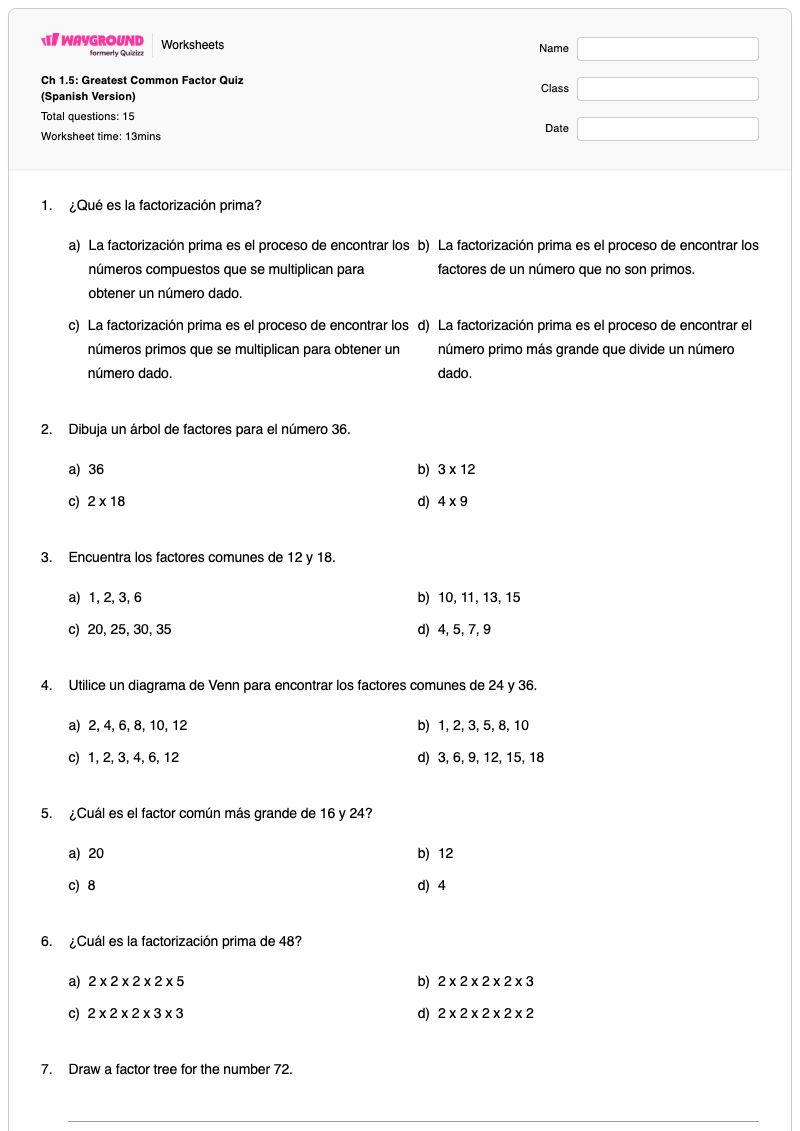
1.
¿Qué es la factorización prima?
a)
La factorización prima es el proceso de encontrar los números compuestos que se multiplican para obtener un número dado.
b)
La factorización prima es el proceso de encontrar los factores de un número que no son primos.
c)
La factorización prima es el proceso de encontrar los números primos que se multiplican para obtener un número dado.
d)
La factorización prima es el proceso de encontrar el número primo más grande que divide un número dado.
2.
Dibuja un árbol de factores para el número 36.
a)
36
b)
3 x 12
c)
2 x 18
d)
4 x 9
3.
Encuentra los factores comunes de 12 y 18.
a)
1, 2, 3, 6
b)
10, 11, 13, 15
c)
20, 25, 30, 35
d)
4, 5, 7, 9
4.
Utilice un diagrama de Venn para encontrar los factores comunes de 24 y 36.
a)
2, 4, 6, 8, 10, 12
b)
1, 2, 3, 5, 8, 10
c)
1, 2, 3, 4, 6, 12
d)
3, 6, 9, 12, 15, 18
5.
¿Cuál es el factor común más grande de 16 y 24?
a)
20
b)
12
c)
8
d)
4
6.
¿Cuál es la factorización prima de 48?
a)
2 x 2 x 2 x 2 x 5
b)
2 x 2 x 2 x 2 x 3
c)
2 x 2 x 2 x 3 x 3
d)
2 x 2 x 2 x 2 x 2
7.
Draw a factor tree for the number 72.
4 lines
8.
Encuentra los factores comunes de 20 y 30.
a)
10, 15, 20, 25
b)
2, 4, 6, 8
c)
3, 4, 6, 15
d)
1, 2, 5, 10
9.
Utilice un diagrama de Venn para encontrar los factores comunes de 40 y 60.
a)
3, 6, 8, 12, 15, 30
b)
7, 14, 21, 28, 35, 42
c)
9, 18, 27, 36, 45, 54
d)
1, 2, 4, 5, 10, 20
10.
¿Cuál es el máximo común divisor de 36 y 48?
a)
12
b)
24
c)
18
d)
6
11.
¿Cuál es la factorización prima de 60?
a)
2 x 2 x 2 x 3
b)
2 x 2 x 2 x 2 x 2
c)
2 x 3 x 4 x 5
d)
2 x 2 x 3 x 5
12.
Dibuja un árbol de factores para el número 90.
a)
90
b)
3 x 30
c)
6 x 15
d)
9 x 10
13.
Encuentra los factores comunes de 15 y 25.
a)
2, 3
b)
10, 15
c)
1, 5
d)
20, 25
14.
Utilice un diagrama de Venn para encontrar los factores comunes de 50 y 70.
a)
15, 20, 25, 30
b)
7, 14, 21, 28
c)
3, 4, 6, 8
d)
1, 2, 5, 10
15.
¿Cuál es el máximo común divisor de 54 y 72?
a)
9
b)
27
c)
36
d)
18
Answer Key
Ch 1.5: Greatest Common Factor Quiz (Spanish Version)
Total questions: 15
1.
c)
La factorización prima es el proceso de encontrar los números primos que se multiplican para obtener un número dado.
2.
a)
36
3.
a)
1, 2, 3, 6
4.
c)
1, 2, 3, 4, 6, 12
5.
c)
8
6.
b)
2 x 2 x 2 x 2 x 3
7.
n/a
8.
d)
1, 2, 5, 10
9.
d)
1, 2, 4, 5, 10, 20
10.
a)
12
11.
d)
2 x 2 x 3 x 5
12.
a)
90
13.
c)
1, 5
14.
d)
1, 2, 5, 10
15.
d)
18
140 %
Browse by subjects
Browse by grades
Browse by format
FAQs
What does this greatest common factor worksheet help students learn?
This Grade 6 worksheet develops GCF skills through 14 multiple-choice questions and one open-ended factor-tree task. Students identify prime factorization, construct or interpret factor trees, find common factors for pairs such as 12 and 18 or 40 and 60, use Venn diagrams to organize shared factors, and select the greatest common factor.
How can I use this worksheet to teach greatest common factor?
Use the factor-tree items for numbers such as 36, 72, and 90 to model how a number can be broken into prime factors. Then have students use the common-factor and Venn-diagram questions to compare factor lists before solving the GCF items, such as finding the GCF of 36 and 48. Ask students to explain why the greatest shared factor is correct rather than choosing the largest factor from either number.
What mistakes should I watch for on this GCF worksheet?
Students may list factors of only one number instead of factors shared by both numbers, or include numbers that do not divide evenly into either pair. On the factor-tree questions, check that students continue splitting composite factors until the leaves are prime; on the GCF questions, watch for answers that are common factors but not the greatest one. Students may also confuse a complete list of common factors with the single GCF.
How do I assign and grade this greatest common factor worksheet?
Wayground provides this worksheet as a printable PDF and as a digital quiz, and it includes a complete answer key for the 14 multiple-choice items and the factor-tree response. Printable submissions can be graded by scanning student work with the Wayground for Teachers app, while the digital quiz supports online assignment and grading.
How can I differentiate this factor-tree and GCF worksheet for my students?
In the worksheet’s Advanced Settings, adjust font spacing or choose a larger font size to make the factor-tree prompts, factor lists, and Venn-diagram questions easier to read. You can also enable a dyslexia-friendly font or translate this Spanish-version worksheet into another language when that better supports access to the prime-factorization and GCF tasks.
Where can I find more worksheets like this on Wayground?
Wayground offers a broad collection of free printable worksheets and practice problems across subjects, with downloadable PDFs and answer keys to support essential skills and concepts. Browse more resources at https://wayground.com/en-us/worksheets.