
 Worksheets
From Seed to Pumpkin to Seed with Prompt
Total questions: 1

Read the selection and choose the best answer to each question.
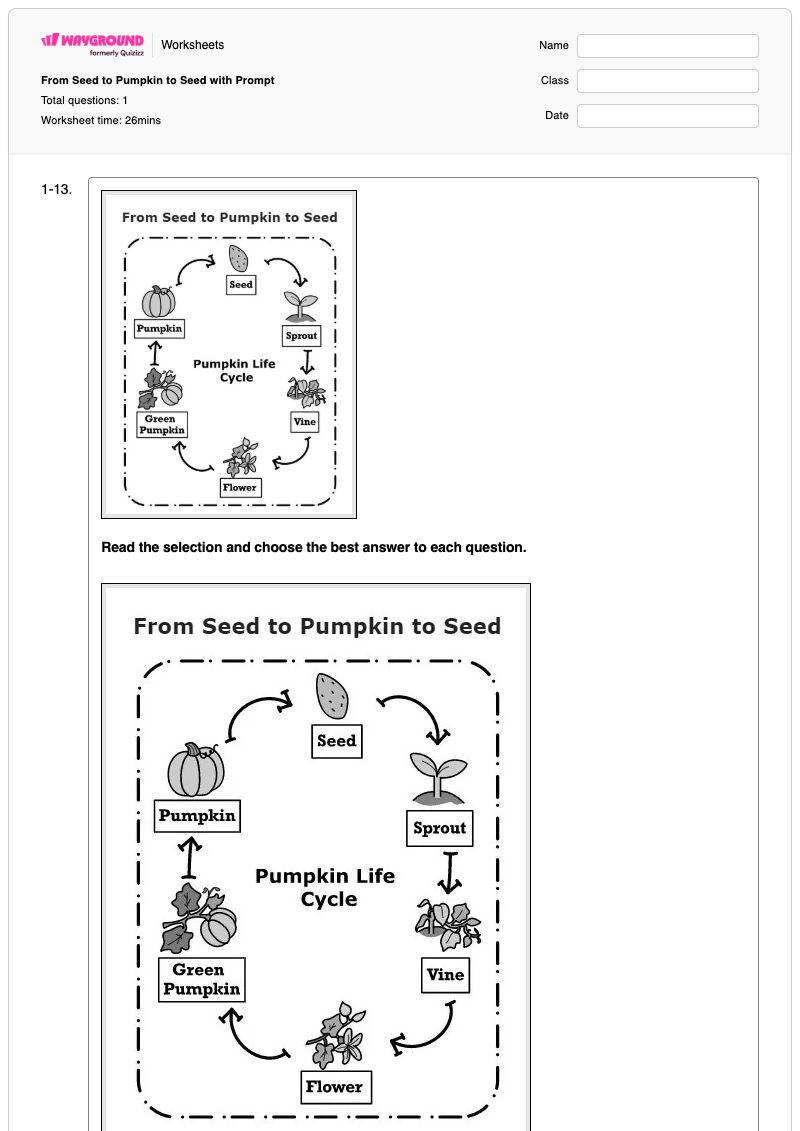
From Seed to Pumpkin to Seed
1 In the fall of the year, pumpkins seem to be everywhere. Truckloads are brought from farms to markets. People decorate their homes with pumpkins. It is hard to imagine that these enormous fruits grow from small seeds. But they do—and this is how.
Seeds
2 A pumpkin seed is white, oval, and flat. Inside its hard coat is everything needed to produce a new pumpkin. Most pumpkin seeds are only about a half inch long, but they need a lot of space around them to grow. Some will require a garden plot about the size of a parking spot for a car!
3 In spring, when the weather has warmed up and the ground is no longer cold, four or five seeds can be planted in the middle of the garden plot. If the ground is dry, the seeds should be watered, but not too much, since soggy soil might make them rot.
Sprouts and Vines
4 About a week after planting, a seed emerges from the soil and becomes a sprout, and the tiny pumpkin plant begins to grow. The roots grow down into the soil, seeking water. Two leaves push up from the soil. These seed leaves are green and smooth. They make food for the plant using sunlight, water, and air.
5 After another week, new, larger leaves appear. These leaves are jagged, rough, and scratchy. They take over the job of making food for the plant, so the seed leaves dry up and drop off. The pumpkin plant grows quickly. Long vines stretch over the ground. Thin, twisty stems wind around other stems. They may reach up onto fences or other plants in the garden.
Pollination
6 When the pumpkin plants are about 10 weeks old, bright yellow flowers bloom on the vines. In the center of each blossom is a feathery part covered with powdery pollen. Bees are attracted to the pollen, which they take back to their hive for making honey. Once the bees have found the pumpkin plants, they come back again and again.
7 Other blossoms open later. Each pumpkin flower lasts only one day. The bees land on one pumpkin flower after another. Pollen sticks to and falls off the bees as they move. In this way, pollen is spread among the pumpkin plants. The pollen makes new pumpkins grow. To make new pumpkins, bees have to visit.
Pumpkins
8 After the bees have delivered the pollen, the flower dries up and falls off, but the little pumpkin grows, and grows, and grows. It becomes too heavy to hang from the vine. It settles on the ground, where it continues to grow. The leaves shade it from the hot sun and keep the ground damp. In very dry weather, the plant might need to be watered.
9 As the weather gets cooler in fall, the pumpkins mature. They stop growing and change color. Most varieties turn orange, but others are yellow, white, blue, or even striped.
10 When the leaves turn brown, it's time to pick the pumpkins. A pumpkin will last longer if three or four inches of stem are left on the pumpkin when it's cut from the vine. Pumpkins should be stored in a dry, cool place until they are wanted for making pies, cookies, bread, or soup.
11 The inside of a pumpkin is a blob of stringy pulp with hundreds of seeds. The seeds can be picked out of the pulp and washed. Some of the seeds can be baked in the oven until they are crisp. They make a tasty snack.
12 Other seeds may be allowed to dry and not baked. Those can be saved until spring. When they are planted, they'll sprout and grow leaves and flowers. Then, with the help of bees, there will be another crop of pumpkins.
In paragraph 1, what is the most likely reason the author uses the phrase "pumpkins seem to be everywhere"?
Select TWO correct answers.
To show that fall is when most pumpkins are picked
To show that there are too many pumpkins
To show that many people like pumpkins
To show that pumpkins can grow in strange places
To show that many people go to where pumpkins grow
What is the central idea of the article?
Pollen from flowers spreads to other pumpkin plants.
Small seeds become the plants that produce pumpkins.
Pumpkins remain as sprouts for most of their lives.
Pumpkins can come in many different colors.
What is the shape of most pumpkin seeds?
Round and flat
Green and round
White, oval, and flat
Small and square
How long after planting does a seed emerge from the soil to become a sprout?
About a week
A month
Two weeks
Immediately
What is the most likely reason the author wrote this article?
To invite people to carve their own pumpkins
To describe how people use pumpkins
To tell why bees need pumpkins
To explain where pumpkins come from
What is the most likely reason the author includes the chart in the article?
To show that the stages happen over and over
To show how large the plants are at each stage
To show why each stage happens
To show how long each of the stages lasts
In which section of the article would the reader most likely find information about caring for pumpkin plants that are just starting to grow?
Seeds
Sprouts and Vines
Pollination
Pumpkins
What is the next stage after the sprout stage in the pumpkin life cycle?
seed
pumpkins
flowers
What part of the pumpkin flower attracts bees?
The stem
The leaves
The flowers
The roots
What might a pumpkin plant need in very dry weather?
More bees
To be watered
Less sunlight
Cooler temperatures
When is it time to pick the pumpkins?
When the leaves turn brown
When the bees stop visiting
When the flowers bloom
When the pumpkins turn blue
What can be done with the seeds inside a pumpkin?
They can be dried and saved until spring
They can be thrown away
They can be planted immediately
They can be used to make pumpkin juice
Read the article "From Seed to Pumpkin to Seed." Based on the information in the article, write a response to the following:
Explain how bees and pumpkins are beneficial to one another.
Write a well-organized informational essay that uses specific evidence from the article to support your answer.
Remember to —
• clearly state your central idea
• organize your writing
• develop your ideas in detail
• use evidence from the selection in your response
• use correct spelling, capitalization, punctuation, and grammar
Manage your time carefully so that you can —
• review the selection
• plan your response
• write your response
• revise and edit your response
Write your response in the box provided.
Answer KeyFrom Seed to Pumpkin to Seed with Prompt
Total questions: 1
To show that fall is when most pumpkins are picked
, c)To show that many people like pumpkins
Small seeds become the plants that produce pumpkins.
White, oval, and flat
About a week
To explain where pumpkins come from
To show that the stages happen over and over
Sprouts and Vines
flowers
The flowers
To be watered
When the leaves turn brown
They can be dried and saved until spring