 Worksheets
8-3 Adding Tens and Ones on a Hundred Chart
Total questions: 5
Name
Class
Date


 Answer Key
8-3 Adding Tens and Ones on a Hundred Chart
Total questions: 5
1.
d)
46
2.
c)
13
3.
d)
37
4.
b)
28
5.
c)
68

5 questions
1st - 1st Grade
Mathematics
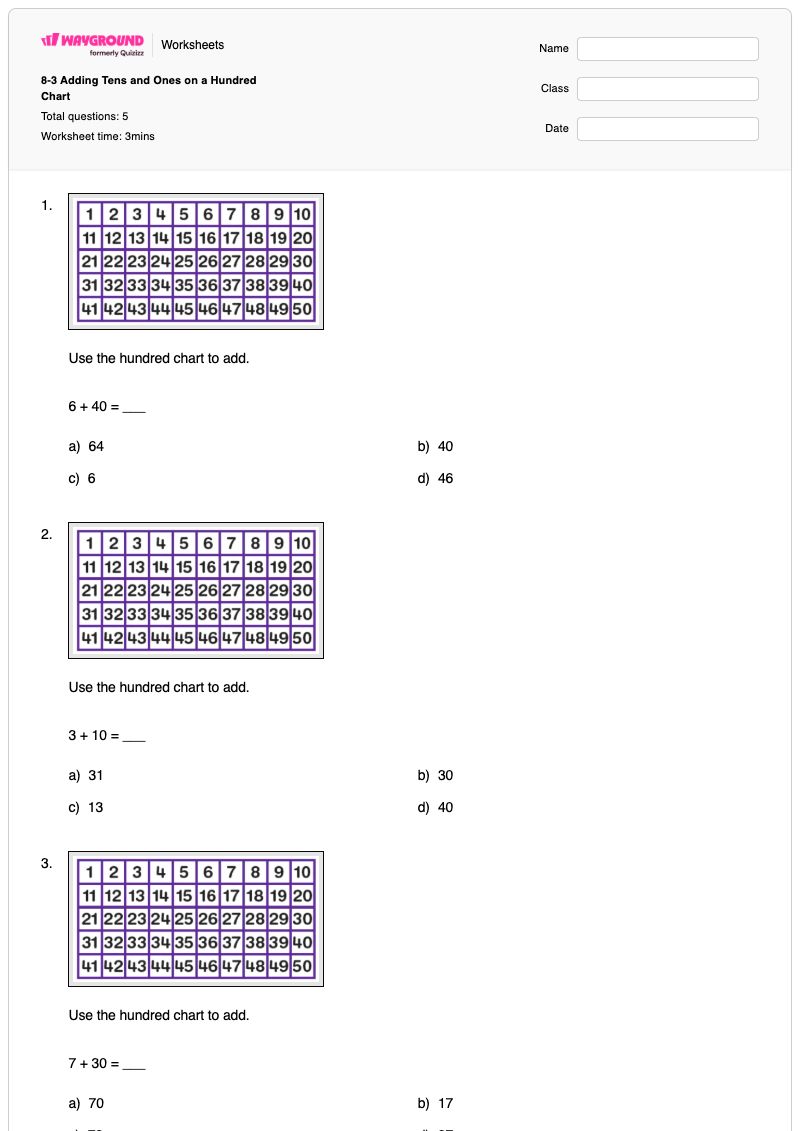
This Grade 1 mathematics worksheet gives students focused practice adding a multiple of ten to a one-digit number with a hundred chart. The five multiple-choice items include equations such as 6 + 40, 3 + 10, 7 + 30, and 8 + 20, requiring students to identify each sum while distinguishing the tens and ones in the addition. A final word problem asks students to apply the same strategy to a situation involving 8 eggs and 60 more eggs. This format helps teachers check whether students can transfer hundred-chart addition from equations to a simple context and select the correct total from plausible choices. Use it during early math instruction, independent practice, review, or a quick formative check. It is a free printable worksheet with a complete answer key.
Worksheet settings
Font size
WorksheetsAnswer Key46
13
37
28
68
This Grade 1 worksheet focuses on adding a one-digit number to a multiple of ten, such as 6 + 40 or 8 + 20, using a hundred chart. Its five multiple-choice questions build fluency with identifying the correct sum and include one eggs word problem that asks students to apply the same addition strategy in context.
First model one equation, such as 3 + 10, by showing how the hundred chart represents the addition of one ten to three ones. Then have students solve the remaining equation-based multiple-choice items and explain why the correct choice matches the chart. Use the final eggs word problem to discuss how the same strategy applies when the addition is presented in a situation rather than an equation.
Watch for students selecting a number that reverses the digits, such as 64 instead of 46 for 6 + 40, or confusing the added tens with the total. Students may also choose a distractor such as 18 for the final problem by adding the digits without accounting for 60. Ask them to represent the tens and ones on the hundred chart before choosing an answer.
Wayground provides this worksheet as a printable PDF and as a digital quiz, and it includes a complete answer key for the five multiple-choice items. You can grade printable submissions by scanning student work with the Wayground for Teachers app, or review responses from the digital quiz.
In the worksheet’s Advanced Settings, adjust font spacing or choose a larger font size to make the five multiple-choice equations and the eggs word problem easier to read. You can also enable a dyslexia-friendly font or translate the worksheet into another language when those options support access to the math content.
Wayground offers a comprehensive collection of free printable worksheets and practice problems across subjects, including downloadable PDFs and answer keys to support essential skills and concepts. Browse more resources at https://wayground.com/en-us/worksheets.