
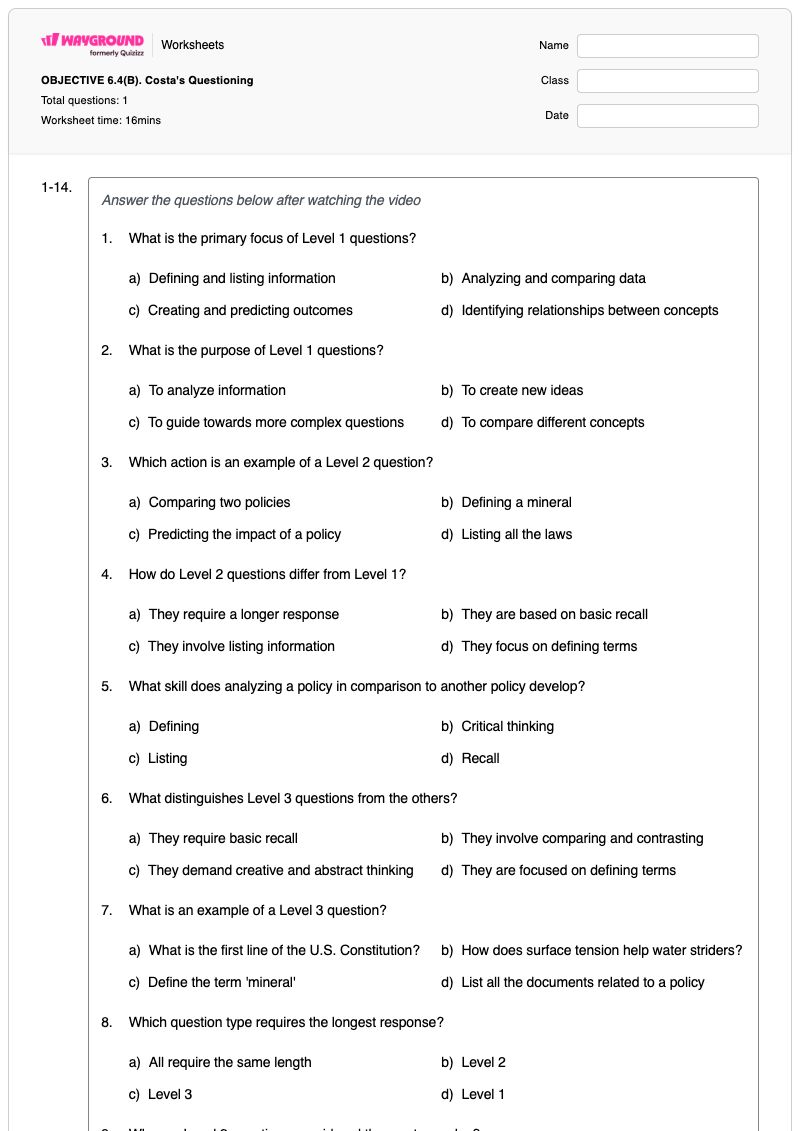

OBJECTIVE 6.4(B). Costa's Questioning is a Grade 6 social studies worksheet that teaches students to distinguish among Costa’s Levels 1, 2, and 3 questions. Students examine what each level asks them to do, from defining and listing information to comparing ideas and using creative, abstract thinking. The examples include policies, scientific concepts, weather patterns, the U.S. Constitution, and chemical characteristics, helping students classify questions across content areas.
This free printable worksheet includes 15 items in a combination of multiple-choice, comprehension-video, and open-ended formats. The multiple-choice questions ask students to identify examples, purposes, response demands, and thinking skills associated with each level; the final prompt asks them to explain the differences in their own words. An answer key is included, making the worksheet useful for guided instruction, independent practice, or a formative check of students’ understanding of question complexity.
Worksheet settings
Font size
S
M
L
XL
Worksheets
OBJECTIVE 6.4(B). Costa's Questioning
Total questions: 1
Name
Class
Date
1-14.
Answer the questions below after watching the video
1.
What is the primary focus of Level 1 questions?
a)
Defining and listing information
b)
Analyzing and comparing data
c)
Creating and predicting outcomes
d)
Identifying relationships between concepts
2.
What is the purpose of Level 1 questions?
a)
To analyze information
b)
To create new ideas
c)
To guide towards more complex questions
d)
To compare different concepts
3.
Which action is an example of a Level 2 question?
a)
Comparing two policies
b)
Defining a mineral
c)
Predicting the impact of a policy
d)
Listing all the laws
4.
How do Level 2 questions differ from Level 1?
a)
They require a longer response
b)
They are based on basic recall
c)
They involve listing information
d)
They focus on defining terms
5.
What skill does analyzing a policy in comparison to another policy develop?
a)
Defining
b)
Critical thinking
c)
Listing
d)
Recall
6.
What distinguishes Level 3 questions from the others?
a)
They require basic recall
b)
They involve comparing and contrasting
c)
They demand creative and abstract thinking
d)
They are focused on defining terms
7.
What is an example of a Level 3 question?
a)
What is the first line of the U.S. Constitution?
b)
How does surface tension help water striders?
c)
Define the term 'mineral'
d)
List all the documents related to a policy
8.
Which question type requires the longest response?
a)
All require the same length
b)
Level 2
c)
Level 3
d)
Level 1
9.
Why are Level 3 questions considered the most complex?
a)
They involve simple comparisons
b)
They require basic definitions
c)
They demand a synthesis of ideas and creativity
d)
They are focused on listing information
10.
What type of question is this: What distinguishes fish from amphibians?
a)
Level One Question
b)
Level Two Question
c)
Level Three Question
11.
What type of question is this:
In a La Nina year, would you expect the weather to be drier or wetter than usual? Why?
a)
Level One Question
b)
Level Two Question
c)
Level Three Question
12.
What type of question is this:
What is the first line of the U.S. Constitution?
a)
Level One Question
b)
Level Two Question
c)
Level Three Question
13.
What type of question is this:
Given a set of characteristics for an unidentified element, what chemical family might it belong to?
a)
Level One Question
b)
Level Two Question
c)
Level Three Question
14.
IN YOUR OWN WORDS: What makes each level of questioning different from eachother?
4 lines
Answer Key
OBJECTIVE 6.4(B). Costa's Questioning
Total questions: 1
1-14.
1.
a)
Defining and listing information
2.
c)
To guide towards more complex questions
3.
a)
Comparing two policies
4.
a)
They require a longer response
5.
b)
Critical thinking
6.
c)
They demand creative and abstract thinking
7.
b)
How does surface tension help water striders?
8.
c)
Level 3
9.
c)
They demand a synthesis of ideas and creativity
10.
b)
Level Two Question
11.
c)
Level Three Question
12.
a)
Level One Question
13.
b)
Level Two Question
14.
n/a
140 %
Browse by subjects
Browse by grades
Browse by format
FAQs
What does this Costa’s Questioning worksheet help students learn?
This Grade 6 social studies worksheet helps students classify questions as Costa’s Level 1, Level 2, or Level 3 and explain how the levels differ. Its multiple-choice items use examples such as defining a mineral, comparing policies, and explaining a La Niña outcome, while the open-ended prompt asks students to describe each level in their own words.
How can I use this worksheet to teach Costa’s Levels of Questioning?
Introduce the three levels by modeling the difference between recalling a fact, comparing ideas, and synthesizing information creatively. Then have students justify classifications from the worksheet, such as identifying the U.S. Constitution item as Level 1 and the La Niña question as Level 3, before completing the open-ended explanation as a brief reflection.
What mistakes should I watch for when students complete this Costa’s Questioning worksheet?
Students may confuse a question’s subject matter with its cognitive level—for example, labeling the mineral or chemical-family examples Level 1 simply because they involve science. They may also classify every question requiring explanation as Level 3; the worksheet distinguishes Level 2 comparison, such as contrasting fish and amphibians or two policies, from Level 3 synthesis and creative or abstract thinking.
How do I assign and grade this Costa’s Questioning worksheet?
Assign it as a printable PDF or as a digital quiz on Wayground; it includes a complete answer key for the multiple-choice items and guidance for reviewing the open-ended response. For printable submissions, teachers can scan student work with the Wayground for Teachers app to support grading and record keeping.
How can I differentiate this Costa’s Questioning worksheet for my students?
Use the worksheet’s Advanced Settings to adjust font spacing and font size so the multiple-choice options and open-ended prompt are easier to navigate. You can also enable a dyslexia-friendly font or translate the worksheet into another language, which can support access to terms such as recall, comparison, synthesis, and abstract thinking.
Where can I find more free worksheets like this on Wayground?
Wayground offers a comprehensive collection of free printable worksheets and practice problems across subjects, with downloadable PDFs and answer keys to help students master essential skills and concepts. Browse more resources at https://wayground.com/en-us/worksheets.