

Wayground
Author's Purpose - Printable English Worksheets grade 5 - Wayground

Author's Purpose

10 questions

4th - 6th Grade

English

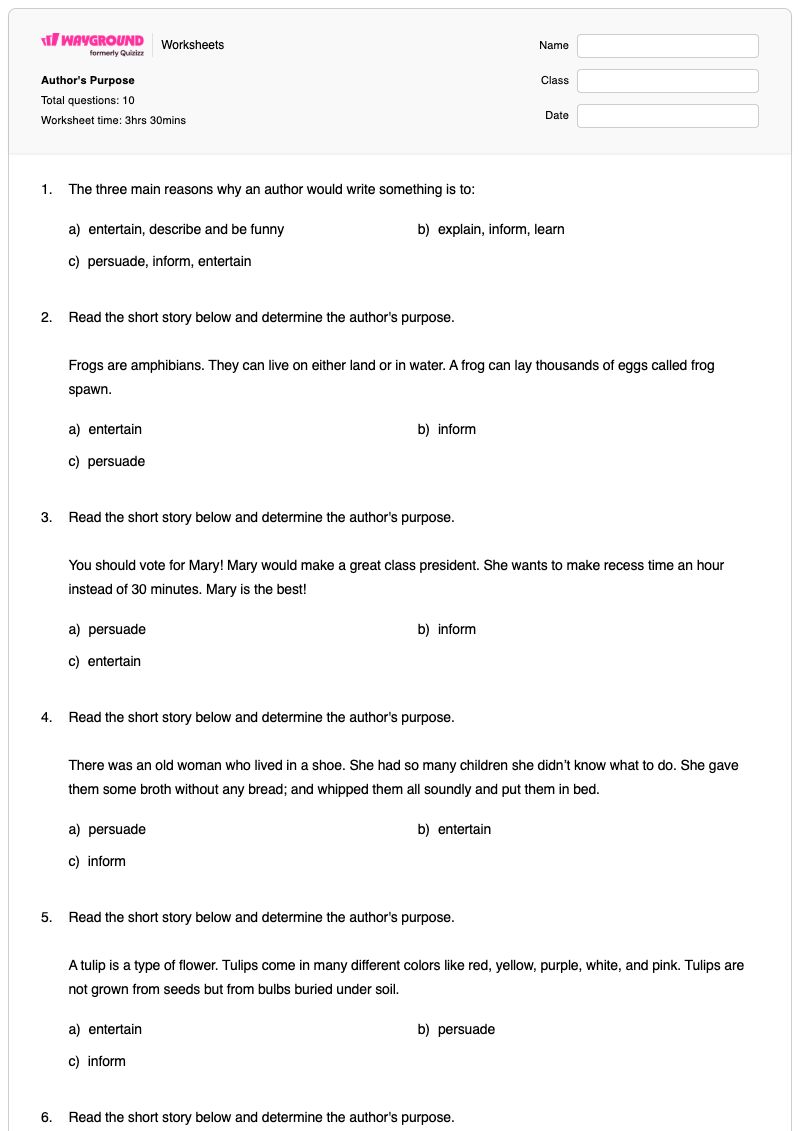
This free printable Author’s Purpose worksheet helps students in Grades 4–6 identify why an author writes: to persuade, inform, or entertain. Through 10 multiple-choice questions, students first review the three purposes and then classify short texts about frogs, tulips, voting for a class president, asking for help, and familiar story writing. Additional questions connect each purpose to recognizable text types, including comics, mystery stories, and nonfiction. The worksheet builds close-reading and text-analysis skills by asking students to use the writer’s goal and the clues in each passage to select the best purpose. It works well for introducing the concept, reinforcing instruction, or checking whether students can distinguish factual information from attempts to convince or entertain. A complete answer key is included, making this free printable worksheet convenient for independent practice, partner work, homework, or quick assessment.

Worksheet settings

Font size

S
M
L
XL
Worksheets

Author's Purpose

Total questions: 10

Name
Class
Date
1.

The three main reasons why an author would write something is to:

a)

entertain, describe and be funny

b)

explain, inform, learn

c)

persuade, inform, entertain

2.

Read the short story below and determine the author's purpose.


Frogs are amphibians. They can live on either land or in water. A frog can lay thousands of eggs called frog spawn.

a)

entertain

b)

inform

c)

persuade

3.

Read the short story below and determine the author's purpose.


You should vote for Mary! Mary would make a great class president. She wants to make recess time an hour instead of 30 minutes. Mary is the best!

a)

persuade

b)

inform

c)

entertain

4.

Read the short story below and determine the author's purpose.


There was an old woman who lived in a shoe. She had so many children she didn’t know what to do. She gave them some broth without any bread; and whipped them all soundly and put them in bed.

a)

persuade

b)

entertain

c)

inform

5.

Read the short story below and determine the author's purpose.


A tulip is a type of flower. Tulips come in many different colors like red, yellow, purple, white, and pink. Tulips are not grown from seeds but from bulbs buried under soil.

a)

entertain

b)

persuade

c)

inform

6.

Read the short story below and determine the author's purpose.


I know you are super busy, but can you please help me with the math homework today? You are so good at math, and I am really having trouble. Plus if you help me today, I will help you with your book report next week. Also, I will bake you some yummy cookies! Please help me!

a)

entertain

b)

inform

c)

persuade

7.

Funny stories, comics, and mystery stories are most likely written to:

a)

persuade

b)

inform

c)

entertain

8.

Nonfiction stories with facts about animals or historical events are written to:

a)

inform

b)

entertain

c)

persuade

9.

When the author is trying to convince you of something, they are trying to _________________ you.

a)

persuade

b)

entertain

c)

inform

10.

When authors just want the reader to enjoy the story and have fun reading, their purpose is to:

a)

persuade

b)

inform

c)

entertain

Answer Key

Author's Purpose

Total questions: 10

1.
c)

persuade, inform, entertain

2.
b)

inform

3.
a)

persuade

4.
b)

entertain

5.
c)

inform

6.
c)

persuade

7.
c)

entertain

8.
a)

inform

9.
a)

persuade

10.
c)

entertain

FAQs

What does this Author’s Purpose worksheet cover?

This Grade 4–6 English worksheet focuses on identifying whether a text is written to persuade, inform, or entertain. Its 10 multiple-choice items ask students to classify short passages, such as factual writing about frogs and tulips, a request designed to convince someone, and a nursery rhyme, then connect each purpose to text types like comics, mysteries, and nonfiction.

How can I use this worksheet to teach author’s purpose?

Introduce the three purposes—persuade, inform, and entertain—before students complete the multiple-choice items. Have students underline clues in each short passage, such as facts in the frog and tulip texts or convincing language in the class-president and homework-help examples, and explain why the selected purpose fits.

What mistakes should I watch for when students complete this worksheet?

Students may confuse informing with persuading when a passage states an opinion, as in the request to vote for Mary, or overlook persuasive language in the request for math homework help. They may also choose entertain simply because a passage is written as a story, even when it mainly provides facts, such as the texts about frogs and tulips.

How do I assign and grade this Author’s Purpose worksheet?

You can assign this worksheet as a printable PDF or as a digital quiz on Wayground. It includes a complete answer key, and printable submissions can be graded by scanning student work with the Wayground for Teachers app. The printable format also gives schools an option for reducing screen time.

How can I differentiate this worksheet for my students?

For the short passages and multiple-choice options in this Author’s Purpose worksheet, use Advanced Settings to adjust font spacing or choose a larger font size for easier tracking. You can also enable a dyslexia-friendly font or translate the worksheet into another language when those changes will help students access the questions and distinguish the three answer choices.

Where can I find more worksheets like this on Wayground?

Wayground offers a comprehensive collection of free printable worksheets and practice problems across subjects, with downloadable PDFs and answer keys to support essential skills and concepts. Browse more resources at https://wayground.com/en-us/worksheets.