
Wayground
Linear Inequalities and Systems of Linear Inequalities - Printable Math Worksheets 9th Grade - Wayground

Linear Inequalities and Systems of Linear Inequalities

Gina Petrosi-Higgins

Created by Gina Petrosi-Higgins

17 questions

9th Grade

Math

Updated Oct 2026

Linear Inequalities and Systems of Linear Inequalities is a Grade 9 Algebra I worksheet that develops students’ ability to interpret, write, and test linear inequalities from graphs and equations. Across 17 multiple-choice questions, students identify inequalities represented by graphs, determine whether boundary lines are included, distinguish solid and dashed boundaries, interpret shading, and decide whether ordered pairs satisfy an inequality. The worksheet also introduces systems of linear inequalities by asking students to test points and match systems with their graphs and solution regions. These tasks reinforce the connection between symbolic notation, graph features, and solution sets while giving students repeated practice checking both individual inequalities and systems. This free printable worksheet includes a complete answer key and can support independent practice, review, or a formative Algebra I assessment.

Worksheet settings

Font size

S
M
L
XL
WaygroundWorksheets

Linear Inequalities and Systems of Linear Inequalities

Total questions: 17

Name
Class
Date
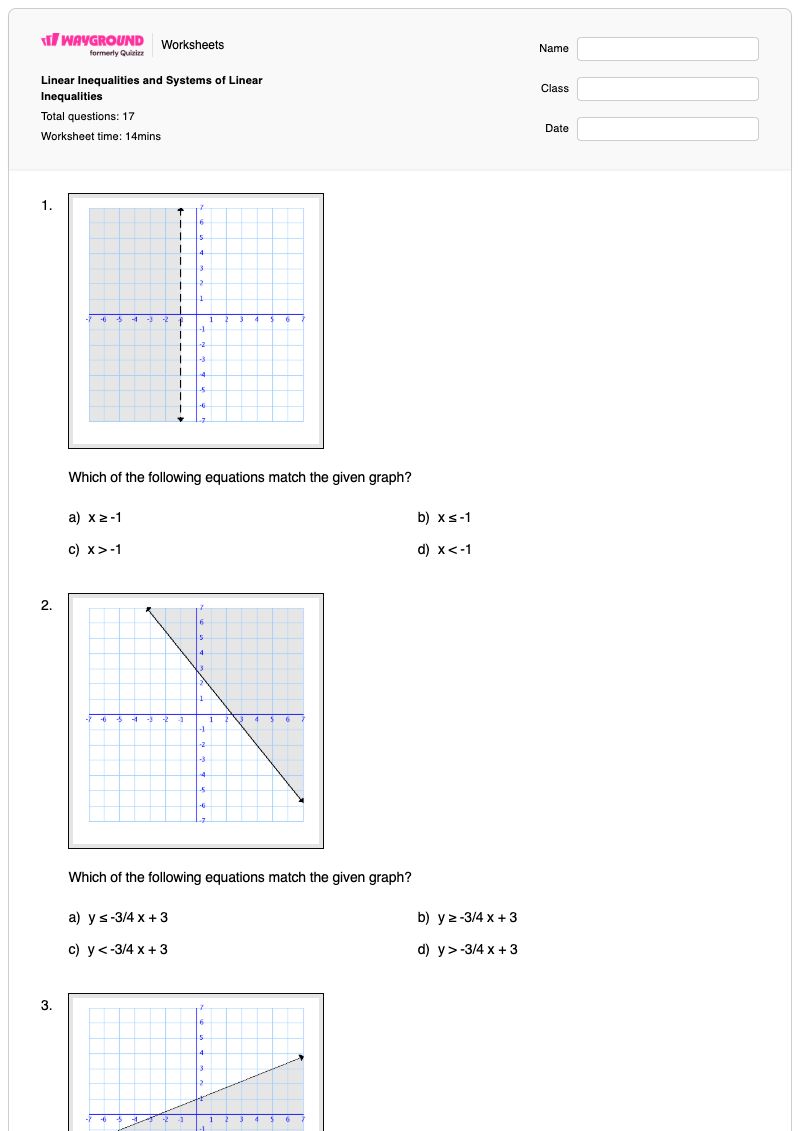
1.
Which of the following equations match the given graph?
a)
x ≥ -1
b)
x ≤ -1
c)
x > -1
d)
x < -1
2.
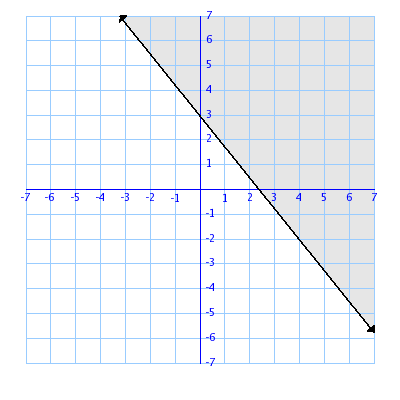
Which of the following equations match the given graph?
a)
y ≤ -3/4 x + 3
b)
y ≥ -3/4 x + 3
c)
y < -3/4 x + 3
d)
y > -3/4 x + 3
3.
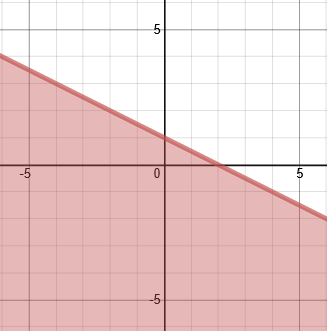
Which of the following equations match the given graph?
a)
y ≥ 2/5x + 1
b)
y ≥ -2/5x + 1
c)
y≤  2/5x + 1
d)
y ≥ -2/5x - 1
4.
Are the points on the boundary line part of the solution set or not?
a)
Yes, they are part of the solution set
b)
No, they are NOT part of the solution set
5.
Consider the function y<2x+3. Which is true?
a)
The line would be solid with shading above.
b)
The line would be dashed with shading above.
c)
The line would be solid with shading below.
d)
None of these.
6.
How can I tell if an inequality will have a solid line?
a)
It has an equal sign.
b)
The symbol is greater than.
c)
The symbol has "or equal to."
d)
You just guess.
7.
Which point below is NOT a part of the solution set?
a)
(0, 0)
b)
(0, 1)
c)
(-100, -3)
d)
(5, 10)
8.
Which point below is NOT part of the solution set?
a)
(0, 0)
b)
(-10, -10)
c)
(-1, 5)
d)
(5, 20)
9.
Which point below is NOT part of the solution set?
a)
(0, 0)
b)
(5, 1)
c)
(-1, -3)
d)
(20, -5)
10.

Which ordered pair is a solution of the inequality?

y ≥ 4x – 5

a)

(3, 4)

b)

(3, 0)

c)

(2, 1)

d)

(1, 1)

11.
Which point is a solution?
a)
(0, 6)
b)
(-3, 4)
c)
(1, 0)
d)
(-4, 3)
12.
Is (-2,4) a solution to the system?
a)
Solution
b)
Not a solution
13.
Match the system to the graph (solution set is on the left)
a)
y ≤ 3x   and  y ≤ -2x + 4
b)
y > 3x   and  y > -2x + 4
c)
y < 3x   and  y > -2x + 3
d)
y > 3x   and  y < -2x + 4
14.
Which of the following is not a solution to this system of inequalities?
a)
(0,-1)
b)
(0,3)
c)
(4,0)
d)
(6,-2)
15.
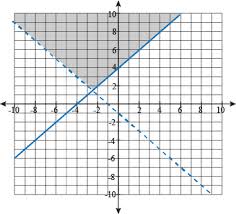
Which system of inequalities matches the graph?
a)
y > 2x - 4
y < 2
b)
y < 2x - 4
y < 2
c)
y > 2x - 4
y <  2 
d)
y < 2x - 4
y <   -2
16.
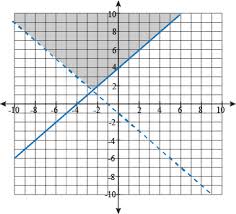
Which system of inequalities is shown?
a)
y ≥ -x - 1
y < x + 4
b)
y < -x - 1
 y ≥ x + 4
c)
y > -x - 1
y ≥ x + 4
d)
y > -x - 1
y ≥ x + 3
17.
Is (0,0) a solution to the system?
a)
Solution
b)
Not a solution
WaygroundAnswer Key

Linear Inequalities and Systems of Linear Inequalities

Total questions: 17

1.
d) x < -1
2.
b) y ≥ -3/4 x + 3
3.
c) y≤  2/5x + 1
4.
a) Yes, they are part of the solution set
5.
d) None of these.
6.
c) The symbol has "or equal to."
7.
d) (5, 10)
8.
b) (-10, -10)
9.
c) (-1, -3)
10.
d)

(1, 1)

11.
c) (1, 0)
12.
a) Solution
13.
d) y > 3x   and  y < -2x + 4
14.
a) (0,-1)
15.
c) y > 2x - 4
y <  2 
16.
c) y > -x - 1
y ≥ x + 4
17.
a) Solution

FAQs

What does this worksheet cover, and how does it help students learn linear inequalities?

This Grade 9 worksheet uses 17 multiple-choice questions to connect linear-inequality notation with graphs, including boundary-line type, shading direction, and whether points belong to the solution set. Students also test ordered pairs and match systems of linear inequalities to graphs, building the ability to verify solutions symbolically and visually.

How can I use this worksheet to teach graphing linear inequalities and systems?

Introduce the worksheet by reviewing how strict inequalities use boundaries differently from inequalities that include equality, then model how shading identifies the solution region. Have students explain why a selected point satisfies or fails an inequality before they work through the point-testing and system-matching questions independently.

What mistakes should I watch for when students complete this worksheet?

Watch for students choosing a solid boundary for a strict inequality or a dashed boundary when the inequality includes “or equal to.” Students may also shade the wrong side of a line, substitute an ordered pair incorrectly, or check only one inequality in a system instead of confirming that the point satisfies both.

How do I assign and grade this linear inequalities worksheet?

This worksheet is available as a printable PDF and as a digital quiz on Wayground, and it includes a complete answer key for the 17 multiple-choice questions. You can grade printable submissions by scanning student work with the Wayground for Teachers app, while the digital version supports online completion and grading.

How can I differentiate this linear inequalities worksheet for my students?

In the worksheet’s Advanced Settings, adjust font spacing and font size to make the graph descriptions, inequality notation, and answer choices easier to read. You can also enable a dyslexia-friendly font or translate the worksheet into another language when those options better support students working through the graph-matching and point-testing items.

Where can I find more worksheets like this on Wayground?

Wayground offers a broad collection of free printable worksheets and practice problems across subjects, with downloadable PDFs and answer keys to help students build essential skills and concepts. Browse more resources at https://wayground.com/en-us/worksheets.